
In crystal lore, fluorite is the stone people keep for a clear head. It's said to help you stay alert, focused and in the present moment.
See it as
Halide
Fluorite
Fluorita
- Palette
- Green Purple Blue Clear Multicolor
- Mined in
- China, Mexico, South Africa, Namibia, United Kingdom (Derbyshire), United States, United Kingdom, Mongolia, Spain
- Hardness
- Mohs 4.0 ?
- See-through
- transparent
- Known since
- 1530
- Named for
- Latin fluere, to flow, for its use as a smelting flux
- Also sold as
- fluorspar, Blue John (banded Derbyshire variety), rainbow fluorite
- Intention
- Calm
- Looking for
- Focus and clarity Calm Rest and meditation Protection
- Water
- Keep it dry; wipe with a soft cloth
- Dye or finish
- Fluorite beads are sold natural, with no color change added.
In our pieces · 1See the piece ↓
16 TONNES
The largest documented single fluorite crystal was a cube about 2.12 meters across, weighing roughly 16 tonnes.
1852
The word fluorescence was coined in 1852 by George Gabriel Stokes, after the glow he saw in fluorite under ultraviolet light.
HALF A TON
Only about half a ton of Blue John fluorite is mined at Castleton each year, down from 20 tons a year allowed under 18th-century leases.
What it is
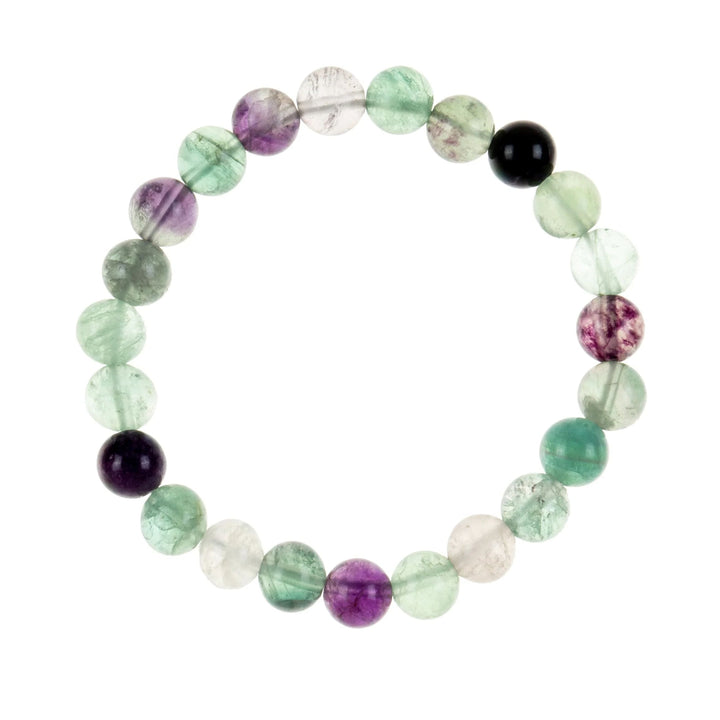
Glassy to translucent beads in soft green, violet, blue and clear, often with banding that gives the popular rainbow look. It is a genuine mineral, though its softness and perfect cleavage mean beads can chip.
What gives it its color
Fluorite is tinted by trace elements that take the place of calcium in the crystal (yttrium is linked to blue) and by exposure to natural radiation that leaves color centers in the crystal.
Where it comes from
China is the largest producer and Mexico second; classic sources include Asturias in Spain, Derbyshire in England (Blue John), Mongolia and South Africa.
In history
Roman writers prized "murrhine" cups, which scholars identify with banded fluorite, and Pompey was the first to dedicate such cups to Jupiter after his triumph of 61 BC. The Crawford Cup in the British Museum, made about AD 50-100, is carved from fluorite. In Derbyshire, England, banded fluorite called Blue John was being made into vases and fireplace panels by the 1760s, including panels designed by Robert Adam for Kedleston Hall.
What's said about it
People like it for starting something new, such as a course of study or a meditation practice. Blue is traditionally linked with calm and clear speech, lavender with refocusing on the present. Many keep a piece in view on the desk.
The name comes from the Latin word for flow, because the mineral was once used to help metal melt and run in smelting.
It is soft and scratches easily, so it suits a necklace, earrings or a desk piece better than a pocket. Keep it dry.
How people wear or keep it: On a desk in view, on a necklace or earrings, in a calm room or classroom, or in a meditation corner.
In crystal practice
In the crystal tradition, fluorite is paired with the heart and third eye and crown chakras, so practitioners rest it there during meditation or lie down with it in place for a few quiet minutes. Day to day, the same tradition suggests keeping it close: on a desk in view, on a necklace or earrings, in a calm room or classroom. People reach for it when they want focus and clarity, calm, rest and meditation, and many set an intention when they put it on. Most practitioners cleanse a new stone first (running water only if the stone can take it, otherwise smoke or moonlight) and set it aside now and then to rest.
These are beliefs people have held and still hold about the stone, reported as such. Nothing here is a promise or a medical claim. We sell stones as jewelry, not for these effects.
Associations
The chakra and star sign this stone is usually matched with. These are popular traditions, not facts about the stone.
ChakraHeart, Third Eye, Crown
ZodiacCapricorn, Libra, Pisces
ElementAir
Also calledfluorspar, Blue John (banded Derbyshire variety), rainbow fluorite
Care
- Fluorite is soft (Mohs 4) with perfect cleavage in four directions, so it scratches and chips easily.
- Suits pendants and earrings better than rings or active-wear bracelets.
- Clean with a soft damp cloth; avoid ultrasonic cleaners and steam.
- Keep away from heat and knocks.
- Store apart from harder stones that can scratch it.
How to tell what you have
- Fluorite is soft (Mohs 4), much softer than quartz or glass, and chips along flat cleavage faces.
- Look for color banding and zoning in purple, green, blue and clear; the rainbow look is natural.
- Strong sun can fade it.
What sets the price
Strands differ by how clear and evenly colored the beads are, how strongly the colors zone or band, and the bead size, shape and polish; the common purple and green cost less to match than the less common colors.
Questions people ask at our table
What is fluorite?
Fluorite is calcium fluoride, a natural mineral that forms cubic crystals in many colors. Its name comes from the Latin fluere, to flow, from its use as a smelting flux.
Is rainbow fluorite natural or dyed?
The banding in green, purple and blue fluorite is natural color zoning caused by trace chemistry and natural irradiation. Ask the seller if you want to know whether a strand has also been coated or waxed.
Is fluorite fragile?
Comparatively, yes. At Mohs 4 it scratches easily, and it cleaves cleanly in four directions, so one source calls it too fragile for most rings and bracelets.
What is Blue John?
Blue John is a rare banded purple-blue fluorite found in the UK only at Castleton in Derbyshire. Only about half a ton a year is produced today, so most fluorite beads come from elsewhere.
Where is fluorite mined?
Fluorite occurs widely; China leads production, followed by Mexico, with large deposits also in South Africa. Fine ornamental material comes from several localities.
Our fluorite pieces

Stay in the loop
Sign up to hear about new product drops, upcoming events, and the latest from Peritik. No spam, just the good stuff.