
Angelite is a trade name for blue-gray anhydrite from Peru, a soft mineral and not a separate stone. No older tradition for it has turned up, so what follows is modern crystal lore, and some books call it a form of celestite.
See it as
Sulfate · Anhydrite
Angelite
Angelita
- Palette
- Blue Gray White
- Mined in
- Peru
- Hardness
- Mohs 3.5 ?
- See-through
- translucent
- Known since
- 1804
- Named for
- trade name built on the word 'angel' (a heavenly being); coinage not documented
- Also sold as
- blue anhydrite
- Intention
- Calm
- Looking for
- Peace Calm Compassion and empathy Communication
- Water
- Keep it dry; wipe with a soft cloth
- Dye or finish
- Sold as a natural stone; the bead sellers we read list no dye or heat. It is soft and dissolves in water over time, so keep it dry.
In our pieces · 1See the piece ↓
MOHS 3.5
The mineral behind angelite rates just 3.5 on the Mohs scale, far softer than quartz at 7.
STAUFEN
In 2007 a geothermal drilling project in Staufen, Germany, let water reach a layer of anhydrite, and the ground above began to swell.
What it is
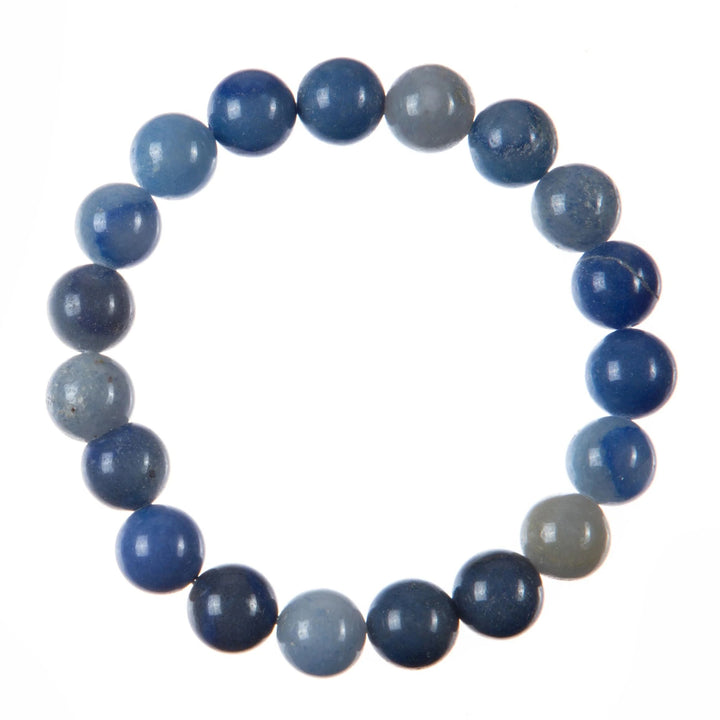
Soft, fine-grained, semi-transparent light blue-gray beads, sometimes with a white coating. Angelite is a trade name for a variety of anhydrite (calcium sulfate) from Peru, not a separate mineral.
Where it comes from
Angelite is the pale blue anhydrite of Peru; specimens are traced to the Casapalca area in the Lima region.
In history
The mineral behind angelite, anhydrite, was first found in 1794 in a salt mine near Hall in Tirol, Austria, a mine that had been worked for salt since 1272. It was named in 1804 because its crystals hold no water. Angelite is the trade name for the pale blue-gray anhydrite from Peru.
What's said about it
In crystal lore, angelite is a stone of peace and awareness. It's said to help people feel supported and open-hearted, and it's associated with the throat, third-eye and crown chakras.
People keep it for compassion, gratitude and speaking with integrity. Some wear it at the throat as a necklace or earrings.
It dislikes water, so keep it dry and take it off before washing.
How people wear or keep it: On a necklace or earrings, in a pocket, kept dry, in the nondominant hand, or in a meditation corner.
In crystal practice
In the crystal tradition, angelite is paired with the throat and third eye and crown chakras, so practitioners rest it there during meditation or lie down with it in place for a few quiet minutes. Day to day, the same tradition suggests keeping it close: on a necklace or earrings, in a pocket, kept dry, in the nondominant hand. People reach for it when they want peace, calm, compassion and empathy, and many set an intention when they put it on. Most practitioners cleanse a new stone first (running water only if the stone can take it, otherwise smoke or moonlight) and set it aside now and then to rest.
These are beliefs people have held and still hold about the stone, reported as such. Nothing here is a promise or a medical claim. We sell stones as jewelry, not for these effects.
Associations
The chakra and star sign this stone is usually matched with. These are popular traditions, not facts about the stone.
ChakraThroat, Third Eye, Crown
ZodiacAquarius
ElementAir
Also calledblue anhydrite
Care
- Soft (Mohs 3.5) and brittle, so it scratches and breaks easily.
- Keep dry: anhydrite absorbs water and transforms into gypsum, which can leave a white coating.
- Wipe only with a dry soft cloth; no soaking, steam or ultrasonic cleaners.
- Remove before washing hands, showering or swimming.
- Store separately in a soft pouch.
How to tell what you have
- Angelite is the pale blue-gray variety of anhydrite, a soft sulfate mineral at about 3.5 on the Mohs scale, so a steel point scratches it.
- A deep, even sky blue is a reason to ask what the bead really is, since other soft white stones such as howlite are commonly dyed blue.
- Anhydrite slowly turns into gypsum when it takes up water, so a bead that feels chalky or swollen has been wet too long.
What sets the price
Angelite strands differ mainly in how deep and even the soft blue is and how much white or gray shows through, plus bead size and whether the finish is polished or matte. It is a soft stone, so it is made mostly into beads and carvings.
Questions people ask at our table
What is angelite?
Angelite is a trade name for a light blue-gray, semi-transparent, fine-grained anhydrite from Peru. Anhydrite is calcium sulfate, a relative of gypsum.
Is angelite water-sensitive?
Yes. When exposed to water anhydrite readily transforms into gypsum, and a supplier notes this has left a white coating on some angelite. Keep it dry and do not wash it.
How hard is it?
About 3.5 on the Mohs scale and brittle, so handle it as a gentle-wear bead.
Is the blue natural or dyed?
Natural anhydrite can be colorless to pale blue or violet from impurities. The sources consulted do not document dyeing, but a very bright, even blue is worth a question to the seller.
Where does it come from?
The trade name refers to anhydrite from Peru.
Our angelite pieces

Stay in the loop
Sign up to hear about new product drops, upcoming events, and the latest from Peritik. No spam, just the good stuff.