
In crystal lore, amethyst is the stone people keep for calm, a clear head and a good night's rest. It's said to quiet busy thoughts, make the wearer gentler, and open the way to intuition and inner guidance.
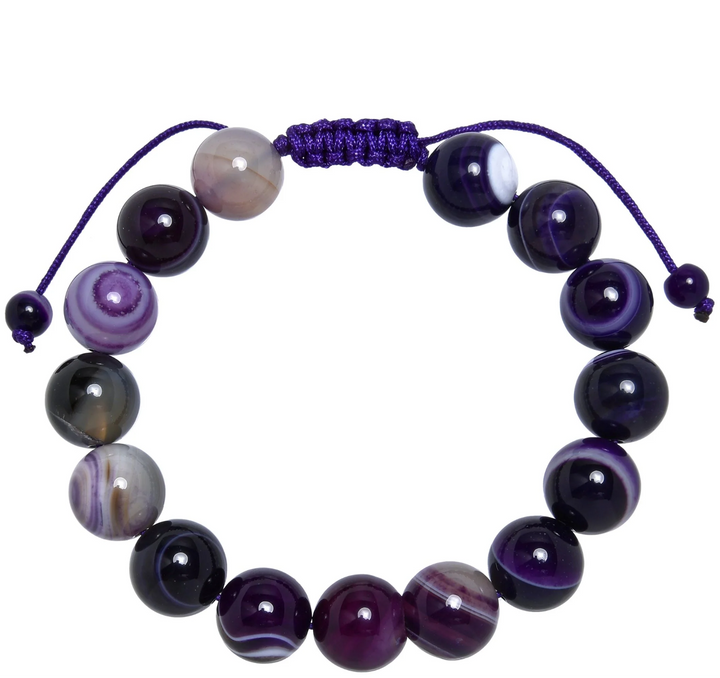
See it as
quartz (silicate, trigonal) · quartz
Amethyst
Amatista
- Palette
- Purple
- Mined in
- Brazil, Uruguay, Zambia, Bolivia, Canada, Madagascar, India, Mexico, Namibia, Russia, United States, South Korea, Nigeria, Morocco, Australia
- Hardness
- Mohs 7.0 ?
- See-through
- transparent
- Known since
- Prehistoric
- Named for
- Greek amethystos, meaning not drunken
- Also sold as
- purple quartz, Siberian amethyst (colour grade), Rose de France (pale grade), chevron amethyst (banded with white quartz)
- Intention
- Calm Protection
- Looking for
- Calm Protection Rest and meditation Focus and clarity
- Water
- Fine with water and mild soap
- Dye or finish
- Amethyst beads are normally sold with natural color. Heat can turn amethyst yellow or orange, which is how much citrine is made.
In our pieces · 2See the 2 pieces ↓
3.7 METERS
An amethyst geode from Artigas, Uruguay, stands 3.7 meters tall and weighs about 4 tons; it is on display at the American Museum of Natural History.
1,000 TONS
Zambia is one of the world's largest amethyst producers, with an annual output of around 1,000 tons.
TYRIAN PURPLE
Roman naturalists ranked India's amethysts the best, favoring stones with the shade of Tyrian purple and a gentle glow.
What it is
Amethyst runs from pale lilac through violet to a deep reddish purple, often with angular bands of lighter and darker color (zoning) that are strongest near the crystal tips. As a bead it is usually transparent to translucent with a glassy polish; lighter beads look airy and lavender, darker ones look almost grape-black in low light, and many strands mix the two.
What gives it its color
Amethyst is quartz colored violet by a trace of iron that natural radiation has altered; heating it above roughly 400 C turns it yellow, orange or brown, which is how most citrine is made.
Where it comes from
Most amethyst comes from Brazil (Pará, Rio Grande do Sul), Uruguay (Artigas), Bolivia and Zambia, with Brazil giving large stones of moderate color and Zambia and Uruguay smaller, richer ones. Old sources such as Siberia, Lower Austria and southern India are no longer significant.
In history
Amethyst beads were strung in Egypt by the Middle Kingdom, and a necklace from about 2000 BC is among the oldest amethyst pieces known. Romans listed India, Petra, Armenia, Egypt and Galatia as its sources. It ranked with the costliest gems until large Brazilian deposits were found, and it still sits in the rings of Anglican bishops and in English regalia.
What's said about it
The name comes from a Greek word meaning 'not drunk', and ancient writers recorded that people wore it for exactly that reason. Soldiers in medieval Europe are said to have carried it for safety.
Bishops have long worn it in a ring, and until the 1700s it ranked among the most prized gems.
People wear it as a necklace, earrings or bracelet, carry it in a pocket, hold it in the non-dominant hand, or keep a piece on the bedside table or under the pillow for dream time.
How people wear or keep it: On the wrist, as a necklace or earrings, in a pocket, or under the pillow or on the bedside table.
In crystal practice
In the crystal tradition, amethyst is paired with the third eye and crown chakras, so practitioners rest it there during meditation or lie down with it in place for a few quiet minutes. Day to day, the same tradition suggests keeping it close: on the wrist, as a necklace or earrings, in a pocket. People reach for it when they want calm, protection, rest and meditation, and many set an intention when they put it on. Most practitioners cleanse a new stone first (running water only if the stone can take it, otherwise smoke or moonlight) and set it aside now and then to rest.
These are beliefs people have held and still hold about the stone, reported as such. Nothing here is a promise or a medical claim. We sell stones as jewelry, not for these effects.
Associations
The chakra and star sign this stone is usually matched with. These are popular traditions, not facts about the stone.
ChakraThird Eye, Crown
ZodiacAquarius, Pisces, Virgo
BirthstoneFebruary
Anniversary6th
ElementAir
Also calledpurple quartz, Siberian amethyst (colour grade), Rose de France (pale grade)
Care
- Wash in warm water with a little mild soap and a soft brush or cloth, then pat dry; skip steam cleaners.
- Keep it out of strong, prolonged sunlight: GIA notes that long exposure to intense light can fade the purple, so store it in a pouch or drawer rather than on a sunny windowsill.
- Avoid heat and sudden temperature swings (hot car, hairdryer, hot dishwater), which can lighten the color or crack the stone.
- At Mohs 7 it resists everyday scratches, but store it apart from harder stones such as sapphire or topaz, and away from household chemicals.
- Put jewelry on after lotions and perfume, and take it off for sports, gardening or cleaning.
How to tell what you have
- Real amethyst is quartz with uneven color: look for lighter and darker bands and a few fine inclusions or small fractures inside the bead.
- A bead that is perfectly clear and perfectly even may be glass or lab-grown, and heated amethyst turns yellow, not purple, so a yellow stone sold as amethyst is a mix-up.
- Strong sun and heat can fade the purple, so judge the color away from a hot window.
What sets the price
Price follows how deep and even the purple is, since pale, zoned or brownish-tinted beads are worth less, and how clear the stone is; bigger beads cost more mostly for the extra material because amethyst is plentiful, and natural color is priced above lab-grown or dyed.
Questions people ask at our table
Why is amethyst purple?
Amethyst is ordinary quartz (SiO2) that contains traces of iron. Natural radiation in the ground alters those iron atoms into color centers that absorb light and leave the purple we see. Because the iron is unevenly spread, many stones show bands of lighter and darker purple, called zoning.
Does amethyst fade in the sun?
It can. GIA and Wikipedia both note that prolonged exposure to intense light can lighten amethyst's color, and heat does the same. A few hours outdoors is fine; years on a sunny windowsill or dashboard is not. Store it in a box or pouch when you are not wearing it.
Is amethyst a birthstone?
Yes. Amethyst is the modern birthstone for February and is also the stone most often paired with Pisces, and sometimes Aquarius, in contemporary zodiac lists. Because it comes in every size at a gentle price, it is a popular choice for birthstone gifts.
What is the connection between amethyst and citrine?
They are the same mineral in different colors. Much of the citrine on the market started life as amethyst and was heated to around 400-500 C, which turns the purple to yellow, orange or brown. Ametrine is a single crystal that is part purple and part yellow, and heating can also give a green quartz sold as prasiolite (sometimes mislabelled 'green amethyst').
How can I tell real amethyst from purple glass?
Natural amethyst usually shows uneven color or angular zoning, feels cool and heavier than glass, and at Mohs 7 will scratch glass rather than be scratched by it. Glass is typically perfectly uniform in color and may show tiny round bubbles or swirl marks. Lab-grown amethyst exists too and looks identical to the eye; only a gem lab can separate it with certainty.


Stay in the loop
Sign up to hear about new product drops, upcoming events, and the latest from Peritik. No spam, just the good stuff.