
In crystal lore, green aventurine is the stone people keep for luck and prosperity. It is thought of as a friendly, hopeful stone, and is traditionally associated with the heart chakra and with new friendships.
See it as
Quartz · Aventurine (quartzite)
Green Aventurine
Aventurina verde
- Palette
- Green
- Mined in
- India, China, United States, Brazil
- Hardness
- Mohs 6.5–7.0 ?
- See-through
- translucent
- Known since
- Prehistoric
- Named for
- Italian 'a ventura', 'by chance', from the lucky discovery of the glass
- Also sold as
- aventurine quartz, fuchsite quartzite, gambler's stone
- Intention
- Abundance New Beginnings
- Looking for
- Luck Prosperity Love Relationships
- Water
- Fine with water and mild soap
- Dye or finish
- Green aventurine is generally natural and untreated; the green comes from mica flakes inside the stone. Very uniform or neon-bright beads are worth questioning.
In our pieces · 1See the piece ↓
1865
In 1865 Pelouze published a chromium recipe for green aventurine glass, the look-alike that gave the quartz its name.
12TH-13TH CENTURY
A goldstone amulet from Persia, made in the 12th or 13th century, is held by the University of Pennsylvania.
What it is
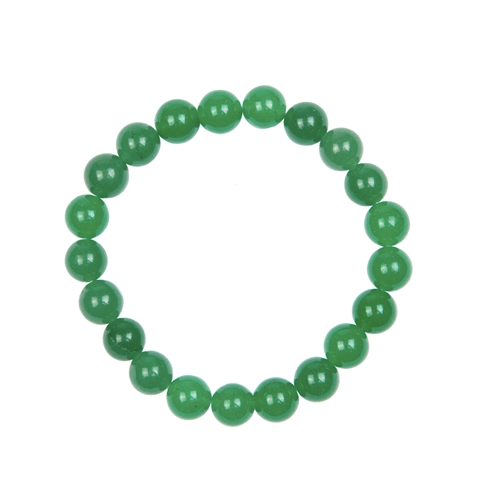
Translucent to nearly opaque green quartz whose color comes from fuchsite, a green chromium mica, with a faint glittering shimmer from the flakes. Beads range from pale minty to deep forest green.
What gives it its color
The green comes from tiny flakes of chromium-rich mica (fuchsite) inside the quartz; just a few percent of it is enough to color the stone.
Where it comes from
Most green aventurine comes from India (near Mysore and Chennai), with Brazil the second-largest producer.
In history
Green aventurine takes its name from a glass: Venetian glassmakers on Murano developed the copper-flecked 'aventurine' glass in the early 15th century, and it first appears in written records in 1626. The name later passed to this sparkling green quartz that looks like it.
What's said about it
It is nicknamed the gambler's stone. That is a modern folklore name for its luck reputation, not a documented old custom.
People wear it as a bracelet or necklace, carry it in a pocket, or keep a piece in the prosperity corner of a home or in a wallet or cash box.
How people wear or keep it: On the wrist, in a pocket, in a wallet or cash box, or in the prosperity corner of a room.
In crystal practice
In the crystal tradition, green aventurine is paired with the heart chakra, so practitioners rest it there during meditation or lie down with it in place for a few quiet minutes. Day to day, the same tradition suggests keeping it close: on the wrist, in a pocket, in a wallet or cash box. People reach for it when they want luck, prosperity, love, and many set an intention when they put it on. Most practitioners cleanse a new stone first (running water only if the stone can take it, otherwise smoke or moonlight) and set it aside now and then to rest.
These are beliefs people have held and still hold about the stone, reported as such. Nothing here is a promise or a medical claim. We sell stones as jewelry, not for these effects.
Associations
The chakra and star sign this stone is usually matched with. These are popular traditions, not facts about the stone.
ChakraHeart
ZodiacAries, Leo
ElementWater
Also calledaventurine quartz, fuchsite quartzite, gambler's stone
Care
- Hard enough for daily wear but can chip on sharp knocks; store beads separately.
- Clean with a soft damp cloth and mild soapy water, then dry.
- The color is from natural mica, not a coating, but avoid prolonged strong sun and harsh chemicals.
- Skip ultrasonic and steam cleaners.
How to tell what you have
- Real green aventurine has tiny mica flakes that flash in the light and a softly uneven green. Green goldstone is man-made glass and looks uniformly sparkly, sometimes with bubbles.
- It is hard quartz (about 6.5 to 7) and feels cool in the hand.
What sets the price
Price follows how strongly the strand sparkles and how even and natural the green is; strands with little glitter, neon-bright dyed color or glass goldstone are the cheap end. Bead size, roundness and a clean, even drill hole also add to the price.
Questions people ask at our table
What is green aventurine made of?
It is quartz (a quartzite rock) colored by tiny green fuchsite mica flakes, a chromium-bearing mica. The flakes also give the faint sparkle.
How is green aventurine different from goldstone?
Green aventurine is natural quartz colored by green fuchsite mica, whose aligned flakes flash together at the right angle. Green goldstone is man-made glass colored by chromium, with metallic crystals that sparkle from various depths.
Is green aventurine dyed?
Its color comes from fuchsite mica inside the stone, not a surface dye. A green bead that sparkles unevenly from different depths may be goldstone glass instead.
Where is it mined?
Most green aventurine comes from India, with some from China and Vermont according to one trade-and-wellness source.
Why is it called the gambler's stone?
That is a modern folklore nickname tied to its luck associations. It is not a documented historic custom.
Our green aventurine pieces

Stay in the loop
Sign up to hear about new product drops, upcoming events, and the latest from Peritik. No spam, just the good stuff.