
Amazonite is the blue-green form of microcline feldspar. In crystal lore it is the stone people keep for a calm, open heart and for speaking their own truth kindly.
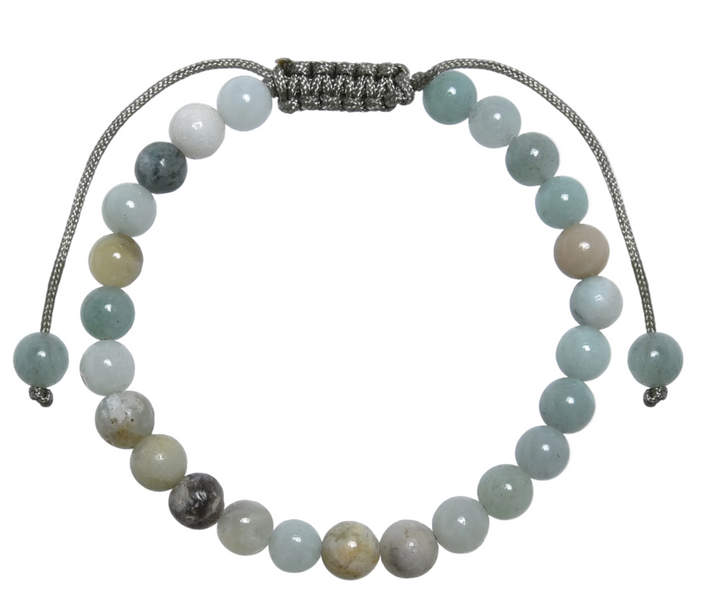
See it as
Feldspar · Microcline
Amazonite
Amazonita
- Palette
- Green Blue White
- Mined in
- Russia, Brazil, United States, Australia, Ethiopia, Egypt, China, Mongolia, Sweden, Libya, South Africa, Madagascar, Namibia, Canada, Norway, Poland, Afghanistan
- Hardness
- Mohs 6.0–6.5 ?
- See-through
- translucent
- Known since
- 1830
- Named for
- the Amazon River, once thought a source of green stones
- Also sold as
- Amazon Stone, Green Microcline
- Intention
- Calm Abundance
- Looking for
- Calm Peace Communication Compassion and empathy
- Water
- Keep it dry; wipe with a soft cloth
- Dye or finish
- Most amazonite beads are sold natural, but some strands are dyed and some blue amazonite has been filled with resin, so look for the strand label.
In our pieces · 3See the 3 pieces ↓
50 X 36 X 14 M
The largest feldspar crystal on record, of the mineral family amazonite belongs to, was found at a Colorado beryl mine and measures about 50 by 36 by 14 meters.
10.23 KG
Tutankhamun's gold mask weighs about 10.23 kilograms (22.6 pounds), and amazonite is one of its inlays beside lapis, quartz, obsidian and carnelian.
6 TO 6.5
Amazonite rates 6 to 6.5 on the Mohs scale and has perfect cleavage, so a hard knock can split a bead along a flat plane.
What it is
Soft blue-green to teal, often streaked or patchy with white lines of intergrown feldspar. Translucent to opaque with a glassy shine.
What gives it its color
The blue-green comes from small amounts of lead and water in the feldspar, and possibly iron; the exact cause is still not settled.
Where it comes from
Nearly all amazonite came from the Ilmen Mountains of Russia until recent times, and it was mined in ancient Egypt; today it also comes from Colorado, Brazil, Australia, Ethiopia, China and other small deposits.
In history
People have made amazonite jewelry for more than 3,000 years, and Bronze Age Egyptians mined it at Gebel Migif in the Eastern Desert. It is one of the stones inlaid in the gold funeral mask of Tutankhamun, made around 1323 BC.
What's said about it
It's traditionally associated with the heart and throat. Amazonite jewelry goes back to ancient Egypt, where it was mined in the Eastern Desert.
People wear it on the wrist or rest a piece over the chest while breathing slowly. It's soft and scratches easily, so carry it alone or wrapped in cloth, and keep it away from water and salt.
How people wear or keep it: On the wrist, over the chest while resting, in a pocket, wrapped in cloth, or held in the receiving hand.
In crystal practice
In the crystal tradition, amazonite is paired with the heart and throat chakras, so practitioners rest it there during meditation or lie down with it in place for a few quiet minutes. Day to day, the same tradition suggests keeping it close: on the wrist, over the chest while resting, in a pocket, wrapped in cloth. People reach for it when they want calm, peace, communication, and many set an intention when they put it on. Most practitioners cleanse a new stone first (running water only if the stone can take it, otherwise smoke or moonlight) and set it aside now and then to rest.
These are beliefs people have held and still hold about the stone, reported as such. Nothing here is a promise or a medical claim. We sell stones as jewelry, not for these effects.
Associations
The chakra and star sign this stone is usually matched with. These are popular traditions, not facts about the stone.
ChakraHeart, Throat
ZodiacAquarius, Taurus, Virgo
ElementWater
Also calledAmazon Stone, Green Microcline
Care
- Fairly soft for a gem (about 6) and brittle with perfect cleavage; avoid knocks and storing it against harder stones.
- Clean with a soft damp cloth and mild soap; skip ultrasonic cleaners.
- Keep it out of long direct sun and heat, which can affect feldspar color.
How to tell what you have
- Real amazonite is a soft blue-green feldspar with white streaks or veins, and it feels cool and a little pearly; color that is very even and very bright is a reason to look closer.
- It scratches more easily than quartz, so worn edges are normal; a bead that shows color rubbing off or a spot that dulls with nail polish remover has been dyed or filled.
- Do not call it jade: amazonite is feldspar, and a different stone from jadeite or nephrite.
What sets the price
Strands cost more when the blue-green is deeper and more even with less white streaking, and less when the color is pale or broken up by white; beads whose color has been dyed or filled are a different product from natural color.
Rules and sourcing
Most amazonite beads are sold natural, but some strands are dyed and some blue amazonite has been resin-filled. The FTC jewelry guides call for the strand label to say so.
Questions people ask at our table
What is amazonite?
It is the green to blue-green variety of microcline, a potassium feldspar. Its color is attributed to small amounts of lead and water in the crystal.
Is it natural or dyed?
Natural amazonite has uneven color and white streaks. We have not verified every strand, and very uniform bright green beads are worth asking the supplier about.
Was it really used in ancient Egypt?
Yes, amazonite jewelry is documented from Middle and New Kingdom Egypt, with the stone mined in the Eastern Desert.
Where does it come from?
Historically mostly from the Ilmensky Mountains of Russia. Today it is also found in Brazil, Australia, the United States and Ethiopia, among others.
How do I care for it?
It is brittle and about 6 on the Mohs scale. Wipe with a damp cloth, avoid knocks and chemicals.


Stay in the loop
Sign up to hear about new product drops, upcoming events, and the latest from Peritik. No spam, just the good stuff.