
In crystal lore, lepidolite is a stone people reach for when they want to feel calm and reassured. It's said to be a steady companion when life feels unsettled.
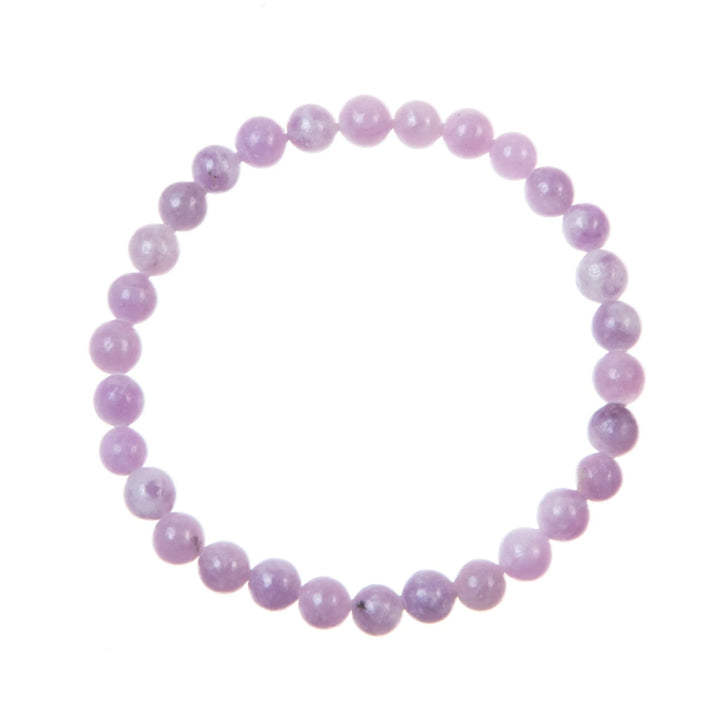
See it as
Mica (phyllosilicate)
Lepidolite
Lepidolita
- Palette
- Purple Pink Gray White
- Mined in
- Brazil, Russia, United States, Canada, Madagascar, Zimbabwe, Japan, Sweden, Australia, Afghanistan
- Hardness
- Mohs 2.5–3.5 ?
- See-through
- translucent
- Known since
- 1792
- Named for
- Greek lepís plus the suffix -lite
- Also sold as
- lithia mica
- Intention
- Calm
- Looking for
- Calm Peace Rest and meditation Patience
- Water
- Keep it dry; wipe with a soft cloth
- Dye or finish
- Most lepidolite beads are stabilized: a clear resin holds the soft mica plates together so the beads can be drilled. Unstabilized beads exist but are uncommon.
In our pieces · 1See the piece ↓
39.3 °C
Rubidium, the element first found in lepidolite, melts at 39.3 degrees Celsius, close to body temperature.
0.3 TO 3.5%
Lepidolite contains between 0.3 and 3.5 percent rubidium and is the commercial source of the element.
2.5 TO 3
Lepidolite rates only 2.5 to 3 on the Mohs scale, in the range between gypsum and calcite.
What it is
Lilac to pink-purple beads with a scaly, pearly sheen from tiny mica flakes, sometimes flecked with gray or white. It is a genuine lithium-bearing mica, and bead strands are often stabilized with resin to hold the flakes together.
What gives it its color
The pink, lilac and purple of lepidolite come from a trace of manganese in the mica, not from the lithium it is known for.
Where it comes from
Lepidolite comes from granite pegmatites in Brazil (Minas Gerais), the Ural Mountains of Russia, Madagascar, Manitoba in Canada, and California, Maine and the Black Hills in the United States.
In history
In 1861 the German chemists Robert Bunsen and Gustav Kirchhoff processed 150 kg of lepidolite to get a few grams of rubidium salts, and found a new element, rubidium, by its red spectral lines. Lepidolite is still the most abundant lithium-bearing mineral and a major source of rubidium.
What's said about it
It is thought of as a meditation stone, associated with the third-eye and crown chakras, insight and a sense of connection to something larger.
Today's crystal shops often pair it with Libra and Pisces and with the element water.
A matched pair of bracelets, one on each wrist, is a favorite, and so are earrings. Others carry a small tumbled stone in a pocket. It is soft, so wear it gently.
How people wear or keep it: A matched pair of bracelets, one per wrist, as earrings or a necklace, a small tumbled stone in a pocket, or in a meditation corner.
In crystal practice
In the crystal tradition, lepidolite is paired with the heart and third eye and crown chakras, so practitioners rest it there during meditation or lie down with it in place for a few quiet minutes. Day to day, the same tradition suggests keeping it close: a matched pair of bracelets, one per wrist, as earrings or a necklace, a small tumbled stone in a pocket. People reach for it when they want calm, peace, rest and meditation, and many set an intention when they put it on. Most practitioners cleanse a new stone first (running water only if the stone can take it, otherwise smoke or moonlight) and set it aside now and then to rest.
These are beliefs people have held and still hold about the stone, reported as such. Nothing here is a promise or a medical claim. We sell stones as jewelry, not for these effects.
Associations
The chakra and star sign this stone is usually matched with. These are popular traditions, not facts about the stone.
ChakraHeart, Third Eye, Crown
ZodiacLibra, Pisces
ElementWater
Also calledlithia mica
Care
- Very soft (Mohs 2.5 to 3.5) with a layered structure that can flake or split.
- Use a soft cloth with lukewarm water and a drop of mild soap, dried immediately; skip ultrasonic and steam.
- Avoid acetone, alcohol-based jewelry dips and abrasive polishing cloths, which can dull it or harm the stabiliser.
- Heat plus moisture can damage stabilising resin.
- Store away from harder stones and metals.
How to tell what you have
- Lepidolite is a lithium mica: lilac to pink-purple with a scaly, pearly shine from tiny flakes.
- It is soft (about Mohs 2.5-3), so avoid water soaks and knocks.
- A strand that is smooth, glassy and hard with no flaky shine may be a different stone, so ask the seller.
What sets the price
The price follows how deep and even the lilac-to-pink color is, whether the beads were stabilized with resin so the soft flakes hold together (most are), and the bead size, roundness and polish.
Rules and sourcing
Most lepidolite beads are stabilized, with a clear resin holding the soft mica plates together. The FTC jewelry guides call for a seller to disclose it, and resin-held beads need dry, gentle care.
Questions people ask at our table
What is lepidolite?
Lepidolite is a lilac to pink mica containing lithium. It is the most abundant lithium-bearing mineral and a secondary source of that metal.
Is lepidolite stabilized?
Often. Stabilisation is typically a resin or polymer infusion that binds the layers so beads can be drilled and strung without chipping. Natural unstabilised lepidolite exists but is more fragile.
Is lepidolite durable?
No. It is about 2.5 to 3.5 on the Mohs scale with perfect cleavage in one direction, so it suits gentle, low-wear pieces.
Where does lepidolite come from?
Notable occurrences include Brazil, the Ural Mountains of Russia, California and the Black Hills in the United States, Manitoba in Canada, and Madagascar.
Is it natural?
The mineral is natural; stabilisation is a common finish, so ask the seller whether a strand is stabilized.
Our lepidolite pieces

Stay in the loop
Sign up to hear about new product drops, upcoming events, and the latest from Peritik. No spam, just the good stuff.