
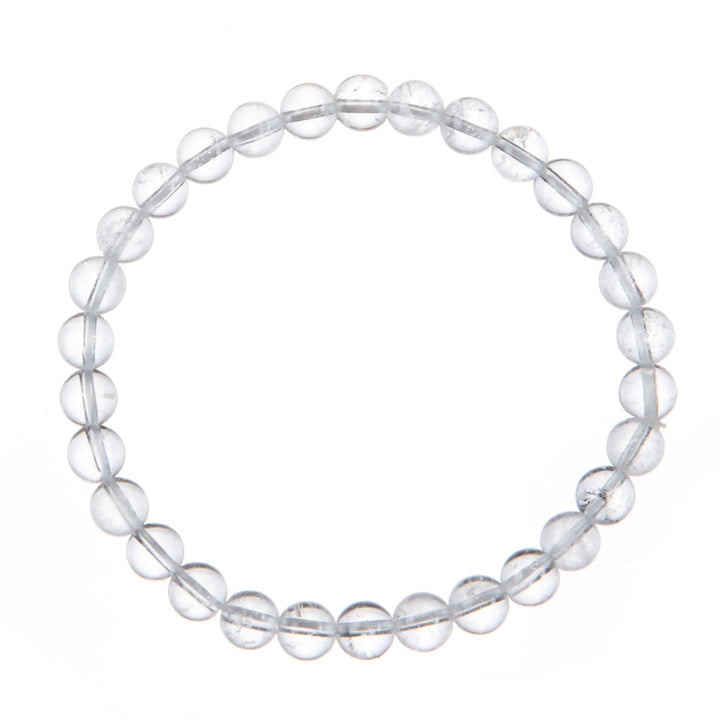
Clear quartz is the colorless form of quartz, also called rock crystal. In crystal lore it is the stone people reach for when they want a clear head and a steady focus, and it's thought of as the all-purpose stone.
See it as
Quartz (silicate) · Quartz
Clear Quartz
Cuarzo cristal
- Palette
- Clear White
- Mined in
- Brazil, China, India, Madagascar, Mozambique
- Hardness
- Mohs 7.0 ?
- See-through
- transparent
- Known since
- Prehistoric
- Named for
- German Quarz, perhaps from Polish kwardy, hard; clear for its look
- Also sold as
- Rock Crystal, Quartz Crystal
- Intention
- New Beginnings Strength
- Looking for
- Focus and clarity Fresh starts Goals and motivation
- Water
- Fine with water and mild soap
- Dye or finish
- Clear quartz beads are usually sold natural, simply cut and polished.
In our pieces · 1See the piece ↓
88,000 POUNDS
The largest documented single quartz crystal, found near Itapora in Goias, Brazil, was about 20 feet long and weighed over 88,000 pounds.
150 POUNDS
A mass of rock crystal dedicated on the Capitol in Rome weighed about 150 pounds and was the biggest piece a Roman scholar had seen.
573 °C
At 573 degrees Celsius quartz abruptly switches crystal structure, which can microfracture rock and ceramics.
What it is
Colorless to slightly milky and glassy, often with small internal veils or ice-like fractures. As a bead it looks bright and watery.
What gives it its color
Clear quartz is pure silica with essentially no coloring impurities, which is why it is colorless; a milky look comes from tiny trapped bubbles of gas or liquid.
Where it comes from
Clear quartz (rock crystal) is mined in Minas Gerais in Brazil, Madagascar, the Swiss Alps, Hot Springs in Arkansas and Herkimer in New York, among other places.
In history
Ancient Greeks called it krustallos, 'ice', and Romans prized crystal cups so highly that one woman paid 150,000 sesterces for a single dipper and Emperor Nero smashed two crystal cups in a rage on hearing that all was lost. Milan, Prague and Florence were the Renaissance centers for cutting rock crystal into jugs and vases. A carved rock crystal ewer with a gold lid, made about AD 1000, is in the Louvre.
What's said about it
Ancient writers believed rock crystal was ice frozen so hard it could never melt, which is where the Greek name for crystal comes from. In older church symbolism it stood for a pure faith.
People wear it on the wrist, carry it in a pocket, or keep it in a room where they want a clear, fresh feeling. Some use a bracelet like prayer beads, naming one thing they are grateful for with each bead.
How people wear or keep it: On the wrist, in a pocket, in a room or on a desk, or as prayer beads.
In crystal practice
In the crystal tradition, clear quartz is paired with the crown chakra, so practitioners rest it there during meditation or lie down with it in place for a few quiet minutes. Day to day, the same tradition suggests keeping it close: on the wrist, in a pocket, in a room or on a desk. People reach for it when they want focus and clarity, fresh starts, goals and motivation, and many set an intention when they put it on. Most practitioners cleanse a new stone first (running water only if the stone can take it, otherwise smoke or moonlight) and set it aside now and then to rest.
These are beliefs people have held and still hold about the stone, reported as such. Nothing here is a promise or a medical claim. We sell stones as jewelry, not for these effects.
Associations
The chakra and star sign this stone is usually matched with. These are popular traditions, not facts about the stone.
ChakraCrown
Also calledRock Crystal, Quartz Crystal
Care
- Hard enough (7) to resist everyday dust, but it can still chip on sharp knocks, so store beads apart from harder gems.
- Clean with lukewarm water, a drop of mild soap and a soft cloth, then dry.
- Avoid sudden temperature swings, which can crack stones with inner fractures.
How to tell what you have
- Real quartz usually shows a few tiny inclusions, fractures or cloudy patches; a bead that is flawlessly clear is more likely glass.
- Quartz feels cool in the hand and is a little heavier than glass.
- Quartz is hard enough to scratch glass, so a glass bead cannot scratch it. Test only a spare bead.
What sets the price
Clear quartz is plentiful, so price mostly follows how water-clear and flawless the beads are, plus bead size and how well they are cut; glass or lab-grown look-alikes are a different, cheaper material.
Questions people ask at our table
What is clear quartz?
It is the colorless form of quartz, a silicon dioxide mineral, also called rock crystal. It is common, and gem-quality clear pieces are found in many countries.
Is it natural, or could it be glass?
Clear beads can be natural quartz, lab-grown quartz or plain glass. Natural quartz usually shows tiny internal veils and is harder than glass; ask the supplier if you need certainty.
Does clear quartz fade?
Colorless quartz has no color to lose. Strong heat can cloud it or crack inner fractures, so keep it away from hot cars and open flames.
Why is it called crystal?
The Greek word krustallos comes from a root meaning icy cold, because ancient philosophers including Theophrastus thought quartz was a form of supercooled ice.
Our clear quartz pieces

Stay in the loop
Sign up to hear about new product drops, upcoming events, and the latest from Peritik. No spam, just the good stuff.