
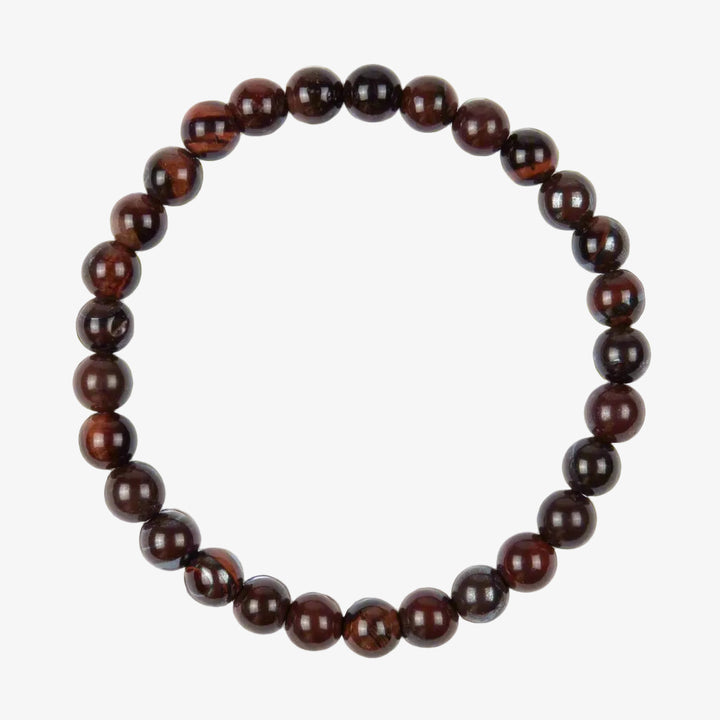
Red tiger eye is natural quartz, but nearly all of the red is made by heating golden tiger's eye. It can also be dyed. Truly natural red is rare.
See it as
Quartz · Quartz (golden tiger's eye, colour changed by heating)
Red Tiger Eye
Ojo de Tigre Rojo
- Palette
- Red Brown
- Mined in
- South Africa, Australia, India, Namibia, Brazil, Thailand, Myanmar, China
- Hardness
- Mohs 6.5–7.0 ?
- See-through
- opaque
- Known since
- Prehistoric
- Named for
- its red color; German quarz, of uncertain origin
- Also sold as
- Red Tiger's Eye, Ox Eye, Bull's Eye
- Intention
- Strength Love
- Looking for
- Goals and motivation Willpower Confidence and self-worth Courage
- Water
- Keep it dry; wipe with a soft cloth
- Dye or finish
- Red tiger eye is almost always golden or brown tiger eye heated to bring out the red. Some bead sellers say red tiger eye may also be dyed.
In our pieces · 1See the piece ↓
2003
A 2003 study found that the quartz in tiger's eye did not fully replace the original crocidolite fibers.
EMIL RIEBECK
Riebeckite, the blue fibrous mineral behind tiger's eye, was first described in 1888 from Socotra Island and named for German explorer Emil Riebeck.
6.5 TO 7
Tiger's eye rates 6.5 to 7 on the Mohs scale and comes in gold, red-brown and blue.
What it is
Opaque quartz with silky banding in deep brick red to red-brown. Almost all of it is golden tiger's eye whose color was changed by heating, and it can also be dyed red; true natural red is rare.
What gives it its color
Tiger's eye gets its golden-brown color from iron staining quartz that replaced blue fibers of crocidolite, and its silky shimmer from those parallel fibers. Red tiger's eye is made by gently heating the golden-brown stone.
Where it comes from
Tiger's eye comes mainly from the Northern Cape of South Africa, with smaller sources in Namibia, Australia and India.
What's said about it
In crystal lore, tiger's eye as a whole is traditionally associated with courage and confidence, and people keep the red one for motivation, willpower and getting started. It's traditionally linked to the root chakra.
Older folklore also counts tiger's eye among the eye-like stones noted in evil-eye lore. Carry it in a pocket for willpower, hold it in your non-dominant hand, or tuck one under a desk chair to spur you to work.
How people wear or keep it: In a pocket, held in the non-dominant hand, under a desk chair, or on the wrist.
In crystal practice
Day to day, the same tradition suggests keeping it close: in a pocket, held in the non-dominant hand, under a desk chair. People reach for it when they want goals and motivation, willpower, confidence and self-worth, and many set an intention when they put it on. Most practitioners cleanse a new stone first (running water only if the stone can take it, otherwise smoke or moonlight) and set it aside now and then to rest.
These are beliefs people have held and still hold about the stone, reported as such. Nothing here is a promise or a medical claim. We sell stones as jewelry, not for these effects.
Associations
Also calledRed Tiger's Eye, Ox Eye, Bull's Eye
Care
- Same hardness as golden tiger's eye, but keep from hard knocks.
- Wipe clean with a soft damp cloth; avoid soaking.
- Keep away from further heat, which can shift the color again.
- Avoid ultrasonic cleaners and strong solvents.
- Store separately from harder stones.
How to tell what you have
- Real tiger eye has a silky, shifting band of light across fibers. Fiber-optic glass imitates it but shows a too-perfect, sharp glow and feels glassy.
- Natural red tiger eye is rare, so a bright brick-red strand has almost certainly been heated; deep unnatural red can mean dye.
What sets the price
Price follows how rich and even the red is and how silky the shifting band of light looks. Red comes from heating (and sometimes dye) of golden tiger eye, so evenly deep red costs more than muddy brown, and larger, rounder beads cost more.
Rules and sourcing
Red tiger eye is almost always golden or brown tiger eye heated to bring out the red, and some is also dyed. The FTC jewelry guides call for a seller to disclose heat or dye. Red tiger eye is quartz that formed from crocidolite, an asbestos mineral under US law, and some original fibers can remain inside. Finished beads are sold as jewelry, but do not grind, sand, drill or cut them without dust protection.
Questions people ask at our table
Is red tiger eye natural?
The stone is natural quartz, but the red is almost always produced by heating golden tiger's eye. Naturally red material is exceptionally rare, per Crystals.com.
Is red tiger eye heated?
Yes, in nearly all cases. Heating oxidises the iron further and shifts the color from golden-brown toward brick red, and sellers should say so.
Will the color fade?
Heated color is stable in normal wear. Further strong heat could shift it again, so keep it away from torches and hot cars.
How is it different from golden tiger eye?
Both are the same quartz and fiber structure. Red has had its iron color deepened by heating; golden is the natural oxidised color.
Where does it come from?
The golden raw material is mined in places such as South Africa, Australia and India, and the color change is made afterwards.
Our red tiger eye pieces

Stay in the loop
Sign up to hear about new product drops, upcoming events, and the latest from Peritik. No spam, just the good stuff.