
In crystal lore, bronzite is the stone of courtesy and self-respect. People keep it when they have a decision to make and want to feel sure of their own judgment.
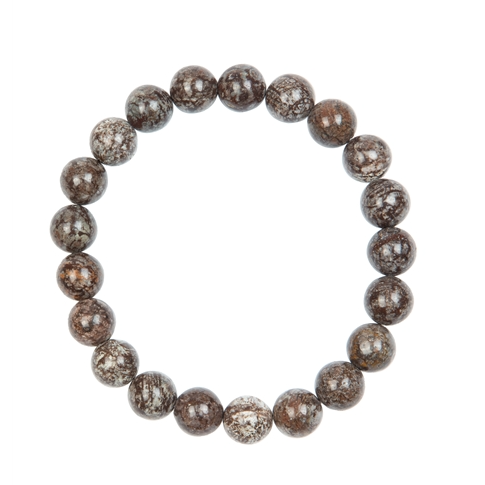
See it as
Pyroxene (orthopyroxene) · Enstatite
Bronzite
Bronzita
- Palette
- Brown Black
- Mined in
- India, Brazil, South Africa, United States
- Hardness
- Mohs 5.0–6.0 ?
- See-through
- opaque
- Known since
- before 1855
- Named for
- its bronze-like luster
- Intention
- Protection Strength
- Looking for
- Confidence and self-worth Change and decisions Grounding Protection
- Water
- Keep it dry; wipe with a soft cloth
- Dye or finish
- Bronzite beads are sold natural, with no dye or coating stated.
In our pieces · 1See the piece ↓
12% TO 30%
The bronzite variety holds roughly 12 to 30 percent iron oxide, while plain enstatite holds up to about 12 percent.
1874
In 1874 enstatite crystals about a foot long turned up at the Kjorstad apatite mine near Brevik, Norway.
NGC 6302
Enstatite, the mineral bronzite is a variety of, has been spotted outside our solar system, in the planetary nebula NGC 6302.
What it is
An iron-bearing enstatite, a pyroxene silicate, with a bronze-brown metallic sheen from tiny iron-oxide platelets inside the crystal. As a bead it is dark brown with a soft golden glow that shifts with the light.
What gives it its color
Bronzite is a form of enstatite that contains iron, and its brown to bronze look and metal-like sheen come from that iron and from fine fibrous inclusions inside the stone.
Where it comes from
Bead and cabochon bronzite comes mainly from India and Brazil. It is also known from the Bare Hills near Baltimore, Maryland, and from Mysore in India.
In history
Bronzite is iron-bearing enstatite whose cleavage surfaces turn a bronze color as it weathers, and it was known long before enstatite itself was formally described in 1855. Cutters have worked it into small convex ornaments from masses found in the Fichtel Mountains and in Styria, and a Maryland variety comes from Bare Hills near Baltimore.
What's said about it
It's traditionally associated with the sacral and root chakras and with the sign Leo. One retailer calls it a stone of strength and respect that guards the wearer, a modern description with no older source.
Wear it on the wrist, or keep it in a pocket. It's softer than quartz, so take it off for rough work.
How people wear or keep it: On the wrist, in a pocket, or on a desk.
In crystal practice
In the crystal tradition, bronzite is paired with the root and sacral chakras, so practitioners rest it there during meditation or lie down with it in place for a few quiet minutes. Day to day, the same tradition suggests keeping it close: on the wrist, in a pocket, on a desk. People reach for it when they want confidence and self-worth, change and decisions, grounding, and many set an intention when they put it on. Most practitioners cleanse a new stone first (running water only if the stone can take it, otherwise smoke or moonlight) and set it aside now and then to rest.
These are beliefs people have held and still hold about the stone, reported as such. Nothing here is a promise or a medical claim. We sell stones as jewelry, not for these effects.
Associations
The chakra and star sign this stone is usually matched with. These are popular traditions, not facts about the stone.
ChakraRoot, Sacral
ZodiacLeo
ElementEarth
Care
- Only medium hardness, so it scratches more easily than quartz and tiger's eye.
- Clean with a soft damp cloth; dry fully.
- Avoid ultrasonic cleaners, acids and hard knocks, and keep apart from harder stones.
- Cleavage planes can split under a sharp blow; remove for heavy work.
- Avoid prolonged soaking or harsh chemicals.
How to tell what you have
- Real bronzite is warm brown with a soft bronze sheen that shows as you turn the bead, and the shimmer comes from inside the stone.
- Color that looks unnaturally bright, or a shine that seems to sit on the surface, is not what bronzite looks like.
- It feels cool and weighty; it is a lightly weathered iron-bearing enstatite, about 5 to 6 on the Mohs scale, with a gravity of 3.2 to 3.3.
What sets the price
Price follows how even and strong the bronze sheen is across the strand, how well the beads are cut and polished, and bead size. Bronzite is a low-priced stone overall, and a bright shine that looks painted on is not natural.
Related stones
Questions people ask at our table
What is bronzite?
Bronzite is an iron-richer enstatite, a pyroxene mineral of magnesium-iron silicate. It is a varietal name rather than a separate formally recognized mineral species.
Where does the bronze shine come from?
Tiny parallel platelets of iron oxide (ilmenite and hematite) form inside the crystal as it cools slowly. They reflect light as a submetallic bronze sheen.
Is bronzite dyed?
Its brown color and sheen come from its own iron content and iron-oxide platelets. Ask the seller about any unusually colored bead.
Is bronzite the same as tiger's eye?
No. Tiger's eye is quartz with golden fibers, while bronzite is a softer pyroxene with a bronze metallic sheen.
How hard is it?
Around 5 to 6 on the Mohs scale, softer than quartz, so it needs gentler handling.
Our bronzite pieces

Stay in the loop
Sign up to hear about new product drops, upcoming events, and the latest from Peritik. No spam, just the good stuff.