
Cat's eye beads sold at fairs are manufactured fiber-optic glass, not natural stone and not chrysoberyl. The bright line of light is made by fused glass fibers. The lore below belongs to the natural gem it imitates.
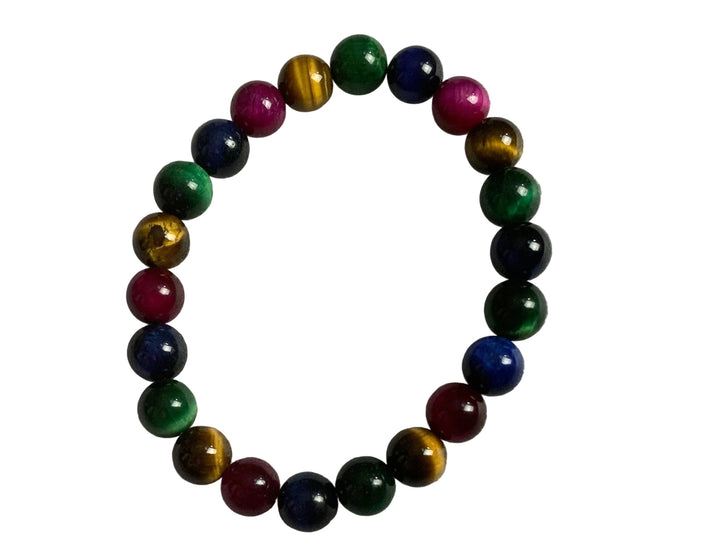
See it as
Glass (manufactured fiber-optic glass)
Cat Eye
Ojo de Gato
- Palette
- Multicolor
- Mined in
- China
- Hardness
- Mohs 5.0–5.5 ?
- See-through
- translucent
- Known since
- no formal date (bead-trade name)
- Named for
- French oeil de chat, meaning cat's eye
- Also sold as
- Cat's Eye, Fibre Optic Glass, Fiber Optic Cat's Eye, Cat's Eye Glass, Simulated Cat's Eye, fiber optic glass
- Intention
- Protection New Beginnings
- Looking for
- Protection Luck Safe travels Hope
- Water
- Keep it dry; wipe with a soft cloth
- Dye or finish
- These beads are manufactured glass, not a natural stone. The color runs through the whole glass, so it is not dyed or coated on the surface.
In our pieces · 2See the 2 pieces ↓
8.5 ON MOHS
The natural gem this glass imitates, cat's-eye chrysoberyl, rates 8.5 on the Mohs scale, just under corundum at 9.
RUTILE NEEDLES
In the natural gem the bright line comes from parallel microscopic needles or tubes, often tied to rutile.
CABOCHON
Cat's-eye stones are cut as smooth domes, because faceting does not show the glowing line well.
What it is
Beads with a bright line of light that slides across the surface as the bead turns, in many solid colors. Cat's eye in the bead trade is manufactured fiber-optic glass, not the natural gem chrysoberyl cat's-eye.
What gives it its color
These beads are manufactured fiber-optic glass: thin glass fibers fused side by side show a bright line of light, and the color is added to the glass itself when it is made.
In history
Most cat-eye beads are fiber-optic glass made to echo cat's-eye chrysoberyl, a gem that sat mostly in collections until the late 1800s. Then the Duke of Connaught gave a cat's-eye ring as an engagement token, and the stone became far more popular and far more sought after in Sri Lanka.
What's said about it
Natural cat's-eye chrysoberyl was used as a charm against evil spirits by people in Ceylon, according to older gem lore. Stones with a moving line of light were also thought of in the East as lucky.
People who like the look keep the glass beads for that same idea of luck and watchfulness. Wear it on the wrist and keep it away from hard knocks.
How people wear or keep it: On the wrist, in a travel bag, or in a pocket.
In crystal practice
Day to day, the same tradition suggests keeping it close: on the wrist, in a travel bag, in a pocket. People reach for it when they want protection, luck, safe travels, and many set an intention when they put it on. Most practitioners cleanse a new stone first (running water only if the stone can take it, otherwise smoke or moonlight) and set it aside now and then to rest.
These are beliefs people have held and still hold about the stone, reported as such. Nothing here is a promise or a medical claim. We sell stones as jewelry, not for these effects.
Associations
Also calledCat's Eye, Fibre Optic Glass, Fiber Optic Cat's Eye
Care
- Glass is softer than most gemstones and scratches easily; store it apart from harder stones.
- Wipe with a soft damp cloth and dry.
- Avoid hard knocks and drops, which can chip or crack glass.
- Keep away from abrasives and strong solvents, which dull the polish.
How to tell what you have
- Bead-trade cat's eye is fiber-optic glass, made by fusing very thin glass fibers; it is not the gem chrysoberyl cat's eye.
- Under a loupe, parallel tubes or a honeycomb pattern point to glass; the glow line is unusually sharp and the same at every angle.
- Glass is soft (about 5 to 5.5, versus 8.5 for the gem), so it scratches easily, and bright blue, red or neon green is almost always glass.
What sets the price
These beads are manufactured glass sold as a low-cost look-alike for the far costlier natural cat's eye gem, so a strand priced like the gem is a warning sign; among glass strands, the color and how crisp the glowing line is are what you are paying for.
Rules and sourcing
These beads are manufactured fiber-optic glass, not a natural stone such as cat's-eye chrysoberyl. Under the FTC jewelry guides a seller should call them glass or simulated cat's eye.
Related stones
Questions people ask at our table
Is cat's eye a natural stone?
The bead-trade cat's eye is fiber-optic glass, not a natural stone. Natural cat's-eye chrysoberyl is a rare gem, and a different material.
What is fiber-optic glass?
It is glass made by fusing many thin glass fibers together, then cutting and polishing it so light runs along them in a bright line. GIA gemmologists note the honeycomb structure under magnification.
Is cat's eye glass the same as chrysoberyl cat's eye?
No. Chrysoberyl is a mineral of Mohs hardness about 8.5 and is far costlier, while fiber-optic glass is around 5 to 5.5. Sellers should name which they are selling.
Does the color fade?
Skyjems notes the glass comes in a wide spectrum of colors. Glass color is not a surface coating, but the polish can scratch or dull, so give it gentler care than a hard gemstone.
How can I tell it from natural cat's eye?
Under magnification fiber-optic glass shows parallel tubes and a honeycomb pattern. It is also much cheaper and softer than chrysoberyl cat's eye.


Stay in the loop
Sign up to hear about new product drops, upcoming events, and the latest from Peritik. No spam, just the good stuff.