
In crystal lore, golden tiger eye is the stone people reach for when they need nerve. It's traditionally associated with courage, confidence and a strong sense of self, and people keep it when a decision is stuck.
See it as
Quartz · Quartz (chatoyant, with iron-stained crocidolite fibres)
Golden Tiger Eye
Ojo de Tigre Dorado
- Palette
- Yellow Brown
- Mined in
- South Africa, Australia, India, Namibia, Myanmar, Brazil, United States, Thailand
- Hardness
- Mohs 6.5–7.0 ?
- See-through
- opaque
- Known since
- Prehistoric
- Named for
- its golden color; German quarz, of uncertain origin
- Also sold as
- Tiger's Eye, Tiger Eye, Tigereye
- Intention
- Strength Protection
- Looking for
- Courage Confidence and self-worth Change and decisions Focus and clarity
- Water
- Fine with water and mild soap
- Dye or finish
- Golden-brown tiger eye is sold as natural. Red tiger eye is heated to get its color, and dark stones are sometimes lightened with acid.
In our pieces · 1See the piece ↓
CRACK-SEAL
A 2003 study found tiger eye forms by crack-seal growth, leaving the original crocidolite fibers sealed inside the quartz.
HAWK'S EYE
Tiger eye has a blue-colored relative in the same quartz group, called hawk's eye.
6.5 TO 7
Tiger eye rates 6.5 to 7 on the Mohs scale, nearly as hard as quartz itself.
What it is
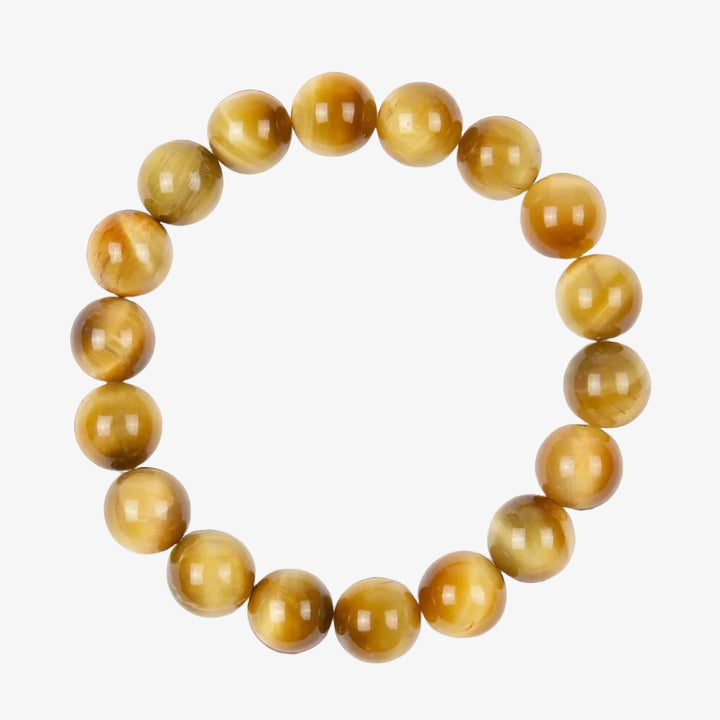
Opaque quartz with parallel golden-to-brown fibrous bands that flash a silky, shifting light as the bead turns. It is a natural stone whose gold color comes from iron oxidised in the original blue crocidolite fibers.
What gives it its color
The gold and brown come from iron that rusted (oxidized) in the original blue crocidolite fibers, leaving golden-yellow iron oxide (limonite) between the quartz. Red tiger eye is made by heating golden stones to about 400 C, which turns the iron to hematite.
Where it comes from
Tiger eye comes from South Africa's Northern Cape (the old Griqualand), Western Australia, Namibia, India, Myanmar and Brazil.
What's said about it
There's an old story that Roman soldiers carried engraved tiger's eye into battle. It's a popular tradition rather than documented history, but it explains why the stone is so often called a protector.
Wear it as a bracelet or ring, carry it in a pocket, or hold a bead in your non-dominant hand. Some people keep one in a meditation spot for focus.
How people wear or keep it: As a bracelet or ring, in a pocket, held in the non-dominant hand, or in a meditation spot.
In crystal practice
In the crystal tradition, golden tiger eye is paired with the solar plexus chakra, so practitioners rest it there during meditation or lie down with it in place for a few quiet minutes. Day to day, the same tradition suggests keeping it close: as a bracelet or ring, in a pocket, held in the non-dominant hand. People reach for it when they want courage, confidence and self-worth, change and decisions, and many set an intention when they put it on. Most practitioners cleanse a new stone first (running water only if the stone can take it, otherwise smoke or moonlight) and set it aside now and then to rest.
These are beliefs people have held and still hold about the stone, reported as such. Nothing here is a promise or a medical claim. We sell stones as jewelry, not for these effects.
Associations
The chakra and star sign this stone is usually matched with. These are popular traditions, not facts about the stone.
ChakraSolar Plexus
ZodiacCapricorn, Leo, Sagittarius
ElementFire, Earth
Also calledTiger's Eye, Tiger Eye, Tigereye
Care
- Hard enough for everyday wear, but still avoid hard knocks that can chip polished edges.
- Clean with a soft damp cloth and mild soap; rinse and dry.
- Avoid ultrasonic cleaners and strong chemicals, which can dull the polish or lift any wax finish.
- Store apart from harder stones such as sapphire or diamond to prevent scratching.
- Dust from cutting or grinding raw material is a workshop concern; finished polished beads are not.
How to tell what you have
- Real tiger eye shows a moving band of light across fine, parallel gold and brown fibers when you tilt it.
- Fiber-optic glass is a common imitation: it shows one very sharp, even stripe and can come in any color.
- Extreme heat can shift the color, so keep it away from hot water and steam.
What sets the price
Price follows how strong and even the moving band of light is, how rich and even the golden-brown color is, and the bead size and polish. Natural golden-brown is the usual, affordable form; red or other vivid colors are heated or dyed, and glass can imitate the look.
Rules and sourcing
Golden tiger eye is quartz that formed from crocidolite, an asbestos mineral under US law, and some original fibers can remain inside. Finished beads are sold as jewelry, but do not grind, sand, drill or cut them without dust protection.
Questions people ask at our table
What is tiger's eye?
It is a natural quartz in which fine fibers of the blue mineral crocidolite were enclosed and later oxidised to gold-brown by iron. The fibers give the silky, moving shimmer called chatoyancy.
Is golden tiger eye dyed or natural?
The classic golden-brown color is natural. Some tiger's eye is dyed (for example to bright reds or blues), so ask about color that looks unusually vivid.
Will the color fade?
Natural golden tiger's eye is stable in normal wear. Strong heat can shift its color, so keep it away from torches and hot cars.
Where does tiger's eye come from?
The best-known deposits are in the Northern Cape of South Africa. Wikipedia also lists Australia, India, Myanmar, Namibia, Brazil and the United States among common sources.
How do I tell it from look-alikes?
Bronzite and fiber-optic glass cat's eye can show a similar sheen, but tiger's eye has coarse wavy golden bands inside quartz and is harder (Mohs 6.5 to 7). Fibre-optic glass is much softer, around 5 to 5.5.
Our golden tiger eye pieces

Stay in the loop
Sign up to hear about new product drops, upcoming events, and the latest from Peritik. No spam, just the good stuff.