
Pink aventurine is a natural quartz whose soft color and glitter come from tiny mica flakes. It is not rose quartz, which has no sparkle.
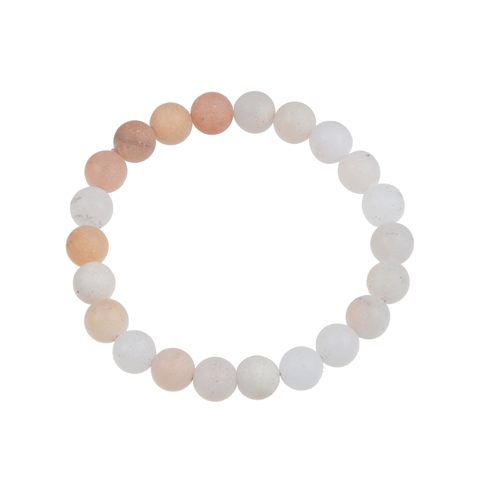
See it as
Quartz · Aventurine (quartzite)
Pink Aventurine
Aventurina rosa
- Palette
- Pink
- Mined in
- Brazil, Chile, China, India, Russia
- Hardness
- Mohs 6.5–7.0 ?
- See-through
- translucent
- Known since
- Prehistoric
- Named for
- Italian 'a ventura', 'by chance', from the lucky discovery of the glass
- Also sold as
- rose aventurine
- Intention
- Love
- Looking for
- Love Self-love Compassion and empathy Joy
- Water
- Keep it dry; wipe with a soft cloth
- Dye or finish
- Pink aventurine is sold natural; the soft peach-pink color comes from mica flakes inside the stone.
In our pieces · 1See the piece ↓
MIOTTI FAMILY
Goldstone, the glass that gave aventurine its name, was made in 17th-century Venice by the Miotti family under an exclusive license from the Doge.
MONK'S GOLD
Goldstone, the sparkling glass behind the aventurine name, has also been called monk's gold or monkstone.
FUCHSITE
In green aventurine the classic glitter comes from fuchsite, a chromium-bearing mica, giving a silvery green or blue sheen.
What it is
Soft peachy to blush-pink quartz with a faint glitter. A GIA report on one bangle traced its pink-to-red color to flaky muscovite mica (alurgite) inside polycrystalline quartz, so it is a quartz variety rather than a separate mineral.
What gives it its color
Tiny flakes of pink to orange-red mica inside the quartz give it both its color and its glitter (aventurescence).
Where it comes from
Most aventurine comes from India, with Brazil second, and smaller amounts from Russia, Spain, Chile, Austria and Tanzania.
In history
Aventurine takes its name from the Italian for 'by chance', after the sparkling Murano glass called goldstone, which Venetian glassmakers developed in the early 1400s and which is first documented in 1626. A goldstone amulet from 12th to 13th century Persia, now at the University of Pennsylvania, shows that earlier artisans made the material too. The name later passed to the glittering quartzite that looked similar.
What's said about it
Crystal lore gives this variety no lore of its own. Aventurine in general is traditionally associated with the heart chakra, and people keep the pink kind for love and compassion.
It is worn on the wrist or carried in a pocket, and some people place a piece in the corners of a room for a quiet space.
How people wear or keep it: On the wrist, in a pocket, on a desk, or by the bed.
In crystal practice
In the crystal tradition, pink aventurine is paired with the heart chakra, so practitioners rest it there during meditation or lie down with it in place for a few quiet minutes. Day to day, the same tradition suggests keeping it close: on the wrist, in a pocket, on a desk. People reach for it when they want love, self-love, compassion and empathy, and many set an intention when they put it on. Most practitioners cleanse a new stone first (running water only if the stone can take it, otherwise smoke or moonlight) and set it aside now and then to rest.
These are beliefs people have held and still hold about the stone, reported as such. Nothing here is a promise or a medical claim. We sell stones as jewelry, not for these effects.
Associations
The chakra and star sign this stone is usually matched with. These are popular traditions, not facts about the stone.
ChakraHeart
ZodiacLibra
ElementWater
Also calledrose aventurine
Care
- Hard enough for daily wear but can chip on sharp knocks.
- Clean gently with a soft damp cloth and avoid soaking, in case a bead has been dyed.
- Keep away from prolonged strong sun and harsh chemicals.
- Avoid ultrasonic and steam cleaners.
How to tell what you have
- Real pink aventurine is quartz with fine pink-to-red mica flakes that give a faint glitter; the color is soft and uneven. Strawberry quartz sold under similar names can be a different quartz with different inclusions.
- Hot pink or very even color suggests dye or glass; wipe a hidden spot on a damp cloth.
What sets the price
Price follows how rich the pink is (soft peachy pink up to deeper shades), how much sparkle shows from the tiny flakes inside, and bead size and shape; very glittery or glassy strands may be man-made.
Questions people ask at our table
What is pink aventurine?
It is pink quartz whose color, in a GIA-examined sample, came from reddish-purple mica flakes. It is a quartz variety, not a different mineral.
Is pink aventurine dyed?
The GIA report on one sample attributed the color to its mica inclusions and mentioned no dye. A bead's color alone does not show whether it has been dyed, so check with the seller.
Is it the same as rose quartz?
No. Rose quartz is a different pink quartz without the glittering mica flakes. Pink aventurine is a quartz rock with a sparkle.
Our pink aventurine pieces

Stay in the loop
Sign up to hear about new product drops, upcoming events, and the latest from Peritik. No spam, just the good stuff.