
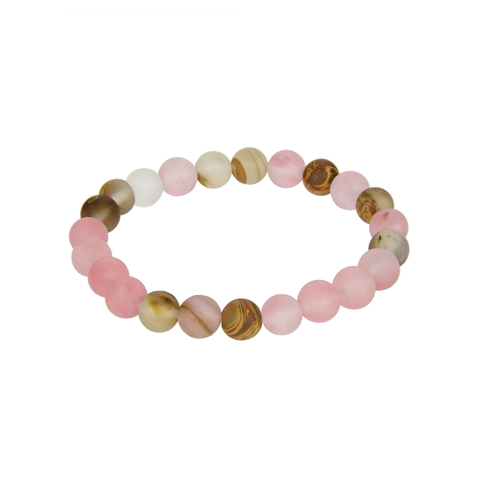
Cherry quartz is manufactured glass, not quartz. Trade testing found glass, with round bubbles and color banding. It is a modern bead-trade name, and no traditional lore of its own was found.
See it as
Glass (not a mineral)
Cherry Quartz
Cuarzo cereza
- Palette
- Pink Red
- Mined in
- China
- Hardness
- Mohs 5.0–6.0 ?
- See-through
- translucent
- Known since
- no formal date (bead-trade name)
- Named for
- its cherry-red color; 'quartz' is a trade label, as the material is glass
- Also sold as
- cherry glass
- Intention
- Strength
- Looking for
- Focus and clarity Calm Compassion and empathy
- Water
- Keep it dry; wipe with a soft cloth
- Dye or finish
- Cherry quartz is manufactured glass, not quartz, and its pink-red color is part of the glass itself. Whether any bead has also been coated is not stated by the sellers.
In our pieces · 1See the piece ↓
1291
A law of November 8, 1291 confined most Venetian glassmaking to Murano, where leaving without permission or revealing secrets was punishable by death.
200 FEET
Venetian bead makers pulled glass cane up to 200 feet (61 m) long before cutting it into beads.
What it is
Cherry quartz is manufactured glass, not quartz. Gem-trade testing found a refractive index of 1.460, a specific gravity of 2.18 and round gas bubbles with color bands and clouds, which marks it as glass.
What gives it its color
Cherry quartz is man-made glass, and its pink-red color is built into the glass as red and pink streaks and flecks rather than coming from quartz.
In history
Cherry quartz is glass, not quartz, so its history is that of glass beads. Glass beads were popular in Egypt and Mesopotamia around 1500 BC, and in the 1400s Murano glassmakers developed aventurine, the sparkling glass later called goldstone. By the 19th century Bohemian and Venetian bead makers were turning out glass beads that imitated costlier materials.
What's said about it
The lore below belongs to quartz, the stone it is named after. In crystal lore, quartz is kept as a bedside or altar stone and is associated with clarity and the heart chakra.
Here the beads are simply pretty cherry-pink glass, worn on the wrist. Keep them away from harder stones, which can scratch them.
How people wear or keep it: On the wrist, by the bed, or on an altar or shelf.
In crystal practice
In the crystal tradition, cherry quartz is paired with the heart chakra, so practitioners rest it there during meditation or lie down with it in place for a few quiet minutes. Day to day, the same tradition suggests keeping it close: on the wrist, by the bed, on an altar or shelf. People reach for it when they want focus and clarity, calm, compassion and empathy, and many set an intention when they put it on. Most practitioners cleanse a new stone first (running water only if the stone can take it, otherwise smoke or moonlight) and set it aside now and then to rest.
These are beliefs people have held and still hold about the stone, reported as such. Nothing here is a promise or a medical claim. We sell stones as jewelry, not for these effects.
Associations
The chakra and star sign this stone is usually matched with. These are popular traditions, not facts about the stone.
ChakraHeart
Also calledcherry glass
Care
- Glass is softer than quartz and scratches or chips more easily; keep it away from harder stones and findings.
- Wipe with a soft damp cloth; avoid ultrasonic cleaners.
- Avoid sudden temperature changes and hard knocks.
- Store in a pouch, separate from other jewelry.
How to tell what you have
- Under a loupe, glass shows round gas bubbles and swirled color bands; quartz does not. Real quartz scratches glass and is cold to the touch for longer.
- Cherry quartz is a trade name for glass, so a strand sold under this name is glass; real pink quartz looks cloudy and has no round bubbles.
What sets the price
Cherry quartz is man-made glass, so price follows bead size, whether the beads are faceted and polished, and how many beads are on the strand rather than the rarity of a stone.
Rules and sourcing
Cherry quartz is manufactured glass, not quartz. Under the FTC jewelry guides a seller should say it is glass.
Questions people ask at our table
Is cherry quartz real quartz?
No. It is man-made glass sold under a quartz name. A GIA trade-lab test reported in a gem forum identified the beads as glass.
How can I tell it is glass?
Round gas bubbles seen with a loupe are a strong sign of glass, along with color banding and cloudy swirls.
Where does it come from?
Vendors in one report said the beads came from China, sold as heated quartz; that account is unconfirmed and the lab found glass.
Does it have any lore?
No traditional lore was found for it; it is a modern bead-trade name.
Our cherry quartz pieces

Stay in the loop
Sign up to hear about new product drops, upcoming events, and the latest from Peritik. No spam, just the good stuff.