
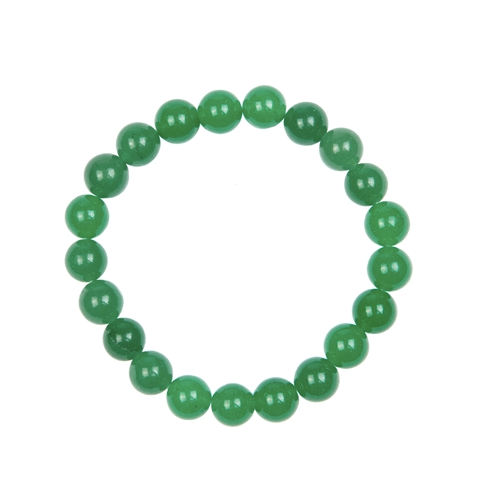
In crystal lore, green jade is the stone of luck, calm and warm relationships. It's said to be soothing, a stone of acceptance, and people hold it in the hand when they want to settle down.
See it as
Pyroxene (jadeite) or amphibole (nephrite); bead-trade 'jade' is often quartz or serpentine
Green Jade
Jade Verde
- Palette
- Green
- Mined in
- Myanmar, Guatemala, Russia, United States, China, Canada, New Zealand
- Hardness
- Mohs 6.5–7.0 ?
- See-through
- translucent
- Known since
- Prehistoric
- Named for
- Spanish 'piedra de ijada', 'flank stone', first recorded 1565
- Also sold as
- jade, fei cui (jadeite), nephrite, imperial jade (jadeite grade name), fei ts'ui (Kunz spelling), punamu / greenstone (New Zealand nephrite)
- Intention
- Abundance
- Looking for
- Luck Relationships Calm Prosperity
- Water
- Keep it dry; wipe with a soft cloth
- Dye or finish
- Beads sold as green jade range from natural stone to dyed or resin-filled stone, so ask the seller to state which.
In our pieces · 1See the piece ↓
10 TONNES
Canadian nephrite jade boulders are so large they are broken into pieces of about 10 tonnes for handling.
180 AXE HEADS
More than 180 axe heads made from jadeitite quarried in northern Italy have turned up across the British Isles.
ALEXIS DAMOUR
French mineralogist Alexis Damour named jadeite in 1863, though the Chinese name fei cui is older.
What it is
A soft to mid green, waxy to glassy in lustre, usually semi-translucent to opaque, sometimes with paler clouds or darker flecks. 'Jade' covers two true minerals, jadeite and nephrite, and green stones sold as jade at bead prices may be other materials such as serpentine, so a single strand cannot be named for certain without lab testing.
What gives it its color
In nephrite jade the green comes from iron (more iron gives a deeper green), and in jadeite it comes from traces of chromium and iron, with chromium giving the intense emerald green. Some beads are dyed or filled with resin to improve color.
Where it comes from
Jadeite comes mostly from Myanmar (northern Kachin State) and also from Guatemala's Motagua River valley and Russia. Nephrite comes from western Canada, Khotan and Lantian in China, and the South Island of New Zealand.
In history
Chinese carvers were shaping jade by the Neolithic, with Hongshan and Liangzhu workshops active between about 4700 and 2200 BC. The Olmec and Maya took their jade from Guatemala's Motagua valley, and Māori carvers made pounamu into hei-tiki pendants dated between 1500 and 1850. Burmese jadeite reached China in quantity only near the end of the 1700s.
What's said about it
In Chinese tradition, jade is a lucky charm. Amulets have been worn in the Far East for over two thousand years, and carved pieces are given to family and friends for protection. In feng shui it is kept for good business.
People wear it on the wrist or on a pendant near the heart, or keep it in a wallet or cash box. Many strands sold as jade are other green stones, so we call it a jade-style green stone unless lab tested.
How people wear or keep it: On the wrist, near the heart on a pendant, in a wallet or cash box, or in a pocket.
In crystal practice
In the crystal tradition, green jade is paired with the heart chakra, so practitioners rest it there during meditation or lie down with it in place for a few quiet minutes. Day to day, the same tradition suggests keeping it close: on the wrist, near the heart on a pendant, in a wallet or cash box. People reach for it when they want luck, relationships, calm, and many set an intention when they put it on. Most practitioners cleanse a new stone first (running water only if the stone can take it, otherwise smoke or moonlight) and set it aside now and then to rest.
These are beliefs people have held and still hold about the stone, reported as such. Nothing here is a promise or a medical claim. We sell stones as jewelry, not for these effects.
Associations
The chakra and star sign this stone is usually matched with. These are popular traditions, not facts about the stone.
ChakraHeart
ZodiacAries, Gemini, Libra, Taurus
ElementEarth
Also calledjade, fei cui (jadeite), nephrite
Care
- Jadeite is very tough but can still chip on a hard knock; store pieces apart from other stones.
- Jadeite is often bleached, polymer-filled or dyed, so avoid acids, solvents, soaking and ultrasonic or steam cleaners.
- Wipe with a soft damp cloth and dry.
- Keep out of long strong sun and heat, and put jewelry on after perfume and lotions.
- If a strand turns out to be serpentine-type 'jade' it is softer and scratches easily, so keep it from keys and coins.
How to tell what you have
- Sold as green jade the bead may be true jade (jadeite or nephrite), or a look-alike such as serpentine, dyed quartz or glass; it varies by lot.
- Real jade feels cool, dense and heavier than it looks, and two beads tapped together ring with a clear click.
- Look out for color gathered in cracks or at the drill hole, very vivid even green, tiny bubbles (glass), and a warm plastic feel.
What sets the price
Price follows what the bead actually is in that lot (true jadeite or nephrite, or a look-alike such as serpentine, dyed quartz or glass), then how deep and even the green is, how translucent the stone is, and whether the color was added by dye. Untreated jade holds its price, while dyed or resin-filled jade costs less.
Rules and sourcing
Green jade that is jadeite from Myanmar (Burma) falls under US sanctions that block dealings with the Burmese state gem enterprise and other listed Burmese gem companies, so a seller should be able to say where it came from. Dyed quartz or serpentine sold as jade, and nephrite from other countries, are not what these rules aim at. Beads sold as green jade range from natural stone to dyed or resin-filled stone. The FTC jewelry guides call for a seller to say which, and not to use jade for a different stone.
Questions people ask at our table
Is green jade real jade?
Gemologically, only two minerals are jade: jadeite and nephrite. Beads sold as 'jade' can be other green stones, so unless a lab has tested the strand the safest description is a jade-style green stone.
What is jadeite?
Jadeite is a sodium-aluminium pyroxene, Mohs 6.5 to 7, very tough, and the stone of the Burmese 'imperial jade' trade. Nephrite, the other jade, has been used in China since the Neolithic and is famously sourced from Hetian in Xinjiang.
Is jade dyed, and does it fade?
Jadeite is commonly bleached, polymer-filled, waxed or dyed; the trade grades A (natural color, wax allowed), B (bleached and polymer), C (dyed). Dye and fillers can suffer from acids, heat and strong cleaners, so gentle care matters.
Where is jade mined?
Gem jadeite is mined mainly in Myanmar, with other sources in Guatemala, Russia and California. Nephrite is long associated with China.
How do I care for it?
Wipe with a soft damp cloth, avoid soaking, acids and ultrasonic cleaners, and keep it out of long heat and sun.
Our green jade pieces

Stay in the loop
Sign up to hear about new product drops, upcoming events, and the latest from Peritik. No spam, just the good stuff.