
Natural blue coral is rare. The blue in most beads like these is likely dye on a common coral such as bamboo or sponge coral, so the color is man-made.
See it as
Coral skeleton (calcium carbonate, organic origin), usually dyed; base species unconfirmed
Blue Coral
Coral Azul
- Palette
- Blue
- Mined in
- Indonesia, Taiwan
- Hardness
- Mohs 3.0–4.0 ?
- See-through
- opaque
- Known since
- Prehistoric
- Named for
- Greek korallion, Theophrastus's word for coral; blue for its color
- Also sold as
- Dyed blue coral, Blue sponge coral, Blue bamboo coral, denim coral
- Intention
- Protection Calm
- Looking for
- Protection Calm
- Water
- Keep it dry; wipe with a soft cloth
- Dye or finish
- Blue coral beads are usually dyed, and many are filled with resin. A rare natural blue coral exists but is grayish.
In our pieces · 1See the piece ↓
8 TENTACLES
Each blue coral polyp has eight tentacles, and the species is the only octocoral known to build a massive stony skeleton.
CRETACEOUS
Fossils show true blue coral has stayed unchanged since the Cretaceous period, and the iron in its skeleton makes it easy to spot in fossil outcrops.
What it is
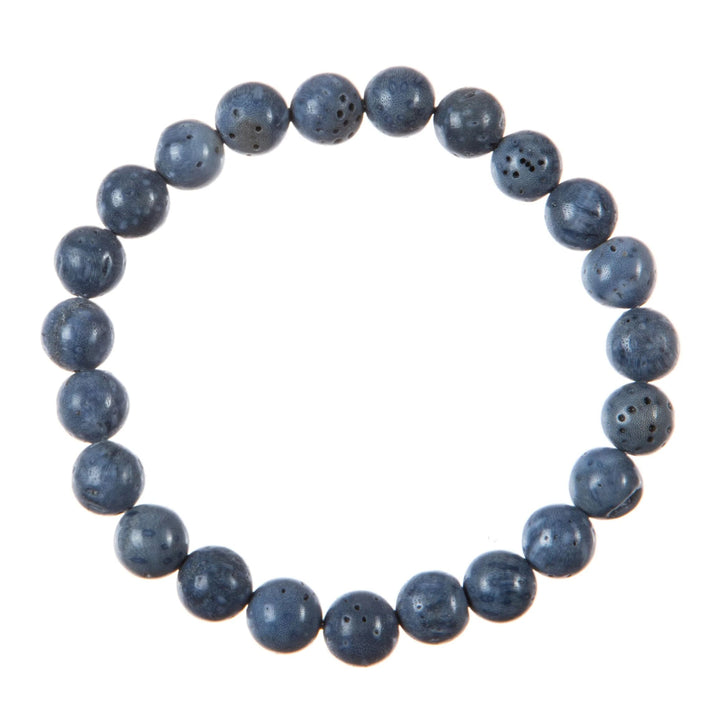
Blue coral beads with a matte, often pitted or mottled surface. 'Blue coral' is a trade name: most strands on the market are coral skeleton colored with dye, and the exact coral species varies by supplier.
What gives it its color
Most blue coral beads are ordinary coral skeleton dyed blue; the rare natural blue coral gets its color from iron salts in its skeleton and tends toward a muted, grayish blue.
Where it comes from
Natural blue coral (Heliopora) lives across the Indian Ocean and the western and central Pacific, including the Great Barrier Reef and the Ryukyu Islands of Japan. Where a given dyed strand's coral came from is not known.
What's said about it
In crystal lore, coral is a soothing, protective stone, and people keep it for a calmer, steadier mood. Those meanings belong to coral in general, not to dyed blue beads in particular.
In older Greek lore, a piece of coral was fixed to a ship's prow to guard the boat from winds and waves.
Coral is soft and the dye can rub off, so wear it on the wrist and keep it dry.
How people wear or keep it: On the wrist, in a pocket, or in a travel bag.
In crystal practice
In the crystal tradition, blue coral is paired with the heart and throat and third eye chakras, so practitioners rest it there during meditation or lie down with it in place for a few quiet minutes. Day to day, the same tradition suggests keeping it close: on the wrist, in a pocket, in a travel bag. People reach for it when they want protection, calm, and many set an intention when they put it on. Most practitioners cleanse a new stone first (running water only if the stone can take it, otherwise smoke or moonlight) and set it aside now and then to rest.
These are beliefs people have held and still hold about the stone, reported as such. Nothing here is a promise or a medical claim. We sell stones as jewelry, not for these effects.
Associations
The chakra and star sign this stone is usually matched with. These are popular traditions, not facts about the stone.
ChakraHeart, Throat, Third Eye
ZodiacAries
ElementWater
Also calledDyed blue coral, Blue sponge coral, Blue bamboo coral
Care
- Coral is soft (about 3.5 to 4 on the Mohs scale), so store it apart from harder stones and metal.
- Keep it away from perfume, hairspray, solvents and cleaning chemicals.
- Avoid soaking and long contact with water, since dye can rub off or fade.
- Clean with a soft damp cloth, dry right away, and keep away from direct sun and heat.
- Skip ultrasonic cleaners.
How to tell what you have
- A bead sold as blue coral may be dyed sponge coral, dyed stony coral or the rare natural blue coral; it varies by lot.
- Bright, strong blue is likely dye; natural blue coral is a muted, grayish blue.
- Look for dye pooling in pits and cracks or rubbing off, and a pitted surface that may be resin-filled.
What sets the price
The price follows what the beads actually are in that lot (dyed sponge coral, dyed stony coral, or the rare natural blue coral) and the usual bead factors: how even the color is, how smooth the surface is, and bead size.
Rules and sourcing
Natural blue coral (Heliopora) is CITES Appendix II, so it moves across borders only with permits, and it is rarely made into beads today. Most blue coral beads are dyed bamboo or sponge coral, which are not CITES-listed, and a seller should say which coral these are. Blue coral beads are usually dyed and many are resin-filled, and a rare natural blue coral is grayish. The FTC jewelry guides call for a seller to disclose dye and resin and to say what the bead actually is.
Related stones
Questions people ask at our table
Is blue coral natural?
The skeleton is a natural coral, but the blue color in beads is most likely dye. Gem Society says dyeing is common in coral, and Bead Chest says much affordable coral is dyed bamboo or sponge coral.
Is there a naturally blue coral?
Yes, a rare blue coral exists, and Rapaport reports that it is threatened and covered by trade rules via CITES. Which species our strands are is not confirmed.
Is coral jewelry covered by conservation rules?
Gem Society says coral harvesting is restricted in most regions and that raw coral could be illegal to possess. Rapaport describes the 'precious' corals as Corallidae and notes that reef corals such as bamboo are illegal to import.
Will the color fade or rub off?
It can. Dye may fade or rub off, especially with water or harsh exposure.
Our blue coral pieces

Stay in the loop
Sign up to hear about new product drops, upcoming events, and the latest from Peritik. No spam, just the good stuff.