
Affordable orange coral beads are usually dyed bamboo or sponge coral. They are not the costly red and pink coral of the Mediterranean, and the orange color is likely dye.
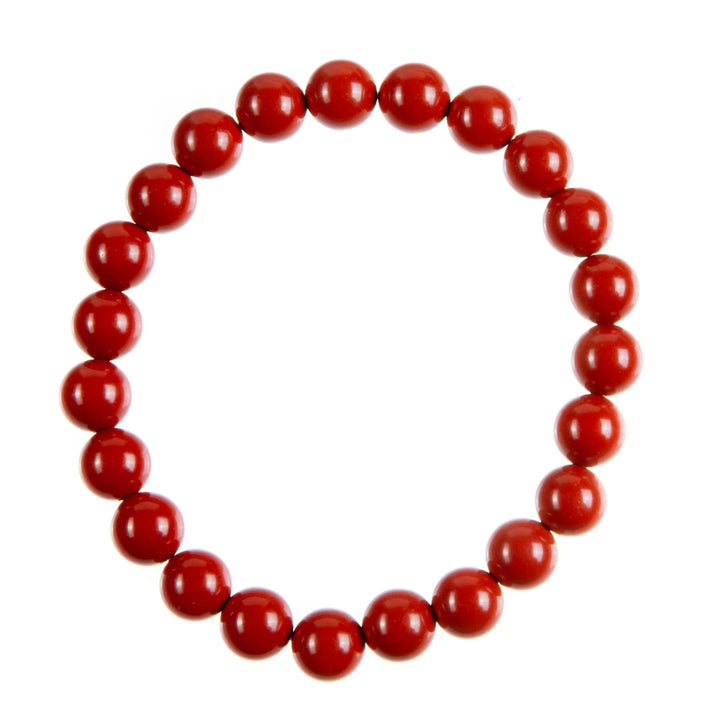
See it as
Coral skeleton (calcium carbonate, organic origin), usually dyed bamboo coral
Orange Coral
Coral Naranja
- Palette
- Orange
- Mined in
- Indonesia, Taiwan
- Hardness
- Mohs 3.0–4.0 ?
- See-through
- opaque
- Known since
- Prehistoric
- Named for
- Latin corallium, from Greek korállion, probably of Semitic origin
- Also sold as
- Dyed orange coral, Orange bamboo coral, Orange sponge coral, sea bamboo
- Intention
- Protection Calm
- Looking for
- Protection Calm
- Water
- Keep it dry; wipe with a soft cloth
- Dye or finish
- Most orange coral beads are bamboo coral, which is naturally beige and is bleached and dyed orange. Sponge coral is usually filled with resin and often dyed too.
In our pieces · 1See the piece ↓
350-1,500 METERS
Western Pacific red coral species live 350 to 1,500 meters deep, while the Mediterranean kind grows at 10 to 300 meters.
PAUL BARTHOLOMEW MARTIN
Paul Bartholomew Martin founded the first coral factory in Torre del Greco, in 1805.
What it is
Warm orange coral beads, often with fine lines, pits or mottling. 'Orange coral' is a trade name: these are most often a common coral, such as bamboo coral, dyed orange, and not the costly natural red-orange coral of the Mediterranean.
What gives it its color
Most orange coral beads are bamboo coral, whose white skeleton is bleached and then dyed orange or red; the natural red of Mediterranean coral comes from carotenoid pigments.
Where it comes from
Bamboo coral lives in oceans almost worldwide, notably around Tasmania, New Zealand and US waters, while natural precious red coral comes from the Mediterranean and from Japan and Taiwan.
In history
Coral jewelry turns up in ancient Egyptian and prehistoric European burials, and by the first millennium BC the Mediterranean and India were trading it heavily; Gauls decorated weapons and helmets with it. The Italian coral town of Torre del Greco has a documented coral trade from the 1400s and opened its first coral factory in 1805.
What's said about it
In crystal lore, coral is a soothing, protective stone, and people keep it for a calmer, steadier mood. Those meanings belong to coral in general rather than to dyed orange beads.
In older Italian lore, fresh coral worn where its color showed was said to guard against spells. Broken pieces were thought to lose that power.
Coral is soft and the dye can rub off, so wear it on the wrist and keep it dry.
How people wear or keep it: On the wrist, in a pocket, or in a travel bag.
In crystal practice
Day to day, the same tradition suggests keeping it close: on the wrist, in a pocket, in a travel bag. People reach for it when they want protection, calm, and many set an intention when they put it on. Most practitioners cleanse a new stone first (running water only if the stone can take it, otherwise smoke or moonlight) and set it aside now and then to rest.
These are beliefs people have held and still hold about the stone, reported as such. Nothing here is a promise or a medical claim. We sell stones as jewelry, not for these effects.
Associations
Also calledDyed orange coral, Orange bamboo coral, Orange sponge coral
Care
- Coral is soft (about 3.5 to 4 on the Mohs scale), so store it apart from harder stones and metal.
- Keep it away from perfume, hairspray, solvents and cleaning chemicals.
- Avoid soaking, since dye can rub off or fade with harsh exposure.
- Wipe with a soft cloth, dry right away, and keep out of direct sun and heat.
- Skip ultrasonic cleaners.
How to tell what you have
- Sold under this name the bead may be dyed bamboo coral, dyed sponge coral (resin filled), or reconstituted coral made from coral powder; it varies by lot.
- Dye can rub off or pool in crevices, and a bright, even orange on an affordable strand points to dye.
- Bamboo coral has dark nodes between white sections and is heavy for its size; cut and polished coral is hard to identify by eye, so ask the seller.
What sets the price
The price follows what the bead actually is in that lot (most likely dyed bamboo coral, otherwise dyed sponge coral or pressed coral powder, all low-cost) versus natural red or orange precious coral, which is rare and costly; within a lot, even color, smooth polish and consistent drilling matter.
Rules and sourcing
Orange coral beads are mostly bamboo coral that is bleached and dyed orange, and bamboo coral is not CITES-listed. Some sponge coral is also dyed or resin-filled, and a seller should say which coral the beads are. Most orange coral beads are bamboo coral, naturally beige, that is bleached and dyed orange, and sponge coral is usually resin-filled. The FTC jewelry guides call for a seller to disclose bleach, dye and resin.
Related stones
Questions people ask at our table
Is orange coral natural or dyed?
Bead Chest says much affordable coral is dyed bamboo or sponge coral, and natural red coral is rare and costly. Our strands are likely dyed, but the exact base is not confirmed.
Is it the red coral of the Mediterranean?
Probably not. Rapaport describes Mediterranean red and pink coral as precious coral of the Corallidae, harvested under rules such as size minimums; dyed orange beads are a different material.
Is there a conservation concern with coral?
Gem Society says harvesting is restricted in most regions and raw coral could be illegal to possess. Ask a seller about sourcing.
Does the color fade?
Dyed coral can fade with harsh exposure, and the dye can rub off or pool in crevices.
Our orange coral pieces

Stay in the loop
Sign up to hear about new product drops, upcoming events, and the latest from Peritik. No spam, just the good stuff.