
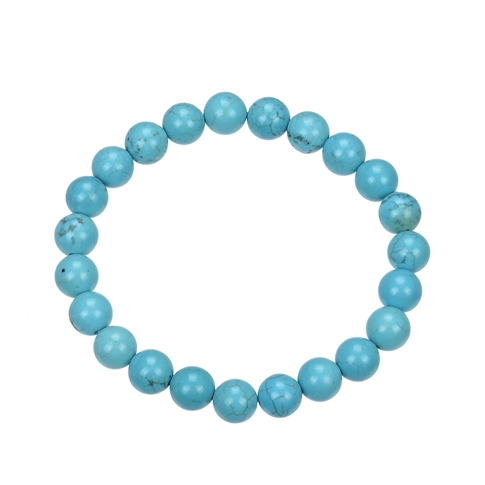
Turquoise is a real mineral, but much of what is sold is natural stone hardened with clear resin, and some is reconstituted or imitation. Dyed howlite is also sold under its name. Ask which one you are holding.
See it as
Phosphate
Turquoise
Turquesa
- Palette
- Blue Green
- Mined in
- Iran, United States, China, Mexico, Egypt, Afghanistan
- Hardness
- Mohs 5.0–6.0 ?
- See-through
- opaque
- Known since
- Prehistoric
- Named for
- Old French turquois, meaning Turkish
- Also sold as
- Persian turquoise, stabilised turquoise
- Intention
- Protection Calm
- Looking for
- Protection Communication Luck Goals and motivation
- Water
- Keep it dry; wipe with a soft cloth
- Dye or finish
- Most turquoise sold for jewelry is stabilized, meaning hardened with resin or wax, and many strands are also dyed. Only the highest grades are left untreated.
In our pieces · 1See the piece ↓
22 POUNDS
Tutankhamun's gold mask weighs over 10 kilograms, about 22 pounds, and is inlaid with turquoise, lapis lazuli and carnelian.
COUNTRY OF TURQUOISE
Ancient Egyptians called the Sinai the Country of Turquoise; its six mines cover about 650 square kilometers.
1 MILLIMETER
Single turquoise crystals are so rare that ones 1 millimeter across, first found in Virginia in 1912, count as large.
What it is
A sky-blue to blue-green opaque stone, often crossed by a web of brown or black host-rock veins (matrix). Much of the turquoise on the market is natural stone hardened with clear resin (stabilized), and some is reconstituted from powder or is an outright imitation.
What gives it its color
The blue comes from copper, and the green from iron (and sometimes zinc) taking copper's place. Some Persian turquoise is naturally blue and turns green when heated; many beads are also dyed or resin-hardened.
Where it comes from
Iran's Nishapur district has been the classic source for over 2,000 years, and Arizona and Nevada lead U.S. production today; the Sinai, Cerrillos (New Mexico) and Sleeping Beauty (Arizona, closed 2012) sources are historic or finished.
In history
Egyptians were using turquoise by about 3000 BC, mining it at Serabit el-Khadim in the Sinai, and it is inlaid in the gold mask of Tutankhamun (about 1323 BC). Iran's Nishapur mines have supplied Persia for at least 2,000 years, and the Aztecs set it into mosaic masks of their gods.
What's said about it
In crystal lore, turquoise is thought of as a bridge between the spiritual and the everyday, and as a stone of protection, luck and success. It is said to help you speak honestly and see clearly. People link it to the throat.
Medieval German stone-books said a true turquoise set in gold kept its wearer safe in a fall. Persian lore called it the national stone, and the Apache prized it as a talisman.
People wear it as any kind of jewelry, carry it in a pocket, or hold it in the hand while meditating. It dislikes water, perfume and sun.
How people wear or keep it: On the wrist, on a chain at the throat, in a pocket, or in a meditation spot.
In crystal practice
In the crystal tradition, turquoise is paired with the throat chakra, so practitioners rest it there during meditation or lie down with it in place for a few quiet minutes. Day to day, the same tradition suggests keeping it close: on the wrist, on a chain at the throat, in a pocket. People reach for it when they want protection, communication, luck, and many set an intention when they put it on. Most practitioners cleanse a new stone first (running water only if the stone can take it, otherwise smoke or moonlight) and set it aside now and then to rest.
These are beliefs people have held and still hold about the stone, reported as such. Nothing here is a promise or a medical claim. We sell stones as jewelry, not for these effects.
Associations
The chakra and star sign this stone is usually matched with. These are popular traditions, not facts about the stone.
ChakraThroat
ZodiacPisces, Sagittarius, Scorpio
BirthstoneDecember
Anniversary11th
Also calledPersian turquoise, stabilised turquoise
Care
- Porous and fairly soft: keep away from perfume, hairspray, solvents and household cleaners.
- Wipe with a soft dry cloth; avoid soaking and ultrasonic cleaners.
- Skin oils and sunlight can slowly shift the color of unstabilised stone, so store it out of direct sun.
- Keep apart from harder stones such as quartz, which can scratch it.
How to tell what you have
- Real turquoise is dull and waxy, not glassy, with natural streaks and uneven color. Soft chalky blue strands, perfect even color, or a very low price often mean dyed howlite, magnesite, reconstituted pieces or glass.
- A cotton swab with nail polish remover picks up color from dyed stones; howlite is lighter in weight.
What sets the price
Price follows an even, intense sky-blue color with little dark host-rock veining, a hard body that takes a good polish, and whether the stone is natural, hardened with resin, or pressed from powder. Chalky, pale or too-perfect strands at low prices are often dyed look-alikes, and prized mine localities cost more.
Rules and sourcing
Most turquoise sold for jewelry is stabilized with resin or wax, and many strands are also dyed; only the highest grades are left natural. The FTC jewelry guides call for a seller to disclose stabilizing and dye.
Questions people ask at our table
Is this real turquoise?
Turquoise is a copper-aluminium phosphate mineral. In the bead trade the name covers natural stone, stabilized stone, reconstituted block and plain imitation, so ask which one you are buying.
What is stabilized turquoise?
Natural turquoise that is soft or chalky is often impregnated with clear resin so it can be cut and polished and keeps its color. It is still the natural mineral and is widely accepted in the trade when disclosed.
What is reconstituted turquoise, and how is it different?
Reconstituted turquoise is ground natural turquoise mixed with plastic or other binders, then cut. It is cheap and easy to work, and experts disagree on whether to call it synthetic, a hybrid or an imitation.
How can I tell turquoise from dyed howlite or magnesite?
Dyed howlite and magnesite are sold as turquoise and have gray-to-black veining that makes them convincing. They are much softer (about 3 to 4 against 5 to 6), lighter in weight and tend to look evenly saturated; a reputable seller can tell you the material.
Where does turquoise come from?
Persia (Iran) produced the finest material historically, and the American Southwest, China, Egypt's Sinai and many other places also yield it. Most of today's trade comes from North America and China.
Our turquoise pieces

Stay in the loop
Sign up to hear about new product drops, upcoming events, and the latest from Peritik. No spam, just the good stuff.