
In crystal lore, apatite is the stone people reach for when they want to speak up or get an idea moving. It is said to help with self-expression, creativity and motivation.
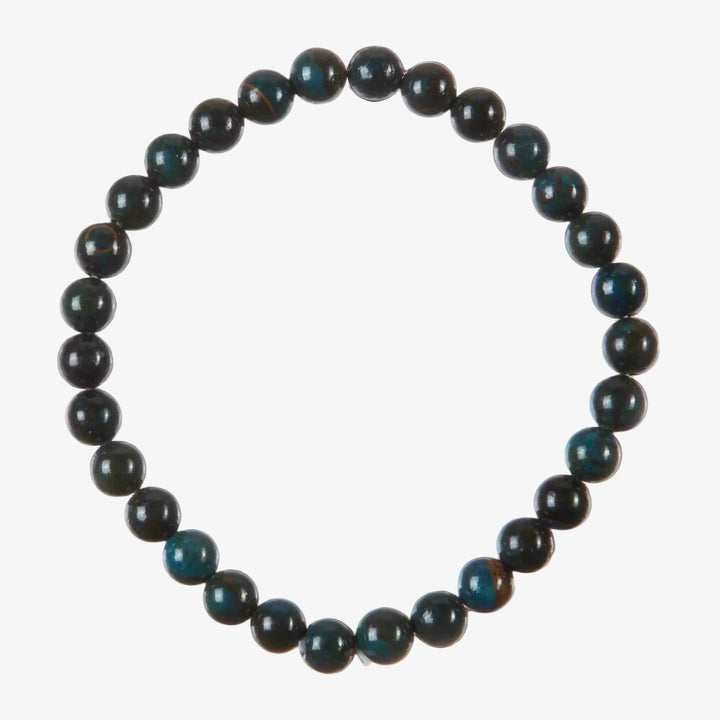
See it as
Phosphate · apatite
Blue Apatite
Apatita Azul
- Palette
- Blue
- Mined in
- Madagascar, Brazil, Myanmar, Mexico, Sri Lanka, Canada, Czech Republic, Germany, India, Mozambique, Norway, South Africa, Spain, United States, Kenya
- Hardness
- Mohs 5.0 ?
- See-through
- translucent
- Known since
- 1786
- Named for
- Greek apatao, to deceive
- Also sold as
- Neon blue apatite, Apatite
- Intention
- New Beginnings
- Looking for
- Communication Creativity Goals and motivation
- Water
- Keep it dry; wipe with a soft cloth
- Dye or finish
- Blue apatite beads are usually sold natural and untreated. Lower-grade beads are sometimes coated, and a few blue stones are made by heating other apatite.
In our pieces · 1See the piece ↓
48 VS. 100
On the Mohs absolute-hardness scale apatite scores 48 and quartz 100, so quartz is more than twice as hard.
MOROXITE
Blue stones of apatite have been called moroxite.
RAMMELSBERG
Chemist Karl Friedrich August Rammelsberg reclassified Werner's original apatite specimen as fluorapatite in 1860.
What it is
A vivid blue to teal-blue mineral, with the finest material an electric neon blue. It is a real natural mineral, not a trade name.
Where it comes from
Gem apatite comes mainly from Brazil, Myanmar and Mexico, with Madagascar, Mozambique, India and other countries also supplying it.
In history
Apatite was ground into a pigment for the Terracotta Army of China's first emperor, whose figures were buried in 210 to 209 BC. Qing dynasty metalworkers later used it in enamel on metalware. The stone got its name in 1786 because it had fooled mineralogists for so long, who had mistaken it for aquamarine and other gems.
What's said about it
It is traditionally associated with the throat and third eye chakras. People bring it to a meeting or keep it on a desk to spur creative thought.
The name comes from a Greek word meaning to deceive, because apatite was so often mistaken for other minerals. It is a real mineral, not a trade name.
It is brittle, so it is best worn as a bracelet, earrings or a pendant, and kept apart from other stones.
How people wear or keep it: On the wrist, on a desk, in a pocket, or as earrings or a necklace.
In crystal practice
In the crystal tradition, blue apatite is paired with the third eye chakra, so practitioners rest it there during meditation or lie down with it in place for a few quiet minutes. Day to day, the same tradition suggests keeping it close: on the wrist, on a desk, in a pocket. People reach for it when they want communication, creativity, goals and motivation, and many set an intention when they put it on. Most practitioners cleanse a new stone first (running water only if the stone can take it, otherwise smoke or moonlight) and set it aside now and then to rest.
These are beliefs people have held and still hold about the stone, reported as such. Nothing here is a promise or a medical claim. We sell stones as jewelry, not for these effects.
Associations
The chakra and star sign this stone is usually matched with. These are popular traditions, not facts about the stone.
ChakraThird Eye
ZodiacGemini
ElementAir
Also calledNeon blue apatite, Apatite
Care
- Only Mohs 5, so it scratches easily; keep it apart from other jewelry.
- Best suited to earrings and pendants; rings need protective settings.
- Clean with warm soapy water and a soft brush.
- No ultrasonic or steam cleaners.
- Coatings are occasionally applied to lower-quality beads, so avoid abrasive cleaners.
How to tell what you have
- Apatite is a real mineral that is quite soft (Mohs 5), so it scratches easily; a steel knife will mark it. Blue stones show blue and pale yellow when turned, and glow blue under ultraviolet light.
- A coating shows as color concentrated at scratches or worn spots under a loupe.
What sets the price
Price follows how deep and even the blue is (richer, more saturated blue costs more than pale or grayish), how clean the beads are, bead size, and how well they are cut and polished.
Rules and sourcing
Lower-grade blue apatite beads are sometimes coated, and a few blue stones are made by heating other apatite. The FTC jewelry guides call for a seller to disclose a coating or heat.
Questions people ask at our table
What is blue apatite?
It is a natural calcium phosphate mineral. Sky Jems says the Madagascar neon blue color is understood to be intrinsic, though the exact mechanism is not fully resolved.
Is it a hard stone?
No. It is Mohs 5, softer than a steel knife blade, which limits it to protected settings and low-abrasion wear.
Is blue apatite dyed or heated?
Most fine Madagascar neon blue is traded as natural material with no heating or coating, Sky Jems says. Heat is applied to some apatite, including yellow stones changed to blue, and coatings are occasionally put on lower-quality beads, so ask your seller.
Where does it come from?
Madagascar is the most important source of fine blue gem apatite, with Brazil, Myanmar, Mexico and Sri Lanka among other sources.
Our blue apatite pieces

Stay in the loop
Sign up to hear about new product drops, upcoming events, and the latest from Peritik. No spam, just the good stuff.