
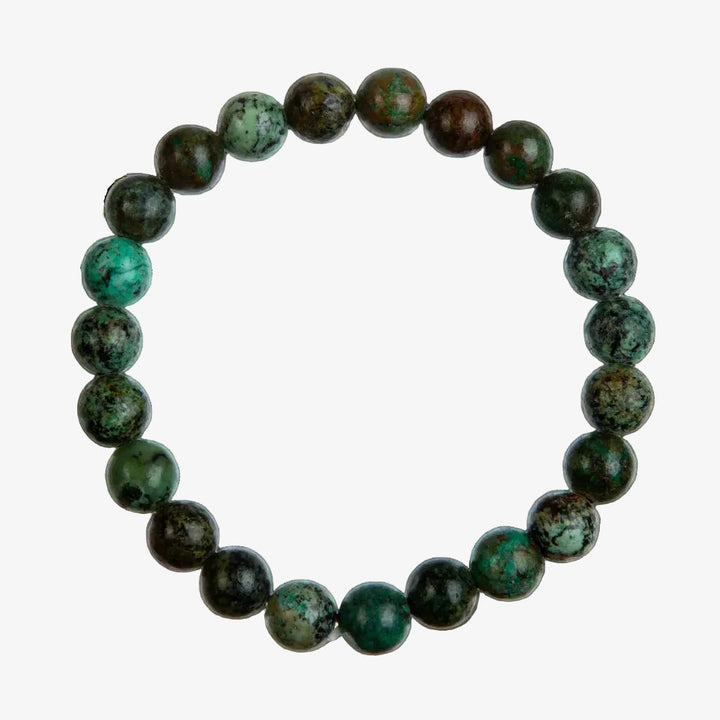
African turquoise is not turquoise. It is a teal-green jasper, a kind of quartz, named for its look, and some makers dye it bluer.
See it as
Quartz (microcrystalline silica) · Jasper
African Turquoise
Turquesa africana
- Palette
- Green Blue Brown Black
- Mined in
- Afghanistan, China, Egypt, Iran, Mexico
- Hardness
- Mohs 6.5–7.0 ?
- See-through
- opaque
- Known since
- Prehistoric
- Named for
- its turquoise-like blue-green color, though the stone is a jasper
- Also sold as
- African jasper, Turquoise jasper, African turquoise jasper
- Intention
- New Beginnings
- Looking for
- Change and decisions Fresh starts Hope
- Water
- Keep it dry; wipe with a soft cloth
- Dye or finish
- Beads sold as African turquoise are jasper, and they are usually dyed to deepen and even out the color. Some are also coated with resin or wax to hold the dye.
In our pieces · 1See the piece ↓
SPECKLED STONE
The word jasper comes through Greek from what was probably a Semitic root, and it means spotted or speckled stone.
6.5 TO 7
Jasper rates 6.5 to 7 on the Mohs scale, nearly as hard as quartz, which defines 7.
16 INCHES
In Roman times a figure of Emperor Nero set in a breastplate was carved from jasper and stood 16 inches high.
What it is
Not turquoise: a teal-green to blue-green jasper (a chalcedony-family quartz rock) from Africa, with a matrix of brown, black and cream. Named for its look, it is harder than true turquoise, and some makers dye it bluer.
What gives it its color
Beads sold as African turquoise are jasper, a quartz rock whose natural color comes from the minerals in the rock, and many are dyed to make the blue-green deeper.
Where it comes from
The jasper is mined in Africa, and much of it is exported to China and Europe to be cut into beads.
In history
African turquoise is a jasper, and people have worked jasper for thousands of years. Green jasper was made into bow drills at Mehrgarh around the 4th to 5th millennium BC, and Minoan craftsmen carved jasper seals at Knossos about 1800 BC. The Roman writer Pliny the Elder noted that jasper served as a signet stone for sealing documents.
What's said about it
As a modern trade name it has no old lore of its own. Today people keep it for growth and positive change, and it is often chosen as a stone for a fresh start.
It is hard enough for daily wear, so it is usually worn on the wrist. Some people carry a bead in a pocket as a reminder of a new direction.
How people wear or keep it: On the wrist, in a pocket, or on a desk.
In crystal practice
Day to day, the same tradition suggests keeping it close: on the wrist, in a pocket, on a desk. People reach for it when they want change and decisions, fresh starts, hope, and many set an intention when they put it on. Most practitioners cleanse a new stone first (running water only if the stone can take it, otherwise smoke or moonlight) and set it aside now and then to rest.
These are beliefs people have held and still hold about the stone, reported as such. Nothing here is a promise or a medical claim. We sell stones as jewelry, not for these effects.
Associations
Also calledAfrican jasper, Turquoise jasper, African turquoise jasper
Care
- Hard and durable; safe for everyday wear.
- If dyed, avoid prolonged soaking and strong solvents that may lift color.
- Clean with a soft cloth and mild soapy water, then dry.
- Keep out of strong sun to protect any dyed color.
How to tell what you have
- It is a jasper (a quartz stone), not turquoise, and the name describes the look only. Real turquoise shows thin veins and marbling; African turquoise tends to have larger patches of darker color and a less intense blue-green.
- Hand-cut beads are rarely the same size and shape. Dye can leave color on a damp cloth or on the thread, so test a hidden spot.
What sets the price
African turquoise is dyed jasper, so price follows bead size, how even the color is against the dark matrix, and whether the beads are polished or matte.
Rules and sourcing
Beads sold as African turquoise are jasper, not turquoise, and are usually dyed and sometimes coated with resin or wax. A seller should say what the bead actually is under the FTC jewelry guides and disclose the dye.
Questions people ask at our table
Is African turquoise real turquoise?
No. It is a jasper, a form of quartz, and contains no turquoise. The name describes its color and pattern.
Is it natural or dyed?
The base stone is natural jasper, but some makers dye it to look bluer. Very even, vivid blue is a hint of dye.
Will the color fade?
Natural jasper color is stable. Dyed beads can lose color with long sun exposure or harsh cleaners.
How is it different from real turquoise?
It is harder (6.5 to 7 on the Mohs scale against 5 to 6), and shows larger darker areas and marbling where real turquoise has thin veins.
Where does it come from?
Sellers describe it as African jasper; the specific mines vary and are not usually stated.
Our african turquoise pieces

Stay in the loop
Sign up to hear about new product drops, upcoming events, and the latest from Peritik. No spam, just the good stuff.