
In crystal lore, moss agate is the gardener's stone. People keep it for growth, new beginnings and a calmer, steadier outlook, and for a love of the natural world.
See it as
Quartz (chalcedony group) · Chalcedony (classed by gemdat.org under dendritic agate)
Moss Agate
Ágata musgo
- Palette
- Green White Clear Brown Red
- Mined in
- India, United States, Brazil, Uruguay, Indonesia, Canada, United Kingdom, Yemen
- Hardness
- Mohs 6.5–7.0 ?
- See-through
- translucent
- Known since
- Prehistoric
- Named for
- its moss-like inclusions
- Also sold as
- mocha stone, Mocha agate, green moss agate, Montana moss agate, scenic agate, tree-agate (Pliny's name)
- Intention
- Abundance New Beginnings
- Looking for
- Fresh starts Grounding Forgiveness Prosperity
- Water
- Keep it dry; wipe with a soft cloth
- Dye or finish
- Moss agate is usually sold natural, but some strands are dyed to improve the green.
In our pieces · 2See the 2 pieces ↓
NO MOSS AT ALL
People once took moss agate for petrified moss, but it holds no organic matter whatever.
NO BANDS
Moss agate lacks the concentric banding of agate, so strictly it is not a true agate.
260 POUNDS
Some Brazilian agates reach about 3 feet across and weigh over 260 pounds.
What it is
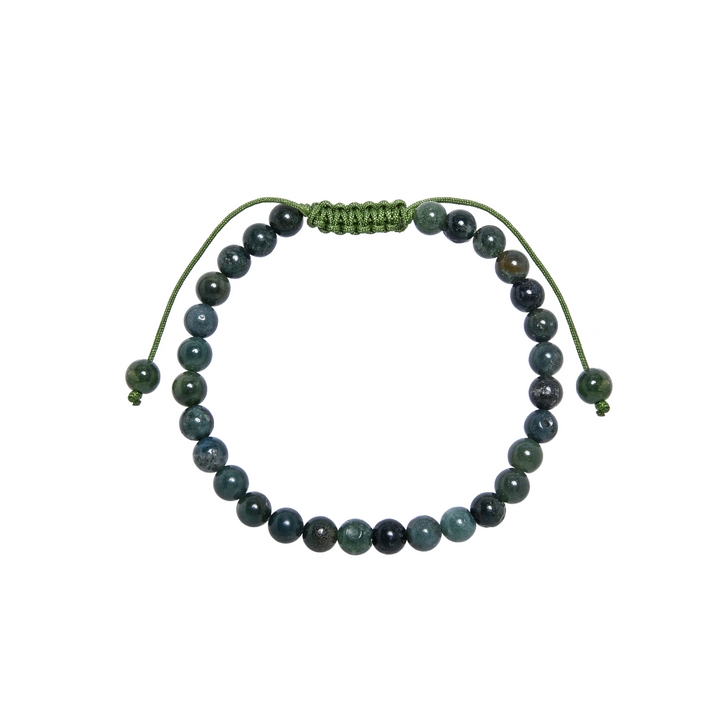
A milky white to nearly clear chalcedony threaded with green, branching filaments that look like moss, ferns or tiny trees suspended inside the stone; the green comes from chlorite or hornblende inclusions, and where those have oxidised the threads turn rust-red or brown. As a bead it reads as a soft, cloudy pale stone with a different green landscape on every piece, no two alike.
What gives it its color
The green threads are tiny inclusions of minerals such as chlorite, hornblende or celadonite, and the rust-red and brown tones come from iron oxide; where manganese oxide is present the threads can be black.
Where it comes from
Moss agate comes from India, Brazil, Uruguay and the United States, including the Yellowstone River gravels of Montana. The stone was once called Mocha stone after Mokha in Yemen, an old source.
In history
Moss agates were among the first agates worked: Natufian people in the Levant made knives and arrowheads from it as early as 10,000 BC, and Stone Age toolmakers in Mongolia shaped it by 7000 BC. The stone was once called Mocha stone, after the Yemeni port of Mokha that supplied it, and the German town of Idar-Oberstein has cut agate on an industrial scale since about 1375.
What's said about it
It's also traditionally associated with letting go of old resentment and with forgiveness. People reach for it when they want to settle a thought before a decision.
Older writers described tree-marked agates, and farmers in parts of Europe are said to have hung moss agate in orchards as a token of a good harvest.
People wear it on the wrist, carry it in a jacket pocket, keep it in a cash box, or set it among house plants or in the garden shed.
How people wear or keep it: On the wrist, in a shirt or jacket pocket, in a wallet or cash box, or around plants or in the garden shed.
In crystal practice
In the crystal tradition, moss agate is paired with the heart chakra, so practitioners rest it there during meditation or lie down with it in place for a few quiet minutes. Day to day, the same tradition suggests keeping it close: on the wrist, in a shirt or jacket pocket, in a wallet or cash box. People reach for it when they want fresh starts, grounding, forgiveness, and many set an intention when they put it on. Most practitioners cleanse a new stone first (running water only if the stone can take it, otherwise smoke or moonlight) and set it aside now and then to rest.
These are beliefs people have held and still hold about the stone, reported as such. Nothing here is a promise or a medical claim. We sell stones as jewelry, not for these effects.
Associations
The chakra and star sign this stone is usually matched with. These are popular traditions, not facts about the stone.
ChakraHeart
ZodiacAquarius, Virgo
ElementEarth
Also calledmocha stone, Mocha agate, green moss agate
Care
- At 6.5 to 7 on the Mohs scale it stands up to daily wear, but store it apart from harder gems (sapphire, topaz, diamond) that can scratch its polish.
- Clean with lukewarm water, a drop of mild soap and a soft cloth, then dry fully.
- Skip ultrasonic and steam cleaners; chalcedony is slightly porous, and the agitation or heat can open hairline fractures or lift color from dyed pieces.
- Keep it away from household chemicals, chlorine and perfume; put jewelry on last and take it off before swimming or cleaning.
- Knock-sensitive at thin edges: avoid sharp impacts and store beads in a soft pouch rather than loose in a drawer.
How to tell what you have
- Moss agate is clear to milky chalcedony with branching green threads inside, not banded like true agate.
- Natural green is a soft, uneven moss color; a flat, bright green or color pooled at the drill hole suggests dye.
- Because the pattern is inside the stone, every bead looks different.
What sets the price
Price follows how clear the stone is and how much of the green moss pattern shows, since every bead's pattern is different, plus bead size and whether the green is natural or dyed.
Rules and sourcing
Some moss agate strands are dyed to improve the green. The FTC jewelry guides call for a seller to say when color has been added.
Questions people ask at our table
Is the moss inside moss agate real moss?
No. The green threads are mineral, not plant: filaments of chlorite or green hornblende that grew inside silica-rich fluid as the chalcedony hardened. Early collectors assumed the stone held fossilised moss, and the name stuck even after mineralogists showed it contains no organic matter.
What is the difference between moss agate, tree agate and dendritic agate?
All three are chalcedony with branching inclusions, and dealers use the names loosely. Moss agate is translucent with green, moss-like tangles; tree agate is opaque white with green branches; dendritic agate is usually clear to gray with black or brown fern-like dendrites of manganese or iron oxide. Gemdat.org files moss agate as a variety within the dendritic agate group.
Is moss agate dyed?
Natural moss agate is not dyed, and the green you see is the inclusion mineral itself. Some material on the market is color-enhanced to look greener, so a stone with flat, uniform or neon green, or with color pooled in cracks, should be questioned. Fire Mountain Gems notes that dyed pieces exist and recommends gentler cleaning for them.
Where is moss agate mined?
India is the long-standing source of fine material, with deposits also in Brazil, Uruguay, Indonesia and central Europe. In the United States, Montana moss agate is collected from Yellowstone River gravels between Billings and Sidney, and Wyoming, Colorado and California also produce it. The old name Mocha stone recalls the Yemeni port of Mokha, through which it once reached European traders.
Is moss agate a true agate?
Strictly speaking, no. Agate is defined by concentric banding, and moss agate has none; it is a chalcedony with inclusions. The trade has called it agate for centuries, so the name is kept even though gemologists class it as a chalcedony variety.


Stay in the loop
Sign up to hear about new product drops, upcoming events, and the latest from Peritik. No spam, just the good stuff.