
Tree agate is milky white chalcedony with branching green or dark marks. The branches are mineral deposits, not plants. The name is a trade habit, since the stone is mostly unbanded.
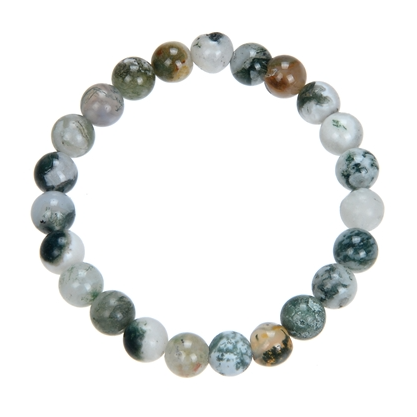
See it as
Quartz (chalcedony) · Chalcedony
Tree Agate
Ágata arbórea
- Palette
- White Green Gray
- Mined in
- Brazil, India, Madagascar, United States, Mexico, Kazakhstan
- Hardness
- Mohs 6.5–7.0 ?
- See-through
- opaque
- Known since
- Prehistoric
- Named for
- its tree-like branching patterns
- Also sold as
- Dendritic agate, Dendritic chalcedony, White tree agate
- Intention
- New Beginnings Abundance
- Looking for
- Calm Focus and clarity Fresh starts Confidence and self-worth
- Water
- Fine with water and mild soap
- Dye or finish
- Sold as a natural stone; the green pattern comes from mineral growth inside the white quartz, not from dye.
In our pieces · 1See the piece ↓
120 KILOGRAMS
Brazilian agates have been found up to 0.9 meters across and weighing over 120 kilograms.
THEOPHRASTUS
Theophrastus wrote about agate around 350 BCE, the earliest description of it on record.
0.5-3% WATER
The chalcedony that forms agate's white ground holds between 0.5 and 3 percent water.
What it is
Opaque to milky chalcedony, whitish or cream, marked with tree- or fern-like branching patterns, often green in trade tree agate and brown or black in other dendritic agate. The patterns are iron or manganese mineral deposits, not plant matter, and the stone is generally unbanded, so it is technically dendritic chalcedony more than true banded agate.
What gives it its color
The green and the tree-like branches are mineral inclusions growing inside white chalcedony, mostly traces of iron (with manganese in dark dendrites), not dye.
Where it comes from
Tree agate is found in India, Brazil, Madagascar, Mexico and Kazakhstan, among other places.
In history
Agate is among the oldest worked stones: people of the Levant were chipping moss agate into knives and arrowheads by about 10000 BCE, and agate jewelry from Sumer dates to about 2500 BCE. The German town of Idar-Oberstein has cut agate on an industrial scale since about 1375, and Roman writers already listed a kind marked with tiny tree shapes.
What's said about it
In crystal lore, agate is kept for calm, focus and steady confidence. People tend to link tree agate's branching look with growth and fresh starts.
Ancient Roman writers described agates marked like little trees. One old tale says a white tree stone, buried beneath a tree, kept axes sharp. The writer himself called it superstition.
People wear it as jewelry, hold it in either hand, or carry it in a pocket. Wrap it in cloth when storing it.
How people wear or keep it: On the wrist, in a pocket, or held in either hand.
In crystal practice
In the crystal tradition, tree agate is paired with the root and heart chakras, so practitioners rest it there during meditation or lie down with it in place for a few quiet minutes. Day to day, the same tradition suggests keeping it close: on the wrist, in a pocket, held in either hand. People reach for it when they want calm, focus and clarity, fresh starts, and many set an intention when they put it on. Most practitioners cleanse a new stone first (running water only if the stone can take it, otherwise smoke or moonlight) and set it aside now and then to rest.
These are beliefs people have held and still hold about the stone, reported as such. Nothing here is a promise or a medical claim. We sell stones as jewelry, not for these effects.
Associations
The chakra and star sign this stone is usually matched with. These are popular traditions, not facts about the stone.
ChakraRoot, Heart
ZodiacVirgo
BirthstoneMay, June
ElementEarth
Also calledDendritic agate, Dendritic chalcedony, White tree agate
Care
- Wipe clean with a soft damp cloth and dry; mild soapy water is fine for short rinses.
- Avoid ultrasonic cleaners and harsh chemicals.
- Keep away from prolonged strong sunlight and heat.
- Hard enough for everyday wear, but beads can chip if struck on edges.
- Store separately from softer stones to avoid scratches.
How to tell what you have
- Tree agate is white to gray chalcedony with green, branching, fern-like inclusions; it is hard (6.5 to 7).
- It is often mistaken for moss agate, which has moss-like inclusions instead of branching ones.
- Color that looks painted on, or very bright green with no branching shape, is worth a question.
What sets the price
Price follows how much of the green branching pattern shows against the white, how clear and well placed it is, and the bead size, shape and polish (or matte finish). It is a natural stone, so each strand varies.
Related stones
Questions people ask at our table
Is tree agate the same as moss agate?
They are close relatives. Moss agate is usually translucent with green moss-like patterns, while tree agate is mostly opaque white with branching, shrub-like patterns, though sources do not draw the line the same way.
Are those green branches plants?
No. They are dendrites, thin deposits of iron or manganese minerals that seeped into tiny cracks and crystallised, so they look organic but are mineral.
Is tree agate dyed?
Usually not. The white base and branching pattern are natural, though any bead sold in an unusually bright color should be checked with the seller.
Is it really an agate?
Strictly, agate implies banded chalcedony, and tree agate is mostly unbanded. The name is a long-standing trade convention.
Where is it found?
Reported sources include Brazil, India, Madagascar, Mexico, Kazakhstan and the United States, with Indian material common in beads.
Our tree agate pieces

Stay in the loop
Sign up to hear about new product drops, upcoming events, and the latest from Peritik. No spam, just the good stuff.