
Kiwi jasper is a trade name, and it is not a true jasper. It is a quartz-rich rock with flecks of other minerals, and the stone itself is natural.
See it as
Rock (mixed minerals)
Kiwi Jasper
Jaspe Kiwi
- Palette
- Green White Black Multicolor
- Mined in
- New Zealand, Australia
- Hardness
- Mohs 6.5–7.0 ?
- See-through
- translucent
- Known since
- Prehistoric
- Named for
- its pale green-yellow color, like kiwifruit flesh
- Also sold as
- Sesame Jasper, Kiwi/Sesame Jasper
- Intention
- Calm New Beginnings
- Looking for
- Grounding Relationships Peace
- Water
- Fine with water and mild soap
- Dye or finish
- Kiwi jasper is sold natural, with no dye listed, though the color can vary by lot.
In our pieces · 1See the piece ↓
What it is
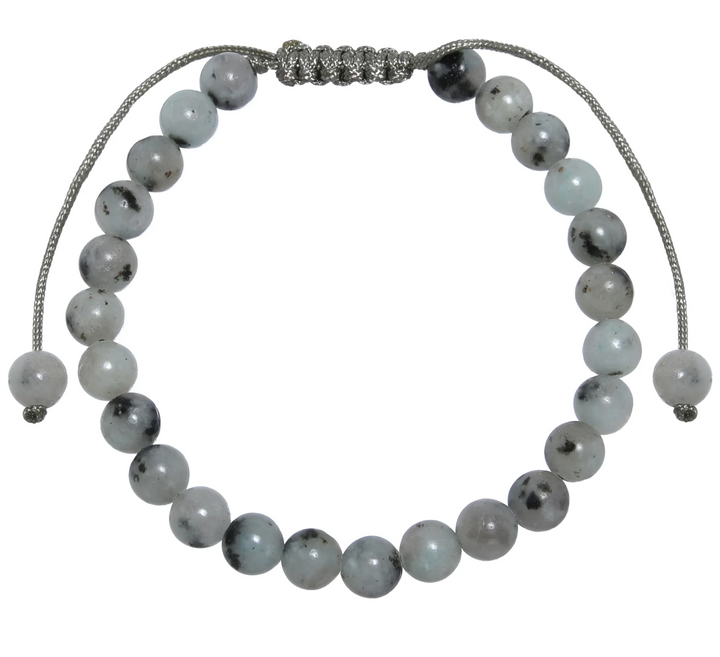
Pale sea-green to cream stone speckled with black and white flecks and glassy translucent patches. Despite the name it is not a true jasper: dealers describe it as a quartz-rich rock with amazonite and tourmaline inclusions, and some call it a quartzite.
What's said about it
In crystal lore, jasper is called the supreme nurturer. It's said to bring stability and to help people feel grounded, and green ones are thought to bring harmony to relationships.
Older gem lore prized jasper of many colors, and green jasper turns up in ancient amulets. That lore belongs to true jasper, not to this trade-named stone.
People wear it as a bracelet, carry a bead in a pocket, or hold it in either hand.
How people wear or keep it: On the wrist, in a pocket, held in either hand, or in a meditation space.
In crystal practice
Day to day, the same tradition suggests keeping it close: on the wrist, in a pocket, held in either hand. People reach for it when they want grounding, relationships, peace, and many set an intention when they put it on. Most practitioners cleanse a new stone first (running water only if the stone can take it, otherwise smoke or moonlight) and set it aside now and then to rest.
These are beliefs people have held and still hold about the stone, reported as such. Nothing here is a promise or a medical claim. We sell stones as jewelry, not for these effects.
Associations
Also calledSesame Jasper, Kiwi/Sesame Jasper
Care
- Hard enough for everyday jewelry, though as a mixed rock it can chip along grain boundaries if knocked.
- Wipe with a soft damp cloth and mild soap; dry fully.
- Keep away from ultrasonic cleaners and harsh chemicals.
- Store apart from harder stones such as sapphire to avoid scratches.
How to tell what you have
- Kiwi jasper is a mint-green stone with black specks and mostly opaque, and the name covers a rock that is not always true jasper.
- The pattern changes by lot, so beads in one strand will not match exactly.
- Test a spare bead: real jasper-type stone is hard and will not scratch with a steel point; very even bright green suggests dye.
What sets the price
Price follows how attractive the green-and-speckle pattern is, whether the color is natural or dyed, and bead size; the name is a trade label, so lots can differ.
Related stones
Questions people ask at our table
Is kiwi jasper a real jasper?
No. Kiwi jasper is a trade name for a rock made mainly of quartz with feldspar and tourmaline, not the fine-grained chalcedony that defines jasper. Some dealers call it a pegmatite, others a quartzite, so descriptions vary.
What is the difference between kiwi jasper and sesame jasper?
They are the same material sold under two names. Dealers disagree on which name goes with which shade, but generally the paler, creamier pieces are called sesame and the greener, darker ones kiwi.
Is kiwi jasper natural or dyed?
The stone itself is natural. Because it is sold by trade name, ask the seller about any dye; ours is carried as natural color.
Where does kiwi jasper come from?
Dealers disagree. One retailer says the greener kiwi variety is mined in New Zealand and the paler sesame in Queensland, Australia (Sesame Creek), while another says New Zealand only. Consider origin unverified.
How do I care for kiwi jasper beads?
Clean with a soft cloth and mild soapy water, then dry. Avoid knocks and ultrasonic cleaners.
Our kiwi jasper pieces

Stay in the loop
Sign up to hear about new product drops, upcoming events, and the latest from Peritik. No spam, just the good stuff.