
Blue cloisonne jasper is a trade name, and the stone is very probably dyed. Jasper is only rarely blue in nature, and real cloisonne is an enamel craft, not a stone. This is our inference, not a lab result.
See it as
Dyed magnesite or howlite, sold as impression jasper (not quartz jasper)
Blue Cloisonne Jasper
Jaspe cloisonné azul
- Palette
- Blue
- Mined in
- China
- Hardness
- Mohs 3.0–4.5 ?
- See-through
- opaque
- Known since
- Prehistoric
- Named for
- its enamel-like blue color and compartment-like patches, after the cloisonne enamel craft
- Also sold as
- Cloisonne Jasper, Dyed Blue Jasper, Blue Dyed Jasper, impression jasper
- Intention
- Calm
- Looking for
- Calm Peace
- Water
- Keep it dry; wipe with a soft cloth
- Dye or finish
- Beads sold as blue cloisonne or impression jasper are dyed, and usually stabilized with resin so the soft stone holds together.
In our pieces · 1See the piece ↓
HENRY HOW
Howlite, a common dyed stand-in for turquoise, is named for chemist Henry How, who found it in Nova Scotia in 1868 after quarry miners flagged it.
3.5 TO 4.5
Magnesite, another stone often dyed blue, rates only 3.5 to 4.5 on the Mohs scale, while real turquoise is 5 to 6.
NOGUCHI
Sculptor Isamu Noguchi used magnesite as a material, including for his Ford Fountain at the New York World's Fair.
What it is
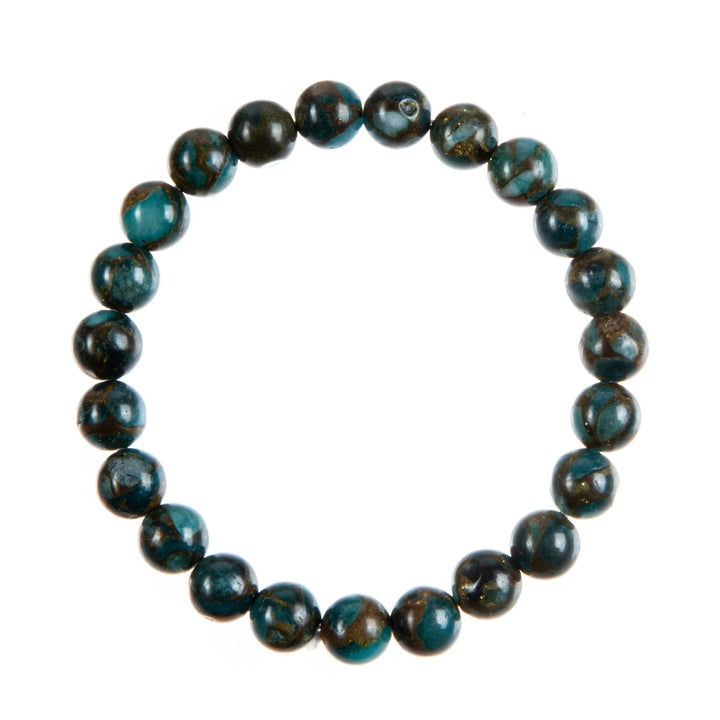
Blue stone with darker veining and mottled brown or white patches. 'Blue cloisonne jasper' and 'Lake Blue variscite' are bead-trade names: the bead is a dyed, soft stone of the impression-jasper group, not a quartz jasper.
What gives it its color
The blue is dye, not natural: beads sold under this name are most often magnesite or howlite, which are white and porous and take dye easily (blue is used to imitate turquoise).
In history
Beads sold under this name are dyed, so the history belongs to the jasper they imitate: green jasper was shaped into bow drills at Mehrgarh in present-day Pakistan in the 4th to 5th millennium BC, and jasper seals were carved on Minoan Crete by about 1800 BC. Roman writer Pliny listed sky-blue jasper from Persia among the kinds traded in his day.
What's said about it
The lore here belongs to natural jasper, which the name borrows from. In crystal lore, blue stones are thought of as calming, and people keep them for quiet moments.
Ancient writers listed sky-blue and deep blue jaspers among the colors of the old stone.
Wear it on the wrist and keep it away from water, perfume and strong sun, which can dull dyed color.
How people wear or keep it: On the wrist, or in a pocket.
In crystal practice
Day to day, the same tradition suggests keeping it close: on the wrist, in a pocket. People reach for it when they want calm, peace, and many set an intention when they put it on. Most practitioners cleanse a new stone first (running water only if the stone can take it, otherwise smoke or moonlight) and set it aside now and then to rest.
These are beliefs people have held and still hold about the stone, reported as such. Nothing here is a promise or a medical claim. We sell stones as jewelry, not for these effects.
Associations
Also calledCloisonne Jasper, Dyed Blue Jasper, Blue Dyed Jasper
Care
- Hardness is about 3.5 to 4, so keep it away from harder stones and rough surfaces to avoid scratches.
- The color is dye: avoid long strong sunlight, heat, and solvents.
- Keep away from water soaks, perfume, hairspray, chlorine, and acids; remove before swimming or washing.
- Wipe with a dry or barely damp soft cloth; no ultrasonic or steam cleaners.
How to tell what you have
- Sold under this name the bead may be a soft pale carbonate or borate stone (magnesite or howlite) dyed blue, or a natural sand-colored impression stone with soft blue splashes; it varies by lot and it is not true jasper.
- Look for very saturated blue, dye pooled at the drill hole, and webbed pale voids where color did not soak in.
- Check weight and hardness: it is light and soft (about 3.5 to 4), so a steel point scratches it, while true jasper does not.
What sets the price
The price follows what the bead actually is in that lot, a soft pale stone such as magnesite or howlite dyed blue, or a natural sand-colored impression stone with blue splashes; beyond that, how deep and even the color is, and the bead size and shape, set the price.
Rules and sourcing
Blue cloisonne or impression jasper is dyed magnesite or howlite, not quartz jasper, and is usually resin-stabilized. A seller should say what the bead actually is under the FTC jewelry guides and disclose dye and resin.
Related stones
Questions people ask at our table
What is blue cloisonne jasper?
It is a trade name for blue stone beads, probably dyed jasper-type silica. Real cloisonne is enamel on metal, so the name refers to the look, not the method.
Is it natural or dyed?
Jasper is only rarely blue in nature, so a strongly blue bead is very likely dyed. This is an inference, not a lab result.
Will the color fade?
Dyed stones can lose color with strong light, heat, solvents and cosmetics, so avoid soaking and harsh chemicals.
Is it lapis or turquoise?
No. It may be sold as an inexpensive blue look-alike, but it is a different material.
Can the exact stone be confirmed?
Not from the name alone. Ask the supplier for the base material.
Our blue cloisonne jasper pieces

Stay in the loop
Sign up to hear about new product drops, upcoming events, and the latest from Peritik. No spam, just the good stuff.