
Sodalite is a deep blue mineral with white veins, often mistaken for lapis lazuli. In crystal lore it is the stone people reach for when they want to speak plainly, write clearly and stay true to themselves.
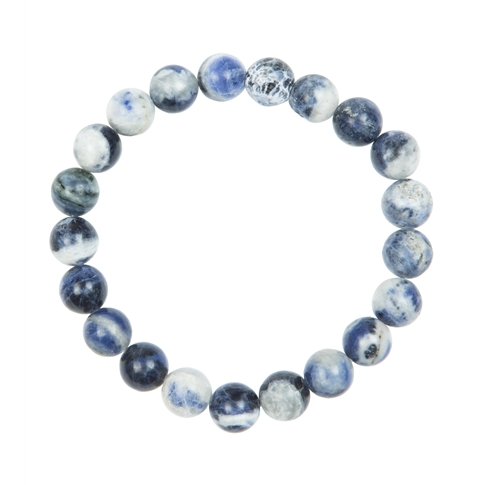
See it as
Feldspathoid
Sodalite
Sodalita
- Palette
- Blue White
- Mined in
- Canada, Brazil, Bolivia, Namibia, Greenland, United States, Afghanistan, Myanmar, India, Norway, Russia, Guinea
- Hardness
- Mohs 5.5–6.0 ?
- See-through
- opaque
- Known since
- 1811
- Named for
- its sodium content
- Intention
- Calm Strength
- Looking for
- Communication Focus and clarity Creativity
- Water
- Keep it dry; wipe with a soft cloth
- Dye or finish
- Sodalite beads are normally sold natural. Heating and irradiation exist, and pale sodalite may be dyed bluer.
In our pieces · 1See the piece ↓
LINUS PAULING
Linus Pauling first studied sodalite's crystal structure in 1930.
HACKMANITE
Hackmanite, a sodalite variety from Afghanistan and Myanmar, starts creamy white, turns violet to pink-red in sunlight, and fades again in the dark.
8 SODIUM ATOMS
Sodalite's formula, Na8(Al6Si6O24)Cl2, holds eight sodium atoms per unit, which is where its name comes from.
What it is
Deep royal blue, usually mottled with white veins or patches. Opaque to translucent with a dull glassy to greasy shine. It is often mistaken for lapis lazuli but is a different mineral with white veining instead of gold pyrite flecks.
What gives it its color
Sodalite's blue comes from tiny sulfur-based clusters trapped in its crystal structure.
Where it comes from
The best-known sodalite comes from Bancroft, Ontario, and Namibia, with more from Brazil, Bolivia, Greenland, and several U.S. states. Mont-Saint-Hilaire in Quebec and Greenland's Ilimaussaq complex are known for hackmanite, a color-changing variety.
In history
Europeans first recorded sodalite in Greenland in 1811, but it stayed a curiosity until fine blue deposits were found near Bancroft, Ontario, in the 1890s, which led to the Princess Sodalite Mine. Long before that, the Caral culture of Peru traded for sodalite from the Andean highlands.
What's said about it
It's thought of as a stone of honest words and trust, and it's traditionally associated with the throat and the brow. It was first described in Greenland in 1811.
People wear it on the wrist or as a necklace, keep it on an office desk to spark ideas, or carry it into a conversation where trust matters. It is fragile, so avoid knocks and soaking.
How people wear or keep it: On the wrist, on a desk, in a pocket, or held in the receiving hand.
In crystal practice
In the crystal tradition, sodalite is paired with the throat and third eye chakras, so practitioners rest it there during meditation or lie down with it in place for a few quiet minutes. Day to day, the same tradition suggests keeping it close: on the wrist, on a desk, in a pocket. People reach for it when they want communication, focus and clarity, creativity, and many set an intention when they put it on. Most practitioners cleanse a new stone first (running water only if the stone can take it, otherwise smoke or moonlight) and set it aside now and then to rest.
These are beliefs people have held and still hold about the stone, reported as such. Nothing here is a promise or a medical claim. We sell stones as jewelry, not for these effects.
Associations
The chakra and star sign this stone is usually matched with. These are popular traditions, not facts about the stone.
ChakraThroat, Third Eye
ZodiacSagittarius, Virgo
ElementAir
Care
- Light, fairly hard but fragile (5.5 to 6); avoid knocks and rubbing against harder stones.
- Clean with a soft damp cloth; avoid soaking and ultrasonic cleaners.
- Avoid acids and strong cleaners that can dull the polish.
How to tell what you have
- Sodalite is deep blue with white veins. Lapis lazuli has gold flecks of pyrite; sodalite does not.
- Sodalite leaves a white streak when scratched, while lapis stays blue.
- It is sensitive to pressure, heat and household cleaners.
What sets the price
Price follows how rich and even the blue is, with solid deep blue the most sought after and pale or mostly white beads worth less; some white sodalite is dyed to look bluer, and bead size matters too.
Related stones
Questions people ask at our table
What is sodalite?
It is a blue feldspathoid mineral named for its sodium content. It forms in igneous rocks such as nepheline syenites.
Is it the same as lapis lazuli?
No. They are different materials; sodalite typically has white veining, while lapis often carries gold pyrite flecks.
Where was it found?
It was first described in 1811 from Greenland. Fine material comes from Bancroft in Ontario and Mont-Saint-Hilaire in Quebec, and it is also found in Brazil and Bolivia.
Is it dyed?
Natural sodalite is already deep blue. We have not verified every supplier, so very uniform bright beads are worth asking about.
How do I care for it?
It is fragile. Avoid knocks, soaking and strong cleaners.
Our sodalite pieces

Stay in the loop
Sign up to hear about new product drops, upcoming events, and the latest from Peritik. No spam, just the good stuff.