
In crystal lore, labradorite is the stone people reach for at a turning point. It's said to steady you while things change, and it's thought of as a constant, quiet shield for whoever wears it.
See it as
Feldspar (plagioclase series) · Plagioclase feldspar
Labradorite
Labradorita
- Palette
- Gray Black Blue Green Multicolor
- Mined in
- Canada, Finland, Madagascar, Russia, Ukraine, India, Australia, Mexico, United States
- Hardness
- Mohs 6.0–6.5 ?
- See-through
- translucent
- Known since
- 1780
- Named for
- Labrador, Canada, where it was first identified
- Also sold as
- Spectrolite (Finnish trade name), Labrador spar, Labradorstein, Rainbow moonstone (trade name for pale labradorite), Labradorite moonstone
- Intention
- Protection New Beginnings
- Looking for
- Protection Change and decisions Confidence and self-worth
- Water
- Keep it dry; wipe with a soft cloth
- Dye or finish
- Bead sellers list labradorite as natural; the flash of color comes from the stone itself.
In our pieces · 1See the piece ↓
128-252 NM
Labradorescence shows when the thin layers inside the feldspar sit between 128 and 252 nanometers apart.
BØGGILD
Ove Balthasar Bøggild coined the term labradorescence, and Lord Rayleigh helped explain the effect in 1923.
SPECTROLITE
Labradorite from Canada or Madagascar flashes mostly blue, grey and green, while Finnish spectrolite can also show pink, orange and purple.
What it is
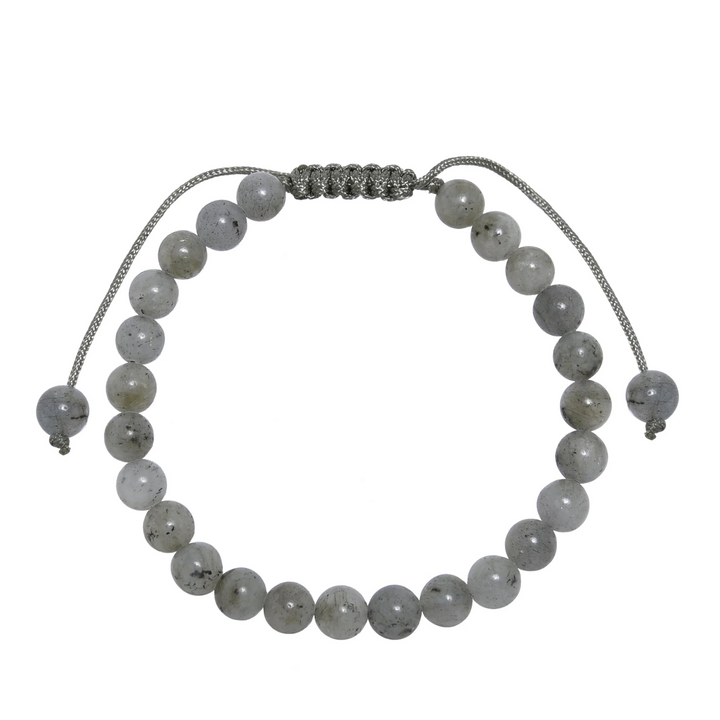
A smoky gray to near-black stone that looks plain until it catches the light, then throws a sheet of electric blue, green or gold across its surface. As a bead or cabochon the flash appears and vanishes as the piece turns, so a strand looks dark one moment and lit from inside the next.
What gives it its color
The blue, green and gold flash is not pigment: very thin alternating layers inside the feldspar bounce light back, so the colors shift as the bead turns (labradorescence). The gray body is the stone itself.
Where it comes from
It is named for Labrador, Canada (Paul Island near Nain), and the best color play comes from Finland (Ylamaa); Madagascar and Russia supply much of the gray-to-black material.
In history
Labradorite's type locality is Paul's Island near Nain, on the Labrador coast of Canada. A second famous source, a Finnish form called spectrolite, was found in 1940 at Ylämaa when Pekka Laitakari came across the deposit while building the Salpa Line fortifications. It was quarried after World War II, and the first workshop cutting it for jewelry opened there in 1973.
What's said about it
People also keep it for intuition, for telling what's real from what isn't, and for trusting their own read of a situation. It looks plain and dark until the light catches it, which is part of why that story fits.
A tale told in Nunatsiavut, on the Labrador coast, says the northern lights were trapped in the rock and the colors left behind became this stone.
People wear it as earrings, a necklace or a bracelet, hold it in a hand, or keep a piece under the pillow for dreams.
How people wear or keep it: On the wrist, as earrings or a necklace, held in either hand, or under the pillow or in a meditation corner.
In crystal practice
In the crystal tradition, labradorite is paired with the third eye chakra, so practitioners rest it there during meditation or lie down with it in place for a few quiet minutes. Day to day, the same tradition suggests keeping it close: on the wrist, as earrings or a necklace, held in either hand. People reach for it when they want protection, change and decisions, confidence and self-worth, and many set an intention when they put it on. Most practitioners cleanse a new stone first (running water only if the stone can take it, otherwise smoke or moonlight) and set it aside now and then to rest.
These are beliefs people have held and still hold about the stone, reported as such. Nothing here is a promise or a medical claim. We sell stones as jewelry, not for these effects.
Associations
The chakra and star sign this stone is usually matched with. These are popular traditions, not facts about the stone.
ChakraThird Eye
ZodiacLeo, Sagittarius, Scorpio
ElementAir
Also calledSpectrolite (Finnish trade name), Labrador spar, Labradorstein
Care
- Labradorite has two directions of perfect cleavage, so a sharp knock can split it. Take it off before sports, housework or anything hands-on.
- At 6 to 6.5 on the Mohs scale it scratches more easily than quartz or sapphire. Store it apart from harder stones and metal chains.
- Clean with lukewarm water, a drop of mild soap and a soft cloth. Skip ultrasonic and steam cleaners.
- Avoid sudden temperature swings, such as hot water straight after a cold day; feldspars can crack from thermal shock.
- Light does not dull the flash, and the stone is not porous, so ordinary wear and daily light exposure are fine.
How to tell what you have
- Real labradorite shows flashes of blue, green or gold from inside the stone that appear and vanish as you turn it, on a natural-looking gray base.
- Coated glass or plastic can imitate the flash but lacks its depth and shifting color, and the color sits on the surface.
- It is a feldspar of about 6 to 6.5 hardness with fine cracks, so it can chip.
What sets the price
Price follows how strong and broad the flash of color is and how much of each bead shows it; blue and green are the usual flashes, while gold, orange, red or purple flash and fine material from certain localities cost more. Bead size and polish matter too, and coated glass can fake the flash.
Related stones
Moonstone · in our piecesRainbow moonstoneSpectroliteSunstone · not carriedAmazonite · in our piecesLarvikite
Questions people ask at our table
What makes labradorite flash?
The color play, called labradorescence, is not on the surface. As the stone cooled slowly inside the earth it separated into microscopically thin layers, and light bouncing between those layers interferes to produce blue, green, gold or occasionally purple. Because the effect depends on the angle of the light, it switches on and off as you tilt the bead.
Is labradorite the same as moonstone?
No, though they are cousins. Both are feldspars, but moonstone is a potassium feldspar with a soft white glow, while labradorite is a calcium-sodium plagioclase with bolder colored flashes. The pale stone sold as 'rainbow moonstone' is actually a light-colored labradorite, which is why it shows blue and rainbow flashes rather than a pure white sheen.
Will the color fade over time?
The flash is built into the stone's crystal structure, not applied as a coating or dye, so it does not fade in light or with wear. What can dull a piece is surface scratching or a crack from a hard knock, so the usual care is about avoiding impact rather than protecting the color.
How can I tell real labradorite from glass?
Natural labradorite shows its color only from certain angles and in patches that follow the stone's internal layering; turn it and the flash appears and disappears. Glass imitations such as opalite glow evenly from every angle and often contain tiny round bubbles. Real stones also tend to have a dark gray body with small natural fractures or inclusions rather than a perfectly uniform look.
Where is labradorite mined?
It takes its name from the coast of Labrador in Canada, where it was first described in the 1770s. Most beads today come from Madagascar, with Finland known for the intense material branded as spectrolite and Russia and Ukraine also producing darker stone. Smaller amounts come from India, Australia, Mexico and the United States, where transparent Oregon material is sold as sunstone.
Our labradorite pieces

Stay in the loop
Sign up to hear about new product drops, upcoming events, and the latest from Peritik. No spam, just the good stuff.