
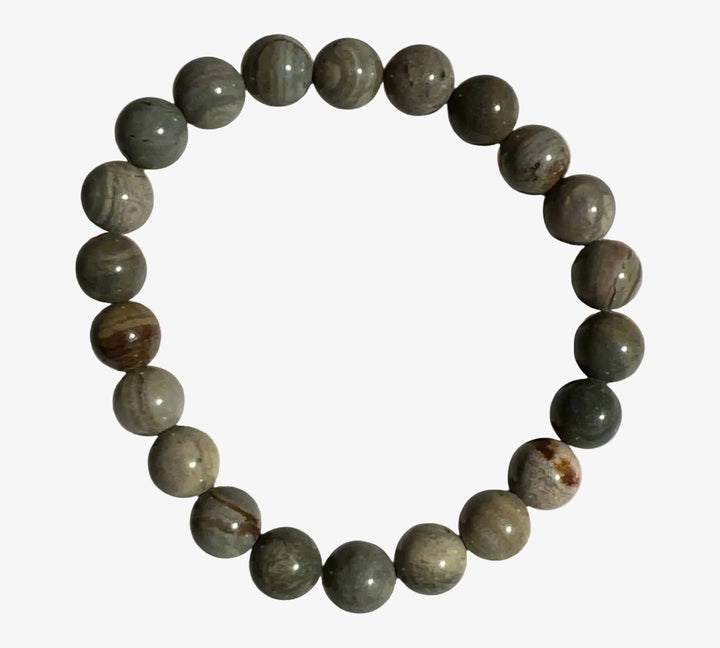
Silverleaf jasper is a bead-trade name, and no source we found settles what rock it is. It may be a rhyolite-type stone sold as jasper. What is certain is the look: swirling gray, black and cream bands.
See it as
Jasper (opaque chalcedony, quartz group), trade name · Jasper (chalcedony, quartz)
Silverleaf Jasper
Jaspe hoja de plata
- Palette
- Gray Black Brown
- Mined in
- Africa, Russia
- Hardness
- Mohs 6.5–7.0 ?
- See-through
- opaque
- Known since
- Prehistoric
- Named for
- its silvery, leaf-like banding
- Also sold as
- Silver Leaf Jasper, Black Silver Leaf Jasper, red silver leaf
- Intention
- Strength Calm
- Looking for
- Grounding Willpower Calm
- Water
- Fine with water and mild soap
- Dye or finish
- Silver leaf jasper beads are sold natural, with no dye or coating stated.
In our pieces · 1See the piece ↓
PURPLE FIRST
Ancient Roman collectors ranked purple jasper best, then rose, then emerald-green.
SPHRAGIDES
The Greeks called jaspers sphragides, meaning signets, because they were excellent for sealing documents.
6.5 TO 7
Jasper rates 6.5 to 7 on the Mohs scale, nearly as hard as quartz, which defines 7.
What it is
Gray, black and cream stone in soft swirling bands that look like leaf or bark patterns, sometimes with reddish tones. Silver leaf is a bead-trade name for a jasper, an opaque form of chalcedony.
Where it comes from
Large deposits are reported in Africa and Russia, and it is also found in India, France, Germany and the United States.
In history
Jasper was carved into seals on Minoan Crete by about 1800 BC, and a male torso in red jasper was found at Harappa in the Indus Valley. Jasper stayed in fashion for centuries: an early 17th-century German jewel-set vase carved from jasper is in the British Museum.
What's said about it
In crystal lore, silverleaf jasper is associated with balance, stability and strength of purpose. People keep it when they want to feel grounded.
Jasper has a long history as an amulet stone. Ancient writers describe eastern peoples wearing it, and older gem lore held it to be a rain-bringer.
It is hard enough for daily wear on the wrist.
How people wear or keep it: On the wrist, or in a pocket.
In crystal practice
Day to day, the same tradition suggests keeping it close: on the wrist, in a pocket. People reach for it when they want grounding, willpower, calm, and many set an intention when they put it on. Most practitioners cleanse a new stone first (running water only if the stone can take it, otherwise smoke or moonlight) and set it aside now and then to rest.
These are beliefs people have held and still hold about the stone, reported as such. Nothing here is a promise or a medical claim. We sell stones as jewelry, not for these effects.
Associations
BirthstoneMarch
Also calledSilver Leaf Jasper, Black Silver Leaf Jasper, red silver leaf
Care
- Hardness is about 6.5 to 7, suitable for everyday wear with ordinary care.
- Clean with warm soapy water and a soft cloth or brush, then dry the stone and the setting completely.
- Avoid ultrasonic cleaners and strong chemicals.
- Store apart from harder gemstones to avoid scratches.
How to tell what you have
- Silver leaf jasper is an opaque, fine-grained quartz-family stone with swirls of gray, black and cream.
- It is hard (6.5 to 7), so a steel point does not scratch it; a very soft, chalky or crumbly bead is something else.
- Trade jasper names are loose, so ask the seller for the material if it matters.
What sets the price
Strands cost more when the gray, black and cream swirls are clear and well contrasted, and when the beads are larger; the pattern runs in lines and bands that set it apart from most jasper, and the supply can be limited.
Related stones
Questions people ask at our table
What is silverleaf jasper?
It is a trade name for gray, black and cream swirl-patterned stone. One retailer describes it as an opaque chalcedony in the quartz group, but I found no mineralogical source defining it.
Is it natural or dyed?
Retailers list it as natural. Because the name is loose, ask the supplier if you need certainty.
Is it a true jasper?
Unconfirmed. Some stones sold as jasper are actually other rocks, and silverleaf's classification is not settled in the sources I read.
Where does it come from?
One retailer cites large deposits in Africa and Russia, with smaller finds in India, France, Germany and the U.S. This is a single retail source, not a survey.
How hard is it?
The same retailer gives a Mohs hardness of about 6.5 to 7, suitable for everyday jewelry.
Our silverleaf jasper pieces

Stay in the loop
Sign up to hear about new product drops, upcoming events, and the latest from Peritik. No spam, just the good stuff.