
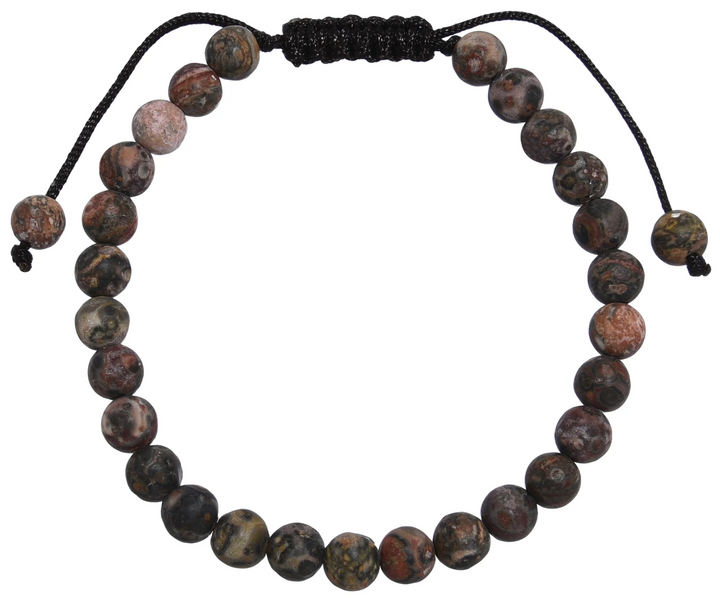
Red leopard, often sold as leopardskin jasper, is really an orbicular rhyolite, a volcanic rock. Its round spots and rings on a brown-to-red ground give it the pelt look.
See it as
Rock (silica-rich volcanic, rhyolite) · Orbicular rhyolite (sold as jasper)
Red Leopard
Jaspe piel de leopardo rojo
- Palette
- Red Brown Orange Gray
- Mined in
- Mexico, Brazil, United States
- Hardness
- Mohs 6.0–7.0 ?
- See-through
- opaque
- Known since
- 1860
- Named for
- its round spots and rings, like a leopard's spotted coat
- Also sold as
- Red Leopard Skin Jasper, Red Leopard, Red Leopardskin Jasper, Leopard Skin Rhyolite, Leopardskin Jasper
- Intention
- Strength Protection
- Looking for
- Protection Grounding Courage
- Water
- Keep it dry; wipe with a soft cloth
- Dye or finish
- Red leopard (leopardskin) beads are usually sold natural; the spots are the stone's own pattern, not applied on top.
In our pieces · 1See the piece ↓
800-1,000 °C
Rhyolite lava erupts at a relatively cool 800 to 1,000 degrees Celsius.
77.8% SILICA
Rhyolite is the most silica-rich of volcanic rocks, with some types reaching 75 to 77.8 percent silica.
What it is
Light brown to deep red stone covered in round spots and rings, reminiscent of a big-cat pelt. Despite the 'jasper' label, leopardskin is an orbicular rhyolite, a silica-rich volcanic rock; the name is a trade label.
What gives it its color
Leopardskin is a silica-rich volcanic rock (rhyolite) whose round spots formed as minerals spread outward from a center; the reds and browns in jasper-type stones come mainly from iron oxide.
Where it comes from
Leopardskin jasper is found in Mexico, Brazil, and the US states of Oregon and Idaho.
What's said about it
We found no settled crystal lore for this stone. People mostly keep it for the pattern, and as a close cousin of red jasper, which is thought of as warm and steadying.
In ancient Egypt, red jasper was used freely for amulets, including the tie amulet. Ancient writers also say jasper was worn as an amulet in the east.
It suits the wrist for everyday wear, with care around hard knocks.
How people wear or keep it: On the wrist, or in a pocket.
In crystal practice
In the crystal tradition, red leopard is paired with the root chakra, so practitioners rest it there during meditation or lie down with it in place for a few quiet minutes. Day to day, the same tradition suggests keeping it close: on the wrist, in a pocket. People reach for it when they want protection, grounding, courage, and many set an intention when they put it on. Most practitioners cleanse a new stone first (running water only if the stone can take it, otherwise smoke or moonlight) and set it aside now and then to rest.
These are beliefs people have held and still hold about the stone, reported as such. Nothing here is a promise or a medical claim. We sell stones as jewelry, not for these effects.
Associations
The chakra and star sign this stone is usually matched with. These are popular traditions, not facts about the stone.
ChakraRoot
ZodiacSagittarius
ElementEarth
Also calledRed Leopard Skin Jasper, Red Leopard, Red Leopardskin Jasper
Care
- Hardness is around 6 to 7; suitable for regular wear with care.
- Wipe with a soft damp cloth and mild soap; dry well.
- Avoid ultrasonic cleaners and sudden temperature changes.
- Keep away from hard knocks and from harder gemstones in storage.
How to tell what you have
- Sold as a jasper, leopardskin is a spotted rock with a round-ring pattern; the name is a trade label and the mix varies by lot.
- The spots run through the stone, so the pattern shows at the drill hole too, and colors are earth tones from tawny to red-brown.
- Very bright red or spots that are only on the surface would suggest dye or a coating; ask the seller.
What sets the price
Price follows how clear and well-defined the spot pattern and warm color are and bead size; because the name is a trade label, lots can be different rocks, and bright or surface-only color would point to dye or a coating.
Related stones
Questions people ask at our table
What is red leopard skin jasper?
It is an orbicular rhyolite, a volcanic rock with round markings, sold under a jasper name; 'jasper' here is a trade label.
Is it natural or dyed?
The pattern is native to the rock. I did not find a source on dyeing, so ask the supplier if you need certainty.
Where is it mined?
Stonemania cites Chihuahua in northwest Mexico. Other sources suggest additional localities, which I did not verify.
How do I tell it from other red stones?
Leopardskin shows round spots and rings on a brown-to-red ground. Plain red jasper lacks the orbicular pattern.
Does it fade?
Natural color is stable under ordinary wear, though harsh chemicals and extended heat are best avoided.
Our red leopard pieces

Stay in the loop
Sign up to hear about new product drops, upcoming events, and the latest from Peritik. No spam, just the good stuff.