
Atlas jasper is a bead-trade name, and we have not confirmed the exact material or whether it is dyed. Matte means a frosted finish instead of a glossy polish.
See it as
Fine-grained siltstone / impure silica (Atlas Mountains, Morocco), sold as jasper; bead unconfirmed
Matte Atlas Jasper
Jaspe Atlas Mate
- Palette
- Brown Gray Multicolor
- Mined in
- Morocco
- Hardness
- Mohs 6.0–7.0 ?
- See-through
- opaque
- Known since
- no formal date (bead-trade name)
- Named for
- a frosted (matte) finish, with 'Atlas' probably echoing the Atlas Mountains of North Africa (inference)
- Also sold as
- Atlas Jasper, Atlas Mountain Jasper, High Atlas jasper
- Intention
- Protection Strength
- Looking for
- Grounding Protection Courage
- Water
- Keep it dry; wipe with a soft cloth
- Dye or finish
- No page we read says what is done to these beads. The matte look is usually a frosted surface, and bright, even color in a jasper-named bead is a reason to ask about dye.
In our pieces · 1See the piece ↓
4,167 METERS
Morocco's Atlas range, the likely namesake of this stone, peaks at Toubkal, 4,167 meters (13,671 feet) high.
What it is
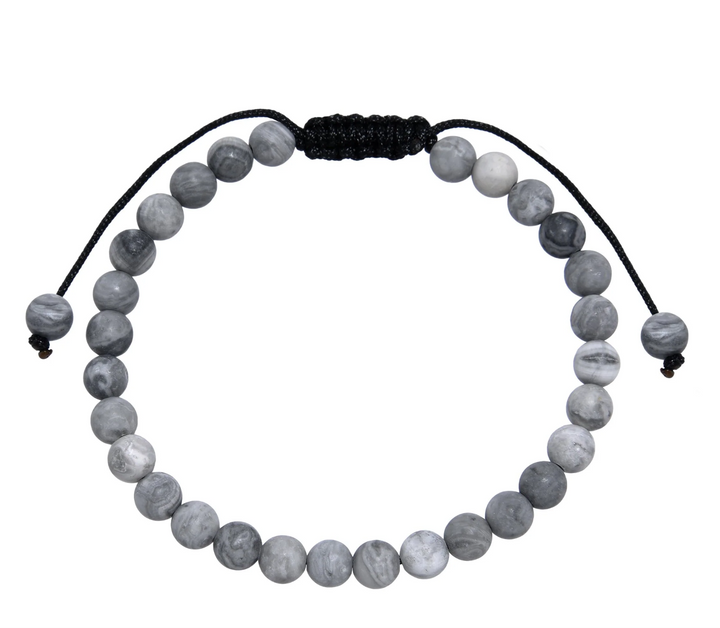
Earth-toned beads in brown, rust and gray with a frosted, non-glossy finish. 'Atlas jasper' is a trade name; stones sold under it are usually a Moroccan rock that is not strictly a true jasper.
What gives it its color
The Moroccan Atlas stone sold under this name is a fine-grained, silica-rich rock whose brown and red markings come from veins and filaments of iron compounds.
Where it comes from
The stone sold as Atlas jasper comes from the Atlas Mountains of Morocco, a range that also runs through Algeria and Tunisia.
What's said about it
In crystal lore, jasper is thought of as a steadying stone. People keep this kind for grounding and for quiet strength.
Older gem lore says jasper was worn as an amulet in many lands. That belongs to true jasper, not to this trade name.
People wear it on the wrist or keep one in a pocket.
How people wear or keep it: On the wrist, in a pocket, or on a desk.
In crystal practice
Day to day, the same tradition suggests keeping it close: on the wrist, in a pocket, on a desk. People reach for it when they want grounding, protection, courage, and many set an intention when they put it on. Most practitioners cleanse a new stone first (running water only if the stone can take it, otherwise smoke or moonlight) and set it aside now and then to rest.
These are beliefs people have held and still hold about the stone, reported as such. Nothing here is a promise or a medical claim. We sell stones as jewelry, not for these effects.
Associations
Also calledAtlas Jasper, Atlas Mountain Jasper, High Atlas jasper
Care
- Wipe with a soft damp cloth and dry; the matte surface holds oils and dust.
- Do not use polishing cloths, which can shine a frosted finish unevenly.
- Avoid soaking and harsh chemicals until the finish and any dye or coating are confirmed.
- Store apart from harder stones to avoid scratches.
How to tell what you have
- Sold under this name the bead may be a Moroccan Atlas Mountains stone, which one seller calls a fine-grained, very hard siltstone and not a true jasper, or an ordinary brown-red jasper; it varies by lot.
- The Atlas stone shows brown and red veins and threads of iron compounds.
- A steel point should not scratch quartz-type jasper; if it does, the bead is softer stone. Unnaturally bright color is a dye warning.
What sets the price
The price follows what the bead actually is in that lot (a Moroccan Atlas Mountains stone that one seller calls a very hard siltstone rather than true jasper, or an ordinary brown-red jasper) and the usual bead factors: the brown and red vein pattern, evenness of color, bead size, and the frosted finish.
Rules and sourcing
Atlas jasper is a fine-grained siltstone from Morocco sold under the name jasper, not a confirmed quartz jasper. Under the FTC jewelry guides a seller should say what the bead actually is, and bright even color may be dye.
Related stones
Questions people ask at our table
What is Atlas jasper?
It is a bead-trade name. A few cabochon sellers list an 'Atlas Mountain' jasper, but we found no geological reference defining it, so the exact material is unconfirmed.
What does matte mean?
The beads are given a frosted finish instead of a glossy polish. It changes the surface only, not the stone.
Is it natural or dyed?
We could not verify this. Consider it unconfirmed until the supplier states it.
Where is it from?
One seller lists South Africa for an Atlas Mountain cabochon, which is a seller claim only. We do not state an origin.
Our matte atlas jasper pieces

Stay in the loop
Sign up to hear about new product drops, upcoming events, and the latest from Peritik. No spam, just the good stuff.