
Muddy jasper is a bead-trade label, not a recognized mineral name. We think it is a jasper-type stone, but we have not confirmed what it is or whether it is dyed.
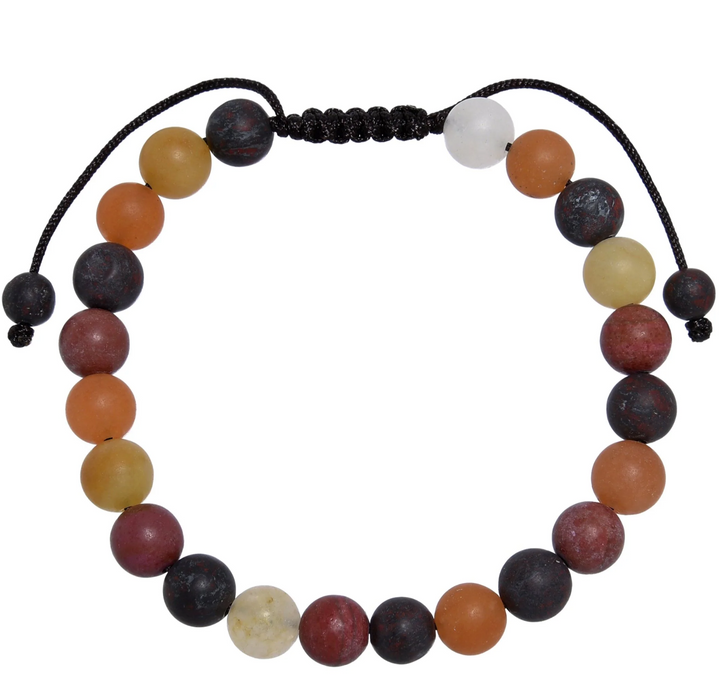
See it as
Muddy Jasper
Jaspe Barroso
- Palette
- Brown Gray Green
- Mined in
- Africa, Australia, India, Madagascar, Mexico
- Hardness
- Mohs 6.0–7.0 ?
- See-through
- opaque
- Known since
- no formal date (bead-trade name)
- Named for
- its mud-toned brown and gray-green color
- Intention
- Protection Calm
- Looking for
- Grounding Courage Protection
- Water
- Keep it dry; wipe with a soft cloth
- Dye or finish
- No page we read states what is done to these beads. Jasper is often sealed with oil or wax, and bright colors can be dyed, though earth tones are less likely to be.
In our pieces · 2See the 2 pieces ↓
YASHUM
The Persian word for jasper is yashum, and the Greek iaspis likely came from an Afroasiatic language, like Hebrew yashpeh.
CAPNIAS
Roman writers named a smoky jasper capnias, which they compared to Megarian salt.
SPHRAGIDES
Roman writers called plain jasper varieties sphragides, 'signets', because they were good for sealing documents.
What it is
Earthy caramel-brown to gray-green stone with soft mottling. 'Muddy jasper' is a descriptive trade name, not a mineral name; we have not confirmed the exact stone.
What gives it its color
If these beads are jasper, as the name suggests, the earthy browns and grays come from iron oxides and other minerals trapped in the silica; the exact stone is unconfirmed.
In history
Jasper, the kind of stone these brown beads are sold as, is among the oldest worked stones: green jasper was shaped into bow drills at Mehrgarh by the 4th to 5th millennium BC, and Minoan carvers cut it into seals around 1800 BC at Knossos. A Roman naturalist wrote of a smoky jasper figure of Nero in a breastplate, 16 inches high, that he had seen himself.
What's said about it
In crystal lore, jasper is called the supreme nurturer. It's said to bring stability, ground you, and lend courage and determination when things feel shaky.
Older gem lore says jasper was worn as an amulet in many lands, and some hold it guards the sleeper's dreams. That belongs to true jasper, not to this trade name.
People wear it as a bracelet, keep it in a pocket, or set it by the bed.
How people wear or keep it: On the wrist, in a pocket, by the bed, or held in either hand.
In crystal practice
Day to day, the same tradition suggests keeping it close: on the wrist, in a pocket, by the bed. People reach for it when they want grounding, courage, protection, and many set an intention when they put it on. Most practitioners cleanse a new stone first (running water only if the stone can take it, otherwise smoke or moonlight) and set it aside now and then to rest.
These are beliefs people have held and still hold about the stone, reported as such. Nothing here is a promise or a medical claim. We sell stones as jewelry, not for these effects.
Care
- Wipe with a soft damp cloth and dry; do not soak.
- Avoid harsh chemicals, solvents and ultrasonic cleaners in case of a wax, oil or dye finish.
- Keep from hard knocks.
- Store apart from harder stones.
How to tell what you have
- Muddy Jasper is a descriptive trade name for a caramel-brown to gray-green mottled bead; it may be a jasper-type quartz or another fine-grained rock, and it varies by lot.
- Some stones sold as jasper are rhyolite, an igneous rock with spherulitic round spots.
- A steel point should not scratch real jasper (6.5 to 7). A damp cloth that picks up shine or wax suggests a sealer.
What sets the price
This is a descriptive trade name, so the price follows what the bead actually is in that lot (the row lists a jasper-type quartz or another fine-grained rock) and the usual bead factors: color and pattern, bead size, roundness and polish, and whether it is natural color or sealed or dyed.
Rules and sourcing
Muddy jasper is a trade name for beads presumed to be jasper, and jasper is often sealed with oil or wax. A seller should say what the bead actually is under the FTC jewelry guides and disclose a seal or dye.
Related stones
Mookaite jasperRed creek jasperPicture jasper
Questions people ask at our table
What is muddy jasper?
It is a descriptive bead-trade name for an earth-brown jasper-type stone. We could not find a published definition, so the exact material is unconfirmed.
Is muddy jasper natural or dyed?
We could not verify this. Many jasper beads are natural color, but some are dyed, so consider it unconfirmed until the supplier says.
Is it a real jasper?
Probably, but the bead trade also sells other rocks under jasper names. We have not tested it.
How do I care for it?
Clean with a soft damp cloth and dry. Avoid harsh chemicals and soaking until the material is confirmed.


Stay in the loop
Sign up to hear about new product drops, upcoming events, and the latest from Peritik. No spam, just the good stuff.