
Green onyx is usually chalcedony dyed green and sold under the loose trade name onyx. Some beads sold under the name are banded calcite instead, which is much softer. Bright green is rarely natural in chalcedony.
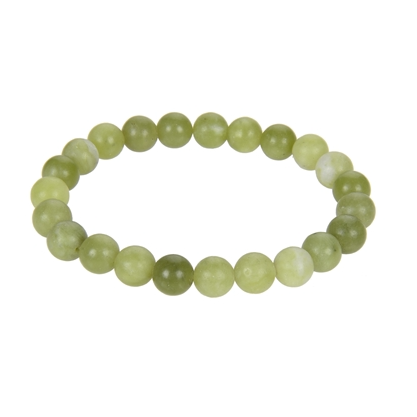
See it as
Quartz (chalcedony), or calcite when sold as onyx marble · Chalcedony
Green Onyx
Ónix verde
- Palette
- Green
- Mined in
- Brazil, Uruguay, India, Madagascar, Argentina, Mexico
- Hardness
- Mohs 7.0 ?
- See-through
- opaque
- Known since
- Prehistoric
- Named for
- Greek ónyx, meaning claw or fingernail
- Also sold as
- green agate, dyed green chalcedony, green onyx marble, dyed green calcite
- Intention
- Protection
- Looking for
- Protection Grounding
- Water
- Keep it dry; wipe with a soft cloth
- Dye or finish
- The green in green onyx is usually dye. Bright green is rarely natural in chalcedony.
In our pieces · 1See the piece ↓
7.5 × 9 INCHES
The Roman cameo Gemma Augustea is cut from a two-layer onyx about 7.5 inches tall and 9 inches wide.
12,000 DUCATS
The onyx cameo Gemma Augustea, once held in a Toulouse abbey treasury, was later sold to Emperor Rudolph II for 12,000 ducats.
VILLA TUGENDHAT
Architect Mies van der Rohe built a semi-translucent wall of onyx slabs from the Atlas Mountains into a Brno villa finished in 1930.
What it is
Even, saturated green, opaque to slightly translucent. Bright green is rarely natural in chalcedony, so green onyx beads are normally chalcedony dyed green; some sold under the name are instead banded calcite, a softer and different material.
What gives it its color
Green is rare as a natural color in banded chalcedony (the nickel in chrysoprase and chromium compounds can make it), so most green onyx beads are dyed; some green 'onyx' is actually banded calcite.
Where it comes from
Brazil is the best-known source of green onyx; onyx in general comes from Brazil, Uruguay, Argentina, India and Madagascar, and banded calcite sold as onyx comes from Mexico and India.
In history
Onyx, the banded stone this one borrows its name from, was carved into bowls in Egypt as early as the Second Dynasty and cut into the Gemma Augustea, a Roman cameo made about AD 10-20 that is now in Vienna. Green onyx from Brazil became a common base for Art Deco sculptures in the 1920s and 1930s.
What's said about it
It has no tradition of its own. The lore people repeat belongs to onyx in general: in crystal lore, onyx is the stone kept for protection, grounding and staying centered.
Older writers also said banded onyx stirred up quarrels, but that was about black-and-white onyx, not dyed green beads.
Lore says to wear onyx as a bracelet, hold it, carry it in a pocket, or keep it in a room or meditation space.
How people wear or keep it: On the wrist, in a pocket, or in a room or meditation space.
In crystal practice
In the crystal tradition, green onyx is paired with the heart chakra, so practitioners rest it there during meditation or lie down with it in place for a few quiet minutes. Day to day, the same tradition suggests keeping it close: on the wrist, in a pocket, in a room or meditation space. People reach for it when they want protection, grounding, and many set an intention when they put it on. Most practitioners cleanse a new stone first (running water only if the stone can take it, otherwise smoke or moonlight) and set it aside now and then to rest.
These are beliefs people have held and still hold about the stone, reported as such. Nothing here is a promise or a medical claim. We sell stones as jewelry, not for these effects.
Associations
The chakra and star sign this stone is usually matched with. These are popular traditions, not facts about the stone.
ChakraHeart
ZodiacGemini, Virgo
ElementEarth
Also calledgreen agate, dyed green chalcedony, green onyx marble
Care
- Wipe with a soft damp cloth and dry at once; do not soak.
- Keep away from strong sunlight, which can dull dyed stones.
- If a strand is calcite (onyx marble, much softer than quartz), keep it away from acids such as vinegar and from knocks.
- Store apart from harder stones to prevent scratches.
How to tell what you have
- A bead sold as green onyx may be dyed chalcedony or banded calcite (onyx marble); it varies by lot.
- Calcite is soft: a copper coin scratches it, and it fizzes in vinegar. Chalcedony does not. Test a spare bead.
- Color pooled in the drill hole, or heavy and even green, points to dye.
What sets the price
The price follows what the bead really is, dyed green chalcedony or banded calcite (softer and more common), and then how even the green is and the bead size, roundness and polish.
Rules and sourcing
The green in green onyx is usually dye, because bright green is rarely natural in chalcedony. The FTC jewelry guides call for a seller to disclose it.
Related stones
Questions people ask at our table
What is green onyx really?
It is usually chalcedony dyed green and sold under the loose trade name 'onyx'. It can also be banded calcite sold under the same name.
Is green onyx natural or dyed?
The base stone is natural, but bright green is rarely natural in chalcedony, so the color is typically artificial. Natural green chalcedony exists as chrysoprase, which is nickel-colored, more opaque and often milky.
How can I tell chalcedony from calcite?
Quartz scratches glass and steel, while calcite is much softer and fizzes in dilute acid such as vinegar. Onyx has even parallel banding, whereas calcite is marbled with varied layers and a waxy sheen.
Will the green color fade?
Dyed color can dull with long strong sunlight, so keep beads out of direct sun.
Our green onyx pieces

Stay in the loop
Sign up to hear about new product drops, upcoming events, and the latest from Peritik. No spam, just the good stuff.