
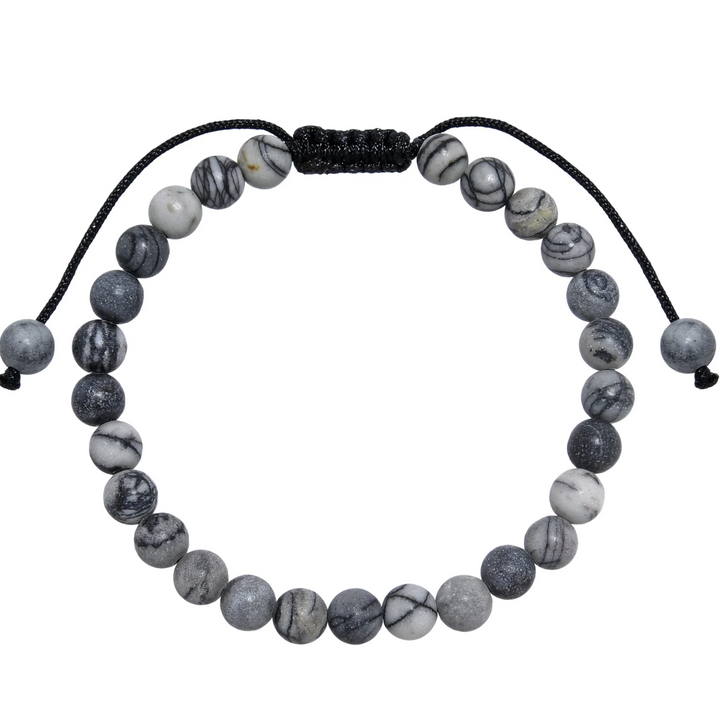
Network or net stone is a bead-trade name, not a recognized mineral. It is usually sold as jasper, though one supplier lists it as marble, so the exact rock is unconfirmed. Handle it gently until we know.
See it as
Black Network
Piedra red negra
- Palette
- Black Gray
- Mined in
- China
- Hardness
- Mohs 3.5–7.0 ?
- See-through
- opaque
- Known since
- no formal date (bead-trade name)
- Named for
- the net-like pattern of fine lines across its dark surface
- Also sold as
- Black Network Stone, black net stone, black netstone, black silk stone, black web jasper, map stone, net jasper, netstone, mesh jasper
- Intention
- Calm Strength
- Looking for
- Grounding Calm Willpower
- Water
- Keep it dry; wipe with a soft cloth
- Dye or finish
- Beads sold as black network are listed natural and undyed by the seller read, but the material is not settled.
In our pieces · 1See the piece ↓
12.7 TO 38 MM
If these beads are marble, light sinks 12.7 to 38 millimeters into the calcite before scattering, which gives marble its waxy glow.
SPECKLED STONE
If the beads are jasper instead, the name itself means spotted or speckled stone.
What it is
Gray to black bead crossed by a fine net-like pattern, often with a frosted finish. 'Network' or 'net stone' is a bead-trade name, not a mineral name; it is sold both as jasper and as marble, and the exact rock is not confirmed.
What gives it its color
The dark net pattern in this stone is not settled, because the material is not: if it is marble, veining comes from impurities in the original limestone such as clay, iron oxides or chert; if it is jasper, color comes from the minerals in the original sediment, with iron giving reds.
What's said about it
Because it is sold as jasper, it borrows jasper's lore. In crystal lore, jasper is traditionally associated with stability and grounding, strength and calm.
In ancient Rome, jasper was valued as a seal stone for marking documents.
Jasper lore says to wear it as jewelry, hold it in either hand, or carry it in a pocket.
How people wear or keep it: On the wrist, in a pocket, or held in either hand.
In crystal practice
Day to day, the same tradition suggests keeping it close: on the wrist, in a pocket, held in either hand. People reach for it when they want grounding, calm, willpower, and many set an intention when they put it on. Most practitioners cleanse a new stone first (running water only if the stone can take it, otherwise smoke or moonlight) and set it aside now and then to rest.
These are beliefs people have held and still hold about the stone, reported as such. Nothing here is a promise or a medical claim. We sell stones as jewelry, not for these effects.
Associations
Also calledBlack Network Stone, black net stone, black netstone
Care
- Wipe with a soft damp cloth and dry it; do not soak.
- Keep away from acids, including vinegar, lemon, and perfume, which can etch carbonate rock.
- Handle gently and avoid knocks and hard surfaces until the material is confirmed.
- Skip ultrasonic and steam cleaners.
How to tell what you have
- Sold as net jasper, netstone or map stone, a bead under this name may be marble (a soft carbonate) or a jasper; it varies by lot.
- Look for a gray ground with a black net pattern; the pattern does not settle which it is.
- Check a spare bead: marble is soft (a copper coin scratches it) and fizzes in vinegar, while jasper does neither.
What sets the price
The price follows what the beads actually are in that lot, a banded marble or a jasper-type stone, and then the usual bead factors: how crisp the black net stands out on the gray, bead size and roundness, and how even the polish and drilling are.
Rules and sourcing
Black network is a trade name for net-patterned beads sold as jasper that may be marble. Under the FTC jewelry guides a seller should say what the bead actually is.
Related stones
Red Network · in our piecesBlack Onyx · in our piecesPicture jasperBlack sea sediment jasperSilver Obsidian · in our pieces
Questions people ask at our table
What is black network stone?
It is a bead-trade name for a gray-and-black stone with a net-like pattern. It is usually labelled jasper, one supplier lists it as marble, and we found no gemological reference confirming either, so the exact rock is unverified.
Is it natural or dyed?
One supplier states the gray bead is untreated and undyed. That is a seller claim, not a laboratory finding.
Why is it called network stone?
The name describes the fine net or mesh pattern running through the bead. It is a trade label, not a mineral name.
Where is it from?
One supplier gives China as the origin; no mine is documented in the sources we found.
How should I care for it?
Wipe gently, keep it dry and away from acids and hard knocks. Handle it as a softer stone until the material is confirmed.
Our black network pieces

Stay in the loop
Sign up to hear about new product drops, upcoming events, and the latest from Peritik. No spam, just the good stuff.