
Silver obsidian is natural volcanic glass, not a crystal. The silvery sheen flashes inside the glass as the bead turns. It is brittle, about 5 to 5.5 on the Mohs scale, so it chips if dropped.
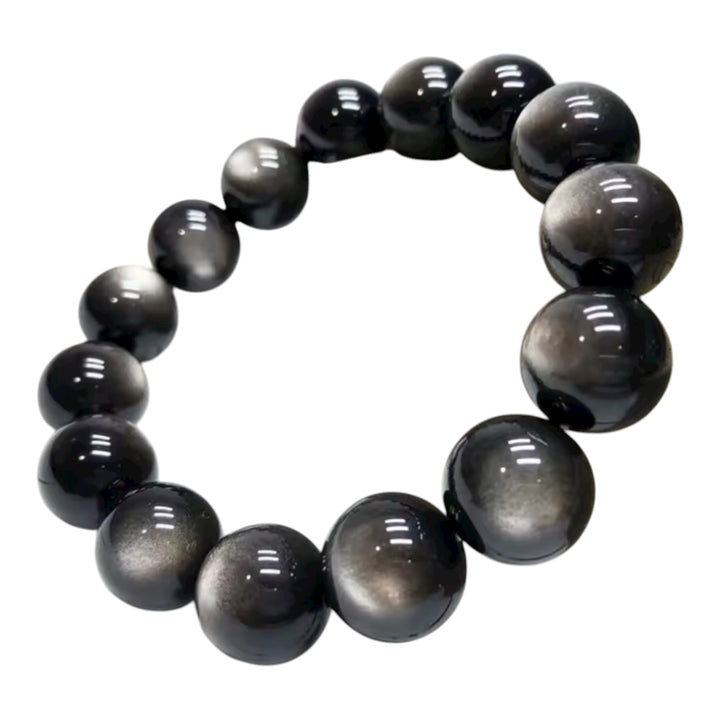
See it as
Volcanic glass (mineraloid) · Obsidian
Silver Obsidian
Obsidiana plateada
- Palette
- Black Gray
- Mined in
- Mexico, United States, Italy, Greece, Turkey
- Hardness
- Mohs 5.0–5.5 ?
- See-through
- opaque
- Known since
- Prehistoric
- Named for
- Obsidius, a Roman explorer; silver for its sheen
- Also sold as
- silver sheen obsidian, Mexican silver obsidian, silvery obsidian
- Intention
- Protection Strength
- Looking for
- Protection Grounding Clearing negativity Courage
- Water
- Keep it dry; wipe with a soft cloth
- Dye or finish
- Silver sheen obsidian is natural volcanic glass and is sold untreated. The silver flash comes from tiny gas bubbles inside the glass.
In our pieces · 1See the piece ↓
3 NANOMETERS
A well-made obsidian blade has a cutting edge only about three nanometers thick, sharper than a steel surgical scalpel.
10.23 KG
Tutankhamun's gold funeral mask weighs about 10.23 kilograms, and its quartz eyes have obsidian pupils.
700,000 BC
The earliest known archaeological evidence of obsidian use comes from Kariandusi in Kenya, dated to about 700,000 BC.
What it is
Glossy black volcanic glass with a silvery sheen that flashes as the bead turns. It is natural obsidian, a glass and not a crystal; the sheen comes from tiny stretched gas bubbles or oriented inclusions.
What gives it its color
Obsidian is black from a trace of iron and other metals in the volcanic glass, and the silver flash comes from tiny gas bubbles and mineral specks lined up in layers that reflect light.
Where it comes from
Mexico is a named source of obsidian, along with Oregon, California and other western U.S. volcanic areas, the Mediterranean islands and Turkey.
In history
Obsidian is one of humanity's oldest tool stones: Anatolian obsidian was traded into the Levant from about 12,500 BC, and the Aztecs cut it into polished mirrors and into the blades of the macuahuitl, a wooden sword. On Easter Island it formed the eyes of the moai statues, and obsidian also forms the pupils of Tutankhamun's gold funeral mask.
What's said about it
In crystal lore, obsidian is the stone people reach for protection and grounding. It's said to absorb negativity, bring hidden feelings to the surface, and give a sense of emotional protection and strength.
The ancient Mexicans polished obsidian into mirrors, and Roman writers described it as dark glass used for gems and mirrors. Some lore also says obsidian should be used with care and a clear intention.
Lore says to hold it, carry it in a pocket, keep it in a room or meditation space, or place it in the home for protection.
How people wear or keep it: On the wrist, in a pocket, in a room for protection, or in a meditation space.
In crystal practice
In the crystal tradition, silver obsidian is paired with the root chakra, so practitioners rest it there during meditation or lie down with it in place for a few quiet minutes. Day to day, the same tradition suggests keeping it close: on the wrist, in a pocket, in a room for protection. People reach for it when they want protection, grounding, clearing negativity, and many set an intention when they put it on. Most practitioners cleanse a new stone first (running water only if the stone can take it, otherwise smoke or moonlight) and set it aside now and then to rest.
These are beliefs people have held and still hold about the stone, reported as such. Nothing here is a promise or a medical claim. We sell stones as jewelry, not for these effects.
Associations
The chakra and star sign this stone is usually matched with. These are popular traditions, not facts about the stone.
ChakraRoot
ZodiacSagittarius, Scorpio
Also calledsilver sheen obsidian, Mexican silver obsidian, silvery obsidian
Care
- Wipe with a soft dry or barely damp cloth.
- Obsidian is brittle glass; avoid knocks and drops.
- Avoid ultrasonic cleaners and sudden temperature change.
- Store apart from harder stones, as it is softer than quartz.
How to tell what you have
- Real sheen obsidian is black glass with a silvery flash that changes as you turn the bead. It is brittle and chips with a curved, shell-like break.
- Man-made glass can copy it; look for a flat, even shine without the shifting sheen, and be wary of very bright blue, purple or green 'obsidian'.
Related stones
Questions people ask at our table
What is silver obsidian?
It is natural volcanic glass, formed when silica-rich lava cooled too fast to crystallise. The sheen is produced by tiny oriented inclusions or flattened gas bubbles.
Is it dyed or coated?
It is sold as natural, with the sheen inside the glass. A bead with a uniform, mirror-flat metallic look may be coated, so ask the supplier.
Is it fragile?
Obsidian is about 5 to 5.5 on the Mohs scale and brittle, so it chips and cracks on impact. Handle it gently.
Where is it from?
Silver sheen material is mined south of Magdalena, Jalisco, Mexico, within the Trans-Mexican Volcanic Belt. It is rarer than plain black, mahogany or rainbow obsidian.
Our silver obsidian pieces

Stay in the loop
Sign up to hear about new product drops, upcoming events, and the latest from Peritik. No spam, just the good stuff.