
Black labradorite is a trade name. Beads sold under it are generally larvikite, a dark Norwegian rock, not true labradorite. The lore below belongs to labradorite, the stone the name borrows, and to larvikite as crystal practice describes it.
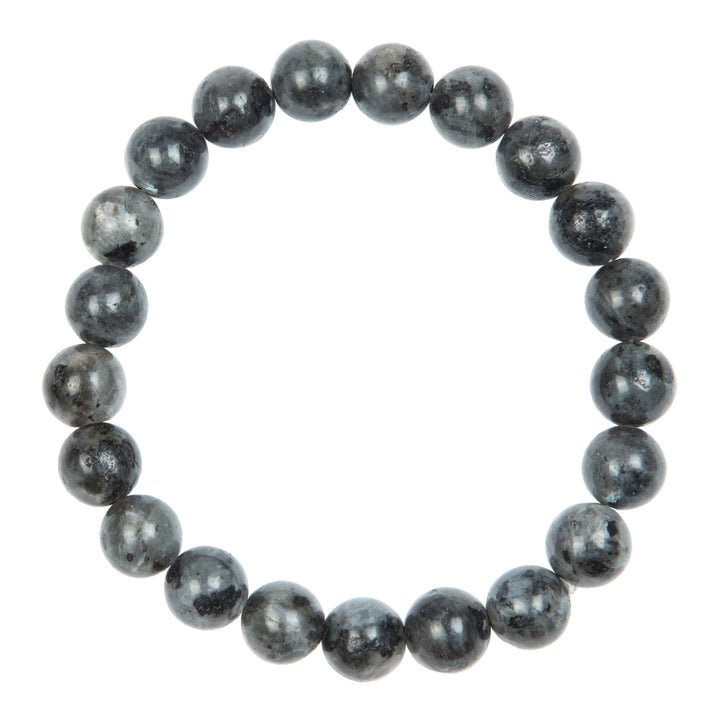
See it as
Feldspar-rich igneous rock
Black Labradorite
Labradorita negra
- Palette
- Black Gray
- Mined in
- Norway, Canada, Finland, Madagascar, Russia
- Hardness
- Mohs 6.0–6.5 ?
- See-through
- opaque
- Known since
- no formal date (bead-trade name)
- Named for
- its dark color plus the name of labradorite, the feldspar first identified in Labrador, Canada; the rock sold under it, larvikite, is named for Larvik, Norway
- Also sold as
- Larvikite, Larvakite
- Intention
- Protection Strength
- Looking for
- Protection Grounding Clearing negativity Focus and clarity
- Water
- Keep it dry; wipe with a soft cloth
- Dye or finish
- Labradorite beads are normally sold natural. Very bright, even rainbow color on a bead is a reason to ask whether it is coated.
In our pieces · 1See the piece ↓
292 MILLION YEARS
The Norwegian rock behind most black labradorite beads, larvikite, is Permian, formed roughly 292 to 298 million years ago.
3 FELDSPARS
Larvikite's thumbnail-sized crystals are ternary feldspars, mixing all three feldspar end members, and they give the silver-blue flash.
HERITAGE STONE
The International Union of Geological Sciences has named larvikite a Global Heritage Stone Resource.
What it is
Dark gray to near-black stone with a silvery-blue shimmer that flashes as it moves. Black labradorite is a trade name: beads sold under it are generally larvikite, a Norwegian monzonite rock made of feldspar crystals, not a single mineral and not true labradorite. Some sellers may also use the name for dark labradorite feldspar.
What gives it its color
The silvery-blue flash on these beads comes from microscopic alternating layers inside the feldspar that bounce light back (labradorescence).
Where it comes from
Beads sold as black labradorite are usually larvikite, which is quarried around Larvik in Norway. True labradorite comes from Labrador in Canada, Finland, Madagascar and Russia, among others.
In history
The black beads are usually larvikite, a Norwegian rock from the Larvik area that is cut and polished as facing stone for office buildings and sold as Blue Pearl Granite. True labradorite was first identified in Labrador, Canada, and its Finnish form, spectrolite, turned up at Ylämaa in 1940 and was first cut for jewelry there in 1973.
What's said about it
In crystal lore, this dark, silvery-flashing stone is what people reach for when they want a sense of being shielded. It's said to steady you and sharpen your sense of what's true.
People wear it every day on the wrist, carry it in a pocket, or hold one in each hand when they want to feel settled. Some tuck a piece under the pillow for more insightful dreams.
How people wear or keep it: On the wrist, in a pocket, one in each hand, or under the pillow.
In crystal practice
In the crystal tradition, black labradorite is paired with the root and third eye chakras, so practitioners rest it there during meditation or lie down with it in place for a few quiet minutes. Day to day, the same tradition suggests keeping it close: on the wrist, in a pocket, one in each hand. People reach for it when they want protection, grounding, clearing negativity, and many set an intention when they put it on. Most practitioners cleanse a new stone first (running water only if the stone can take it, otherwise smoke or moonlight) and set it aside now and then to rest.
These are beliefs people have held and still hold about the stone, reported as such. Nothing here is a promise or a medical claim. We sell stones as jewelry, not for these effects.
Associations
The chakra and star sign this stone is usually matched with. These are popular traditions, not facts about the stone.
ChakraRoot, Third Eye
Also calledLarvikite, Larvakite
Care
- Feldspar is moderately hard (about 6), so keep it away from harder stones that can scratch it.
- Wipe with a soft damp cloth; avoid ultrasonic cleaners.
- Sharp knocks can chip it along feldspar cleavage planes.
- Dry thoroughly after contact with water.
How to tell what you have
- Black labradorite is usually a dark gray to black feldspar that flashes blue or silver as you tilt it; the shimmer sits inside the stone and comes and goes with the angle.
- The name is also used for larvikite, a dark rock with a silver-blue shimmer, so two beads sold under this name can be slightly different stones.
- Be careful of very bright, even rainbow color and of beads that all look identical: that points to coated glass.
What sets the price
Price follows how strong, broad and bright the blue or multicolor flash is, and how much of each bead shows it. Very bright, even rainbow color on a bead can be coated glass, and if the lot is larvikite instead, it is priced as that stone.
Questions people ask at our table
What is black labradorite?
It is a trade name. Beads sold as black labradorite are normally larvikite, a dark Norwegian rock made mostly of feldspar. It is a rock, not a single mineral, and it is not true labradorite.
Why the silvery-blue flash?
Alternating layers of alkali feldspar and plagioclase inside the feldspar crystals produce the silver-blue schiller on polished surfaces.
Is it the same as black moonstone?
No. Trade references describe true black moonstone as a feldspar with a softer floating sheen, while larvikite flashes more crisply. The names are often mixed up by sellers.
Is it dyed?
The dark color is the rock's own. We have not verified how every supplier sources it, so ask if you need certainty.
Where is it from?
Larvikite takes its name from the Larvik area of southern Norway, where it occurs in the Larvik Batholith.
Our black labradorite pieces

Stay in the loop
Sign up to hear about new product drops, upcoming events, and the latest from Peritik. No spam, just the good stuff.