
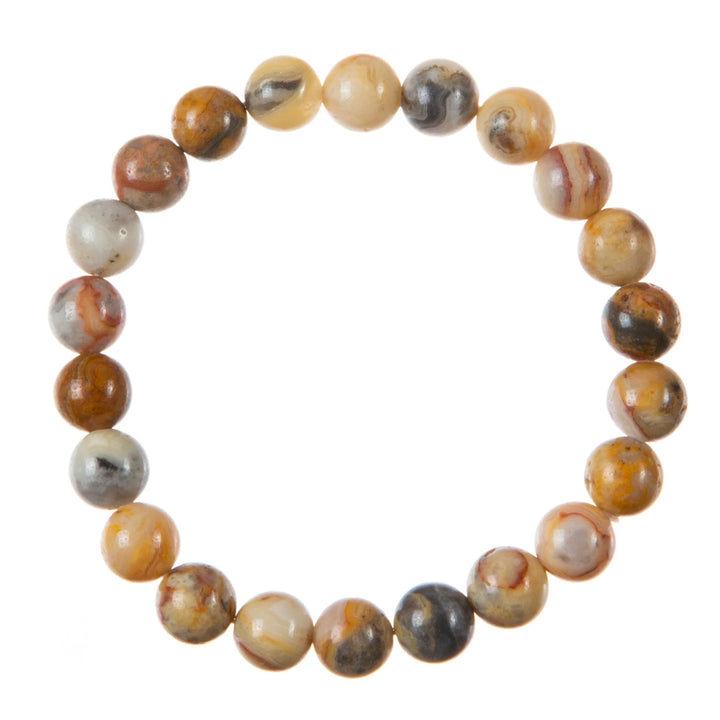
Crazy lace agate is banded agate with tight, tangled lines. Yellow is one of its natural colors in Mexico, though dye is common in the trade. A very bright, even yellow is worth asking about.
See it as
Quartz (chalcedony) · Agate
Yellow Crazy Lace Agate
Ágata crazy lace amarilla
- Palette
- Yellow White Brown Orange
- Mined in
- Mexico
- Hardness
- Mohs 6.5–7.0 ?
- See-through
- translucent
- Known since
- Prehistoric
- Named for
- its tangled lace-like lines, in yellow
- Also sold as
- Yellow lace agate, Mexican crazy lace agate, Crazy lace agate (yellow)
- Intention
- Calm New Beginnings
- Looking for
- Joy Confidence and self-worth Calm Hope
- Water
- Keep it dry; wipe with a soft cloth
- Dye or finish
- Yellow is one of the natural colors of crazy lace agate. Vivid pink, blue, purple or green crazy lace is usually dyed, and dyed stones can fade in heat or sun.
In our pieces · 1See the piece ↓
PYRRHUS
Pyrrhus owned an agate whose natural markings showed Apollo holding his lyre among the nine Muses.
SUGAR AND ACID
Agate cutters in Germany stained stones black by carbonizing sugar in sulfuric acid, a method developed in the early 1800s.
NO SYNTHETIC
Agate has never been made synthetically, so a banded agate bead is always natural stone, though its color may be dyed.
What it is
Banded agate with tight, swirling, tangled lines in creamy yellow, honey, white and rust tones, giving the lace look. Crazy lace from Mexico is mined in natural earthy colors including yellow, though the stone is also dyed in other trade colors.
What gives it its color
Crazy lace agate is mostly gray or white with staining that gives some bands red, yellow, orange or brown; in agate generally, iron oxides such as goethite give the yellow and hematite the red.
Where it comes from
Crazy lace agate is mined in the Sierra Santa Lucia of northern Chihuahua, Mexico, where it forms in a gray Cretaceous limestone, unlike other Mexican agates, which come from volcanic rock.
In history
People have worked agate for at least 12,000 years: Natufian toolmakers in the Levant made knives and arrowheads from moss agate around 10,000 BCE, and Sumerian agate jewelry dates to about 2500 BCE. The German town of Idar-Oberstein began cutting agate on an industrial scale around 1375 and later took in Brazilian agate by the shipload.
What's said about it
In crystal practice today, it's nicknamed the laughter stone or happy lace. It is traditionally associated with joy, self-confidence and a sense of steadiness.
In the Near East, agates with a pale central ring were cut into amulets against the evil eye. That lore belongs to agate in general. Crazy lace is a modern trade name.
People wear it on the wrist or keep it on a desk.
How people wear or keep it: On the wrist, on a desk, or in a pocket.
In crystal practice
In the crystal tradition, yellow crazy lace agate is paired with the third eye and crown chakras, so practitioners rest it there during meditation or lie down with it in place for a few quiet minutes. Day to day, the same tradition suggests keeping it close: on the wrist, on a desk, in a pocket. People reach for it when they want joy, confidence and self-worth, calm, and many set an intention when they put it on. Most practitioners cleanse a new stone first (running water only if the stone can take it, otherwise smoke or moonlight) and set it aside now and then to rest.
These are beliefs people have held and still hold about the stone, reported as such. Nothing here is a promise or a medical claim. We sell stones as jewelry, not for these effects.
Associations
The chakra and star sign this stone is usually matched with. These are popular traditions, not facts about the stone.
ChakraThird Eye, Crown
ZodiacGemini
BirthstoneMay, June
Also calledYellow lace agate, Mexican crazy lace agate, Crazy lace agate (yellow)
Care
- Wipe with a soft damp cloth; avoid soaking.
- Keep out of long direct sunlight; dyed colors fade, and a very saturated uniform yellow is worth asking the seller about.
- Avoid ultrasonic cleaners, steam and harsh chemicals.
- Hard enough for regular wear, but edges of beads can chip if knocked.
- Store apart from softer stones.
How to tell what you have
- Crazy lace agate is a Mexican agate with a tangled, lace-like pattern of bands, swirls and eyes, typically white and red with yellow or gray.
- A soft earthy yellow fits the natural stone; a bright, uniform lemon or neon yellow is a reason to ask about dye.
- Dye tends to sit at the surface and along cracks and the drill hole, and can fade with light or heat.
What sets the price
Agate's price follows its color and pattern: a soft natural yellow with a busy, lace-like band pattern is worth more than a bright dyed color, because dyed agate is considered low in value as a natural stone and the dye can fade.
Rules and sourcing
Yellow is a natural color of crazy lace agate, but vivid pink, blue, purple or green strands are usually dyed and can fade in heat or sun. The FTC jewelry guides call for disclosing added dye.
Related stones
Questions people ask at our table
Is the yellow color natural or dyed?
Yellow is one of the natural earthy colors of Mexican crazy lace, alongside reds, browns, greys, oranges and whites. Dyeing is common in the trade, so a very bright, even yellow may be dyed; a stated color origin is a seller claim unless a lab has tested it.
What is crazy lace agate?
It is a banded agate with a tightly folded, lace-like pattern, mined notably in Chihuahua, Mexico. It is chalcedony, a form of microcrystalline quartz.
Will it fade?
Natural colors are reported to hold in sunlight, while dyed material may gradually lose color. Avoid leaving it in a sunny window.
How can I tell it from yellow glass or jasper?
Crazy lace shows fine, wavy banding that varies from bead to bead, while glass is often perfectly uniform and may show bubbles. Yellow jasper is opaque and lacks the lace banding.
How should I look after it?
Wipe with a soft damp cloth and store it away from harder stones and strong light. Skip ultrasonic cleaners.
Our yellow crazy lace agate pieces

Stay in the loop
Sign up to hear about new product drops, upcoming events, and the latest from Peritik. No spam, just the good stuff.