
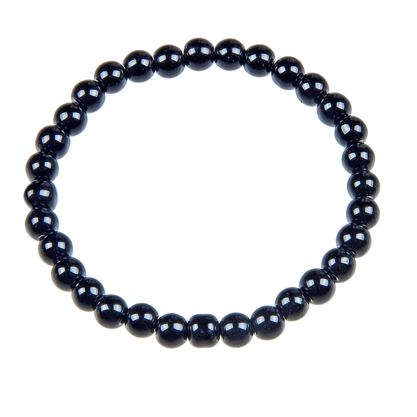
Most solid black onyx is chalcedony dyed black with a sugar-and-acid method. Natural onyx has straight, parallel bands in white, brown and black. The dye is long established and holds well in normal wear.
See it as
Quartz (chalcedony) · Chalcedony
Onyx
Ónix
- Palette
- Black White Brown Gray
- Mined in
- Brazil, Uruguay, India, Madagascar, Botswana, Argentina, China, Pakistan
- Hardness
- Mohs 6.5–7.0 ?
- See-through
- opaque
- Known since
- Prehistoric
- Named for
- Greek ónyx, meaning claw or fingernail
- Also sold as
- Black onyx, Banded onyx, Dyed black chalcedony
- Intention
- Protection Strength
- Looking for
- Protection Grounding Clearing negativity Change and decisions
- Water
- Keep it dry; wipe with a soft cloth
- Dye or finish
- Most black onyx on the market is gray chalcedony dyed black. Naturally black onyx is rare.
In our pieces · 1See the piece ↓
FERDINAND PREISS
Sculptor Ferdinand Preiss used Brazilian green onyx for the bases of most of his chryselephantine sculptures in the 1920s and 1930s.
1533
In 1533 King Francis I of France took the onyx Gemma Augustea to Fontainebleau, saying he wanted to show it to the pope.
1246
The Gemma Augustea first appears in written records in 1246, in the treasury of the abbey of Saint-Sernin in Toulouse.
What it is
Chalcedony with straight, parallel bands, naturally in white, brown and black. Most solid black onyx beads and cabochons are actually black-dyed chalcedony, colored with a sugar-and-acid carbonising method that leaves a deep, even, glossy black.
What gives it its color
Naturally black onyx is rare; most black onyx is gray or banded chalcedony soaked in sugar solution and then heated in acid, which leaves tiny carbon particles in the stone and makes it black only a few millimeters deep.
Where it comes from
Onyx is mined in Brazil, Uruguay, Argentina, India, Madagascar and China, among other countries.
In history
Egyptians carved onyx into bowls as early as the Second Dynasty. The Roman cameo known as the Gemma Augustea, made about AD 10-20 and now in Vienna, is cut from two-layered Arabian onyx. In 1930 the architect Mies van der Rohe used onyx slabs from the Atlas Mountains to build a glowing interior wall at Villa Tugendhat in Brno.
What's said about it
In crystal lore, onyx is the stone people reach for to feel strong and steady. It's said to bring stamina, a centerd mind and clearer decisions. It is also traditionally associated with protection and absorbing negativity.
Not every tradition was kind to it. Arabic tradition called onyx a stone of sadness, and an old text attributed to a Greek philosopher warned of fearful dreams. Roman writers admired its white band, like a fingernail.
People wear it as a bracelet or ring, hold it in either hand, or carry it in a pocket. Some keep one in a room or meditation space.
How people wear or keep it: On the wrist, in a pocket, in any room, or in a meditation space.
In crystal practice
In the crystal tradition, onyx is paired with the root chakra, so practitioners rest it there during meditation or lie down with it in place for a few quiet minutes. Day to day, the same tradition suggests keeping it close: on the wrist, in a pocket, in any room. People reach for it when they want protection, grounding, clearing negativity, and many set an intention when they put it on. Most practitioners cleanse a new stone first (running water only if the stone can take it, otherwise smoke or moonlight) and set it aside now and then to rest.
These are beliefs people have held and still hold about the stone, reported as such. Nothing here is a promise or a medical claim. We sell stones as jewelry, not for these effects.
Associations
The chakra and star sign this stone is usually matched with. These are popular traditions, not facts about the stone.
ChakraRoot
ZodiacLeo
ElementWater
Also calledBlack onyx, Banded onyx, Dyed black chalcedony
Care
- Wipe with a soft damp cloth and dry; mild soap is fine.
- The black color lies in the stone's pores to a shallow depth, so avoid abrasion and deep scratches that could expose paler stone.
- Avoid ultrasonic cleaners, steam and strong chemicals.
- Hard enough for daily wear (about 6.5-7), though beads can chip if struck.
- Store apart from softer stones.
How to tell what you have
- Real onyx is chalcedony (Mohs 6.5-7); dyed black onyx can show gray in the drill holes and on surfaces.
- Black glass is a common substitute, and onyx marble (calcite) is much softer, about Mohs 3, and fizzes in acid.
- Even, deep black is normal because of the dye; heavy polishing can wear it through.
What sets the price
Most black onyx is gray chalcedony dyed black, so the price follows how even and deep the black is, how well the beads are polished and drilled, and their size and roundness; calcite sold as onyx is softer and a different, more common material.
Rules and sourcing
Most black onyx is gray chalcedony dyed black, and naturally black onyx is rare. The FTC jewelry guides call for a seller to disclose the dye.
Related stones
Questions people ask at our table
What is onyx?
Onyx is banded chalcedony, a microcrystalline quartz, with straight parallel bands; banded agate with curved bands is not strictly onyx. The name is often used loosely for any solid black stone.
Is black onyx dyed?
Most of it, yes. Plain black onyx is generally gray chalcedony soaked in sugar solution and then heated in sulphuric acid, which leaves carbon in the pores. The process is long established and stable, but it should be disclosed.
Does black onyx fade?
The color holds well in normal wear, though it only reaches a few millimeters deep, so heavy polishing or abrasion can remove it. Prolonged strong sun can fade dyed stones.
How can I tell it from black glass?
Onyx is cooler to the touch, heavier and harder to scratch than glass, and glass may show bubbles or conchoidal chips. A lab can confirm.
Where does onyx come from?
Brazil and Uruguay are the main commercial sources of the agate dyed black, with others in India (Gujarat), Madagascar and Botswana.

Stay in the loop
Sign up to hear about new product drops, upcoming events, and the latest from Peritik. No spam, just the good stuff.