
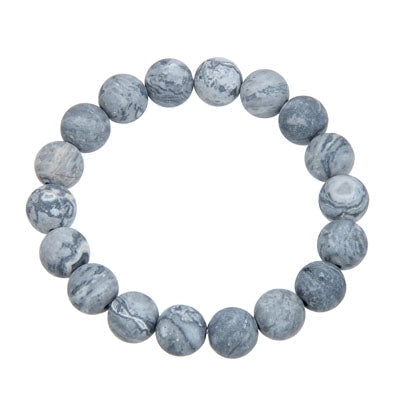
Picasso jasper is not a jasper. It is a natural dolomitic marble from Utah, a soft carbonate rock, shown here with a frosted matte finish.
See it as
Carbonate rock (dolomitic marble)
Matte Picasso Jasper
Jaspe Picasso Mate
- Palette
- Brown Gray Black White
- Mined in
- United States
- Hardness
- Mohs 3.5–5.0 ?
- See-through
- opaque
- Known since
- 1792
- Named for
- a frosted (matte) finish and brush-stroke-like dark veining, after the painter Pablo Picasso (inference)
- Also sold as
- Picasso Jasper, Picasso Stone, Picasso Marble
- Intention
- New Beginnings
- Looking for
- Fresh starts Creativity
- Water
- Keep it dry; wipe with a soft cloth
- Dye or finish
- Picasso jasper is generally sold natural; the pattern comes from the stone itself. The matte finish is a frosted polish, not a color change.
In our pieces · 1See the piece ↓
1791
Dolomieu first described the rock dolomite in 1791, from buildings in old Rome and then from samples from the Tyrolean Alps.
MARMAROS
Marble's name comes from the Greek marmaros, meaning crystalline rock or shining stone.
3.5 TO 4
Dolomite rates 3.5 to 4 on the Mohs scale and, unlike calcite, barely fizzes in cold dilute acid unless it is powdered.
What it is
Cream, tan and gray stone crossed by dark brown to black linear veining that resembles brush strokes, shown here with a frosted matte finish. Despite the name it is not a jasper: it is a metamorphosed dolomitic marble, found mainly in Utah.
What gives it its color
The cream and gray base is carbonate rock (marble), and the black, brown and rusty lines are iron oxides such as hematite and limonite that filled cracks in it.
Where it comes from
Picasso marble comes from the Mineral Mountains of southwestern Utah, mainly Beaver County.
In history
The stone sold as Picasso jasper is a dolomitic marble, and marble has been the sculptor's stone since classical Greece: the Nike of Samothrace was carved about 220 to 190 BC from Parian marble, and the Parthenon's marbles are now in the British Museum. The dolomite mineral that gives such marble its character was named in March 1792 for the French mineralogist Deodat de Dolomieu.
What's said about it
The name is a modern trade name, from brushstroke-like veining that recalls abstract art. It has no older lore of its own.
People pick it for its markings, and some keep it as a stone for fresh starts. Keep it dry and away from acids.
It is best worn as a bracelet on the wrist for easy dry wear.
How people wear or keep it: On the wrist, or on a desk.
In crystal practice
In the crystal tradition, matte picasso jasper is paired with the third eye and crown chakras, so practitioners rest it there during meditation or lie down with it in place for a few quiet minutes. Day to day, the same tradition suggests keeping it close: on the wrist, on a desk. People reach for it when they want fresh starts, creativity, and many set an intention when they put it on. Most practitioners cleanse a new stone first (running water only if the stone can take it, otherwise smoke or moonlight) and set it aside now and then to rest.
These are beliefs people have held and still hold about the stone, reported as such. Nothing here is a promise or a medical claim. We sell stones as jewelry, not for these effects.
Associations
The chakra and star sign this stone is usually matched with. These are popular traditions, not facts about the stone.
ChakraThird Eye, Crown
Also calledPicasso Jasper, Picasso Stone, Picasso Marble
Care
- Carbonate rock is soft and reacts with acid: keep away from vinegar, lemon juice and acidic cleaners, which etch the surface.
- Wipe with a soft damp cloth only; do not soak.
- Remove before swimming, cleaning or applying lotions and perfume.
- Store apart from harder stones to avoid scratches.
How to tell what you have
- It is not a true jasper but a banded marble-type rock from Utah, much softer (about Mohs 3.5 to 4). A drop of dilute acid fizzes on it; real jasper does not.
- Keep vinegar and lemon juice away, as they etch the surface.
Rules and sourcing
Picasso jasper is a carbonate rock (dolomitic marble), not quartz jasper. Under the FTC jewelry guides a seller should say what the bead actually is.
Related stones
Questions people ask at our table
Is Picasso jasper a real jasper?
No. It is a metamorphosed dolomitic marble (a carbonate rock) with iron-oxide veining, sold under the name jasper because it is polished and patterned like one.
Where does it come from?
One dealer says it comes mostly from Utah, USA, apparently from one main locality. Other sellers narrow this to the Mineral Mountains of southwestern Utah (search results only).
How hard is it?
Sources conflict and the dealer page we read gives no value. Carbonate rock is generally soft, so our 3.5 to 5 range is an estimate, not a tested figure.
Can I get it wet or clean it with vinegar?
Avoid acids entirely, since carbonate etches. A soft damp cloth is enough; do not soak it.
Is it dyed?
The patterning is natural veining. We have no report of dye on this material.
Our matte picasso jasper pieces

Stay in the loop
Sign up to hear about new product drops, upcoming events, and the latest from Peritik. No spam, just the good stuff.