
Lemon jasper is a bead-trade name we could not tie to a particular mineral. Similar names turn out to be serpentine, so it may not be a true jasper, and bright even yellow can be dyed.
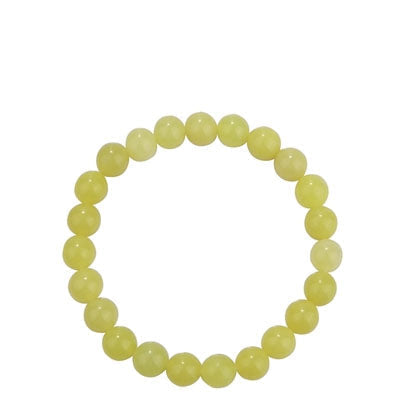
See it as
Lemon Jasper
Jaspe limón
- Palette
- Yellow Green
- Mined in
- Africa, Australia, India, Madagascar, Mexico
- Hardness
- Mohs 2.5–7.0 ?
- See-through
- opaque
- Known since
- no formal date (bead-trade name)
- Named for
- its lemon-yellow color
- Intention
- Protection
- Looking for
- Willpower Grounding Goals and motivation
- Water
- Keep it dry; wipe with a soft cloth
- Dye or finish
- What is done to lemon jasper beads is not settled: one seller lists no change made, but similar yellow-green stones in the trade are often dyed or resin-filled.
In our pieces · 1See the piece ↓
WADDESDON
A jewel-set vase carved from red-and-yellow jasper, probably German and from the early 17th century, is in the British Museum's Waddesdon Bequest.
HARAPPA
A male torso carved from red jasper at Harappa, in the Indus Valley civilization of today's Pakistan, dates to the Bronze Age.
What it is
Opaque beads in lemon yellow to yellow-green, sometimes with lighter mottling. 'Lemon jasper' is a bead-trade name, not a mineral name; we have not confirmed which stone it is.
What gives it its color
'Lemon jasper' is a trade name; where the stone is true jasper, the yellow comes from iron in the silica (iron gives jasper its red, brown and yellow shades).
Where it comes from
Jasper in general is supplied by India, Australia, Venezuela, Russia, Brazil and Uruguay, and Madagascar. Where lemon jasper beads specifically come from is not documented.
In history
Lemon jasper is a trade name, but jasper itself has a long record: Minoan carvers cut it into seals around 1800 BC at Knossos, and Pliny the Elder wrote that it was the stone for signets. A green jasper and gold ring from Egypt's Late Period (664 to 322 BC) is now in the Walters Art Museum.
What's said about it
The lore here belongs to jasper, the stone the name borrows from. In crystal lore, jasper is the stone people keep for steadiness, and yellow jasper is thought of as a stone of perseverance.
In older gem lore, jasper was worn as an amulet by people in the East.
People wear it on the wrist or carry it in a pocket. Handle it as a soft stone until the material is confirmed.
How people wear or keep it: On the wrist, in a pocket, or on a desk.
In crystal practice
Day to day, the same tradition suggests keeping it close: on the wrist, in a pocket, on a desk. People reach for it when they want willpower, grounding, goals and motivation, and many set an intention when they put it on. Most practitioners cleanse a new stone first (running water only if the stone can take it, otherwise smoke or moonlight) and set it aside now and then to rest.
These are beliefs people have held and still hold about the stone, reported as such. Nothing here is a promise or a medical claim. We sell stones as jewelry, not for these effects.
Care
- Handle it as a soft stone until it is identified: avoid knocks and rubbing against harder stones.
- Wipe with a soft cloth; a soft brush, mild detergent and warm water for deeper cleaning.
- Keep away from steam, ultrasonic cleaners and solvents.
- Keep out of long direct sunlight, which can fade some yellow-green stones.
How to tell what you have
- Sold under this name the bead may be true jasper (hard quartz), or a softer yellow-green stone such as serpentine or magnesite; it varies by lot.
- Try a steel point on the drill-hole edge: jasper (6.5 to 7) is not scratched, while serpentine and magnesite are.
- Look for dye at the drill hole, an unnaturally even lemon color, and a lighter weight than jasper should have.
What sets the price
Price follows what the bead actually is in that lot (jasper, or a softer yellow-green stone such as serpentine or magnesite), then how even the lemon color is and whether the color was added by dye. Beads that are very bright and even are more likely dyed.
Rules and sourcing
Lemon jasper is a trade name; the beads may be jasper, serpentine or magnesite, and similar yellow-green stones are often dyed or resin-filled. A seller should say what the bead actually is under the FTC jewelry guides.
Related stones
Questions people ask at our table
What is lemon jasper?
A trade name. We found no source that defines it. Fire Mountain Gems says peridot 'jasper' is a trade name for pale green serpentine, so the word jasper in a bead name is not a reliable guide.
Is it a true jasper?
Unconfirmed. It may be serpentine or another stone, and the supplier should say which.
Is it dyed?
We cannot say. Even, bright yellow can be dyed; natural material usually shows mottling.
How do I care for it?
Assume it is on the soft side. Gemsociety advises serpentine be cleaned only with a soft brush, mild detergent and warm water, and kept from steam and ultrasonic cleaners.
Our lemon jasper pieces

Stay in the loop
Sign up to hear about new product drops, upcoming events, and the latest from Peritik. No spam, just the good stuff.