
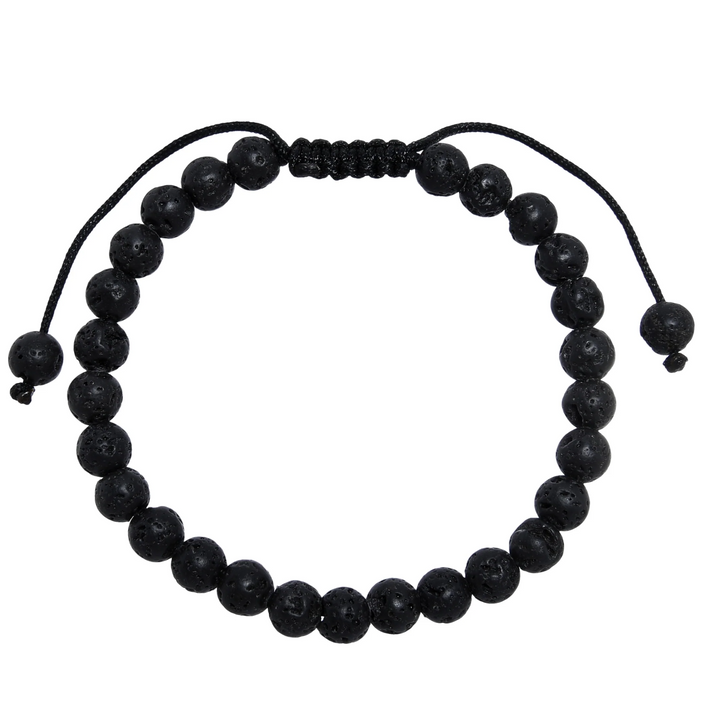
Lava beads are cut from porous volcanic rock, a mix of minerals rather than a single stone. Some bright-colored beads are dyed, so natural lava is the black, gray or brown kind.
See it as
Rock (volcanic, mixed minerals)
Lava
Lava
- Palette
- Black Gray Brown
- Mined in
- United States, Italy, Iceland, New Zealand, Indonesia, China
- Hardness
- Mohs 3.0–6.0 ?
- See-through
- opaque
- Known since
- 1737
- Named for
- Italian for a stream after sudden rain, likely Latin 'labes', a slide
- Also sold as
- Lava rock, Lava stone, Volcanic rock, Basalt beads
- Intention
- Strength
- Looking for
- Grounding
- Water
- Keep it dry; wipe with a soft cloth
- Dye or finish
- Plain lava beads are natural volcanic rock, but many are waxed to feel smooth, and some are dyed blue, red or other colors. Natural lava is matte black or gray.
In our pieces · 2See the 2 pieces ↓
1737
The word lava was first used for erupted rock in an account of the 1737 eruption of Vesuvius.
62 MPH
A 1977 lava flow at Mount Nyiragongo reached up to 100 kilometers per hour, about 62 miles per hour.
3,400 METERS
On November 23, 2013, a lava fountain at Mount Etna briefly peaked at 3,400 meters.
What it is
Matte, pitted beads in charcoal black, gray or brown, cut from porous basalt. It is a rock, an aggregate of minerals, rather than a single mineral, and some beads on the market are dyed in blues, reds and other colors.
What gives it its color
Lava beads are basalt, a volcanic rock that is dark gray to black because it is rich in dark minerals such as pyroxene; the pits are gas bubbles trapped as the rock cooled. Colored lava beads are dyed.
Where it comes from
Bead sellers list lava rock as coming from Iceland, Indonesia, the United States, Italy and China; basalt in general forms in volcanic regions like Hawaii and India's Deccan.
In history
Lava beads are cut from basalt, the dark volcanic rock chosen to carve the Code of Hammurabi on a seven-foot stele around 1750 BC; that stele was found at Susa in 1901 and is now in the Louvre.
What's said about it
In crystal lore, lava is thought of as a grounding stone, traditionally associated with the root chakra. People keep it for feeling steady and rooted.
Because the beads are full of tiny pores, many wearers add a drop of essential oil and let it scent the bracelet for days. That is a jewelry habit, and the bead is simply the carrier.
Lava is often worn on the wrist, and some people carry a bead in a pocket.
How people wear or keep it: On the wrist, in a pocket, or on a bracelet with a drop of essential oil.
In crystal practice
In the crystal tradition, lava is paired with the root chakra, so practitioners rest it there during meditation or lie down with it in place for a few quiet minutes. Day to day, the same tradition suggests keeping it close: on the wrist, in a pocket, on a bracelet with a drop of essential oil. People reach for it when they want grounding, and many set an intention when they put it on. Most practitioners cleanse a new stone first (running water only if the stone can take it, otherwise smoke or moonlight) and set it aside now and then to rest.
These are beliefs people have held and still hold about the stone, reported as such. Nothing here is a promise or a medical claim. We sell stones as jewelry, not for these effects.
Associations
The chakra and star sign this stone is usually matched with. These are popular traditions, not facts about the stone.
ChakraRoot
ZodiacTaurus
Also calledLava rock, Lava stone, Volcanic rock
Care
- Porous surface soaks up liquids, so keep it away from water and perfume if you want it clean.
- Wipe with a dry or barely damp cloth; skip soaking and ultrasonic cleaners.
- Some beads are waxed; the wax has to come off before the bead will take up oil.
- Dyed beads can rub color onto skin or cloth when wet.
- Rough texture can chip and wears elastic cord, so check stretch cord now and then.
How to tell what you have
- Real lava is light for its size, rough and pitted. Smooth, heavy beads sold as lava may be something else.
- Any bright color is dye, and a waxy smooth feel means a wax coat; both rub off with time.
Rules and sourcing
Many lava beads are waxed to feel smooth, and some are dyed blue, red or other colors. The FTC jewelry guides call for a seller to disclose dye or wax.
Related stones
Questions people ask at our table
What is lava stone, actually?
Lava beads are cut from basalt, a volcanic rock formed when molten rock cools. It is an aggregate of minerals, so it is a rock and not a true single-mineral gemstone.
Why do people put essential oil on lava beads?
The beads are porous, so a drop or two soaks in and releases its scent slowly. It is a popular jewelry practice; the stone is just a carrier.
Are the bright-colored lava beads natural?
Natural lava is black, gray or brown. Bead retailers list blue, red and other bright lava beads as dyed, and dye can transfer if they get wet.
How hard is lava?
Sources disagree: one bead supplier gives about 5 to 6 on the Mohs scale and another gives 3 to 3.5, so regard it as a fairly soft, chip-prone bead.
Can I take lava rock home from Hawaii?
No; taking rock from national parks is illegal, and a widely told legend adds bad luck to it. Park staff say the legend is not part of traditional stories.


Stay in the loop
Sign up to hear about new product drops, upcoming events, and the latest from Peritik. No spam, just the good stuff.