
Indian agate is a trade label for banded agate cut in India, not a separate mineral. The stone is natural chalcedony, but the bright blues, greens and purples are usually dye. The browns, greys and whites are natural.
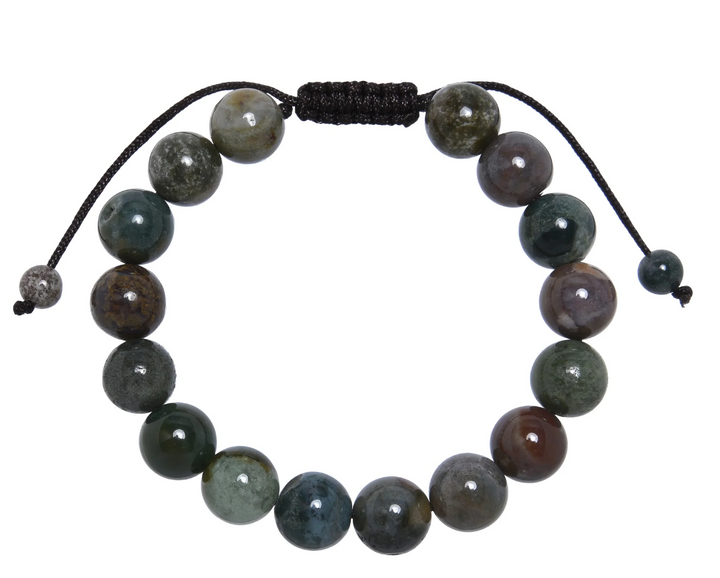
See it as
Quartz (chalcedony) · Agate
Indian Agate
Ágata india
- Palette
- Multicolor Blue Green Purple Brown
- Mined in
- India, Brazil
- Hardness
- Mohs 6.5–7.0 ?
- See-through
- translucent
- Known since
- Prehistoric
- Named for
- the River Achates in Sicily, per Theophrastus and Pliny
- Also sold as
- India agate, Multicolour agate, Cambay agate, Indian banded agate
- Intention
- Strength Protection
- Looking for
- Calm Confidence and self-worth Letting go Forgiveness
- Water
- Keep it dry; wipe with a soft cloth
- Dye or finish
- Indian agate is usually sold in its natural color, but dyed and heated agate is common in the trade, so check the strand label.
In our pieces · 2See the 2 pieces ↓
4,000 YEARS
Agate bead making in Khambhat, India, traces back to Lothal, a Harappan outpost that flourished about 4,000 years ago.
200 KILOMETERS
Khambhat has no stone of its own; its rough agate comes from the Rajpipla hills about 200 kilometers away.
1900
By 1900 Khambhat was celebrated for its agate and carnelian ornaments, mainly made for buyers in China.
What it is
A bead-trade label for banded agate cut in India, not a distinct mineral species. The stone itself is natural chalcedony, but the bright blues, greens, purples and pinks seen on strands are usually dye, while softer browns, greys and whites are the natural colors.
What gives it its color
Agate bands get most of their color from iron: red from tiny spheres of hematite and yellow from goethite; pale agate is often dyed or heated (burned) to deepen the color.
Where it comes from
Agate for India's bead cutters comes mainly from the Narmada River beds of eastern Gujarat (the Rajpipla area), where it weathers out of the Deccan Traps lava, and is cut at Khambhat (Cambay).
In history
Agate was worked at Sumer by about 2500 BC and at Knossos on Bronze Age Crete, and the Greek writer Theophrastus described it around 350 BC. Pliny the Elder wrote that agates from India showed pictures of rivers and woods, and that agate was found in many countries from Crete to Cyprus.
What's said about it
In crystal lore, agate is the stone people keep for calm, focus and steady confidence. It's said to help with letting go of old bitterness and resentment, and with forgiving.
In older gem lore, medieval writers held that agate makes the wearer agreeable and persuasive. Brown agates with a pale ring, seen as an eye, were carried as amulets against the evil eye.
People wear it as jewelry, hold it in either hand, or carry it in a pocket. Layered agates can be fragile, so store them wrapped in cloth.
How people wear or keep it: On the wrist, in a pocket, held in either hand, or wrapped in cloth when stored.
In crystal practice
Day to day, the same tradition suggests keeping it close: on the wrist, in a pocket, held in either hand. People reach for it when they want calm, confidence and self-worth, letting go, and many set an intention when they put it on. Most practitioners cleanse a new stone first (running water only if the stone can take it, otherwise smoke or moonlight) and set it aside now and then to rest.
These are beliefs people have held and still hold about the stone, reported as such. Nothing here is a promise or a medical claim. We sell stones as jewelry, not for these effects.
Associations
BirthstoneMay, June
Also calledIndia agate, Multicolour agate, Cambay agate
Care
- Wipe with a soft damp cloth; avoid soaking, because dye can bleed from porous bands.
- Keep out of long direct sunlight, which can fade dyed colors over time.
- Avoid ultrasonic cleaners, steam and harsh chemicals or solvents.
- Hard enough for daily wear (about 6.5-7), but sharp knocks can chip the edges of beads.
- Store apart from softer stones so the agate does not scratch them.
How to tell what you have
- Natural agate has soft earthy colors in irregular bands, some see-through glow at thin edges, and feels cool and hard (about 6.5 to 7).
- Very bright blue, pink or purple is usually dye; look for color gathered at the drill hole or cracks.
- Glass can copy the look: it often has tiny round bubbles and bands that are too regular.
What sets the price
Strands cost more when the bands are sharp and the color is natural and vivid; bright dyed color is worth less than natural color, and bead size and polish also move the price.
Rules and sourcing
Indian agate is often sold in natural color, but dyed and heated agate is common, so a strand label should say which it is. The FTC jewelry guides call for disclosing added dye or heat.
Related stones
Questions people ask at our table
What is Indian agate?
It is a sourcing and trade label for agate cut and polished in India, much of it around Cambay (Khambhat) in Gujarat. The material is genuine chalcedony, but the name does not describe a single pattern or color.
Is Indian agate dyed?
Very often. Strong blue, green, purple and pink bands are usually dye, and sellers commonly state this. Natural Indian agate tends to be browns, greys, creams and whites.
Will the color fade?
Natural colors are stable, but dyed beads can lose depth with long sun exposure or harsh cleaning. Keeping them out of bright light helps.
How can I tell it from glass?
Agate feels cool and slightly heavy, and shows fine banding with natural irregularities. Glass often has bubbles, perfectly even color or a moulded look.
Where does it come from?
Agate has been worked at Cambay in Gujarat for thousands of years, with rough from Gujarat, Maharashtra and Rajasthan according to the Indian handicrafts portal.


Stay in the loop
Sign up to hear about new product drops, upcoming events, and the latest from Peritik. No spam, just the good stuff.