
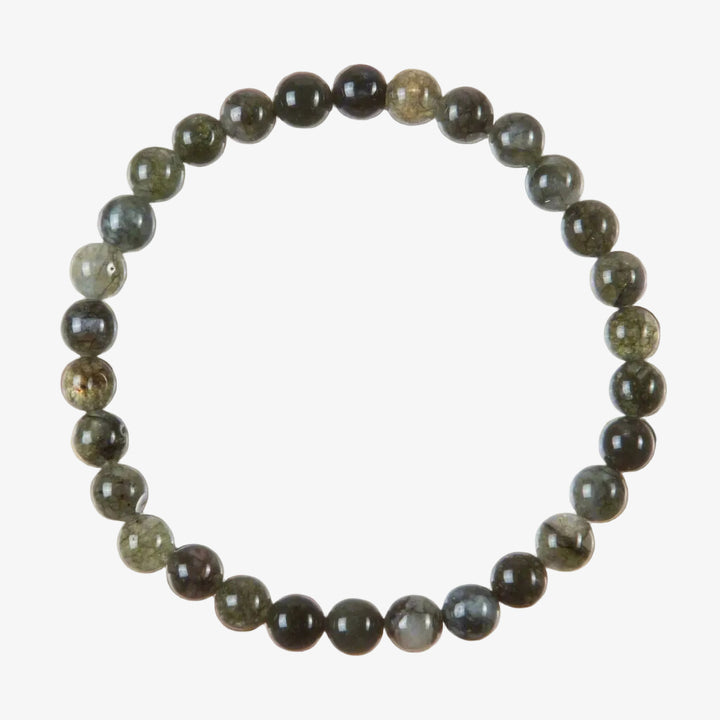
Glassy chalcedony is a bead-trade description, not a mineral name. These smooth, glossy beads may be natural chalcedony, dyed chalcedony or, in some cases, glass. Which one depends on the supplier.
See it as
Quartz (chalcedony), if natural; dye status and glass possibility unconfirmed · Chalcedony (if natural)
Glassy Chalcedony
Calcedonia vítrea
- Palette
- Blue Clear Gray
- Mined in
- China
- Hardness
- Mohs 6.5–7.0 ?
- See-through
- translucent
- Known since
- Prehistoric
- Named for
- Latin chalcedonius, probably from the town of Chalcedon
- Also sold as
- Glassy agate, Clear chalcedony beads
- Intention
- Calm
- Looking for
- Calm Peace Safe travels
- Water
- Keep it dry; wipe with a soft cloth
- Dye or finish
- Glassy chalcedony is a description, not a set stone, so what was done to the beads is not known; blue and green strands are often dyed.
In our pieces · 1See the piece ↓
24 FIGURES
The Great Cameo of France is carved from five-layered sardonyx with 24 figures on three levels, on a stone 31 by 26.5 centimeters.
1804
The Great Cameo of France, carved in banded chalcedony, was stolen in 1804 and recovered in Amsterdam in 1805.
TILLYA-TEPE
Chalcedony objects from the first century, possibly Kushan, were found at Tillya-tepe in northwestern Afghanistan.
What it is
Smooth, glossy, semi-clear beads in soft blue-gray tones. 'Glassy chalcedony' is a trade description rather than a mineral name; the beads are chalcedony-type quartz and may be dyed.
What gives it its color
If natural, the gray-blue of chalcedony comes from tiny amounts of metals such as iron, nickel, copper or titanium in the quartz; strong blue and green beads are often dyed.
Where it comes from
Chalcedony in general is found in California, Nevada, Oregon, Mexico, Iceland, India, Namibia and Russia; named blue types come from California/Nevada, Namibia and Oregon.
In history
Glassy chalcedony is a trade description of chalcedony, a stone people have worked for tens of thousands of years: flakes of it were carried across Central Australia about 32,000 years ago, and seals of it were carved at the Palace of Knossos on Crete around 1800 BC. Stone cameos were being cut in Greece by the 5th century BC.
What's said about it
In crystal lore, chalcedony is thought of as a gentle, calming stone. People keep it for a quiet, even mood. That belongs to chalcedony itself, not to this trade name.
In older Christian writing, chalcedony stood for the flame of inner charity. A Greek amulet set with chalcedony was said to protect sailors at sea.
People wear it on the wrist or carry it on a trip.
How people wear or keep it: On the wrist, in a pocket, or in a travel bag.
In crystal practice
Day to day, the same tradition suggests keeping it close: on the wrist, in a pocket, in a travel bag. People reach for it when they want calm, peace, safe travels, and many set an intention when they put it on. Most practitioners cleanse a new stone first (running water only if the stone can take it, otherwise smoke or moonlight) and set it aside now and then to rest.
These are beliefs people have held and still hold about the stone, reported as such. Nothing here is a promise or a medical claim. We sell stones as jewelry, not for these effects.
Associations
Also calledGlassy agate, Clear chalcedony beads
Care
- Wipe with a soft damp cloth; do not soak, since dye can bleed from dyed chalcedony.
- Keep out of long direct sun, which can fade dyed color.
- Avoid ultrasonic cleaners and harsh chemicals.
- Store apart from harder stones and avoid hard knocks.
How to tell what you have
- Sold under this name the bead may be natural chalcedony (fine-grained quartz), dyed chalcedony, or glass; it varies by lot.
- Natural chalcedony has a waxy shine and is see-through to cloudy; tiny round bubbles and a very glassy, flawless look lean toward glass.
- Look for color collected along cracks or at the drill hole, whitish crackle lines, and very bright blue or green: those point to dye.
What sets the price
The price follows what the bead actually is in that lot: natural chalcedony, dyed chalcedony or glass; within that, strong even color, clearness and bead size set the price, and bright dyed color is worth less than natural color.
Rules and sourcing
Glassy chalcedony is a description, not a set stone, and blue and green strands are often dyed. A seller should say what the bead actually is under the FTC jewelry guides and disclose dye.
Related stones
Questions people ask at our table
What is glassy chalcedony?
It is a trade descriptor rather than a mineral name. It usually points to smooth, glossy, semi-transparent chalcedony, but the same wording is sometimes used loosely for other look-alike materials.
Is it natural, dyed or glass?
That depends on the supplier. A GIA lab note found beads sold as sea-blue chalcedony to be dyed crackled quartz, not glass, so natural-looking color should not be assumed to be undyed. The owner should confirm what the supplier sold.
Does the color fade?
Natural chalcedony colors are stable, but dyed material can fade with sun exposure. Store it out of bright light.
How can I tell chalcedony from glass?
Glass often feels warmer, may show round bubbles, and scratches more easily. A jeweler or gem lab can confirm with simple testing.
How do I care for it?
Wipe with a soft damp cloth, avoid heat and harsh chemicals, and keep it apart from harder stones.
Our glassy chalcedony pieces

Stay in the loop
Sign up to hear about new product drops, upcoming events, and the latest from Peritik. No spam, just the good stuff.