
Cyan Black Rain is a bead-trade name we could not match to a mineral. The teal color is probably dye on a natural stone, so we can't say what it is.
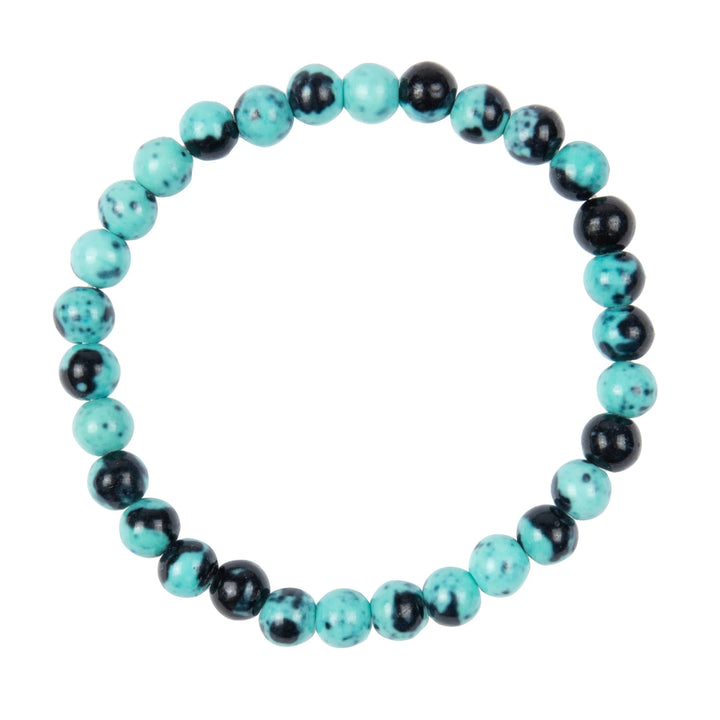
See it as
Cyan Black Rain
Lluvia Negra Cian
- Palette
- Blue Black Multicolor
- Mined in
- China
- Hardness
- not yet confirmed ?
- See-through
- opaque
- Known since
- no formal date (bead-trade name)
- Named for
- its cyan (blue-green) color with black streaks that look like falling rain
- Intention
- Calm
- Looking for
- Calm Peace
- Water
- Keep it dry; wipe with a soft cloth
- Dye or finish
- This is a color name, not a stone name, so what is in the bead varies by lot. A bright teal-blue on a pale stone is often dyed.
In our pieces · 1See the piece ↓
HENRY HOW
Canadian chemist Henry How found howlite near Windsor, Nova Scotia, in 1868, and James Dwight Dana later named the mineral for him.
3.5 MOHS
Howlite rates 3.5 on the Mohs scale and its porous texture soaks up dye, which is why it is dyed teal to stand in for turquoise.
1 CENTIMETER
Howlite crystals are rare and reach only about one centimeter, from Tick Canyon in California and Iona in Nova Scotia; beads are cut from nodules.
What it is
A teal-cyan bead with dark black veining. The name is a bead-trade color name, not a mineral, and the color may be dyed.
What gives it its color
The teal-cyan is most likely dye on a pale stone such as howlite, which is naturally white with fine gray or black veins and soaks up dye easily; the exact stone is unconfirmed.
What's said about it
Because the material is unconfirmed, we don't attach lore to it. People who like it keep it for its look: a calm teal with dark rain-like streaks.
Wear it on the wrist, away from water and long sun.
How people wear or keep it: On the wrist, or in a pocket.
In crystal practice
Day to day, the same tradition suggests keeping it close: on the wrist, in a pocket. People reach for it when they want calm, peace, and many set an intention when they put it on. Most practitioners cleanse a new stone first (running water only if the stone can take it, otherwise smoke or moonlight) and set it aside now and then to rest.
These are beliefs people have held and still hold about the stone, reported as such. Nothing here is a promise or a medical claim. We sell stones as jewelry, not for these effects.
Care
- Assume the color is dyed: avoid soaking, solvents and long direct sun.
- Wipe with a soft damp cloth and dry.
- Skip ultrasonic and steam cleaners.
- Put on after perfume and lotions; store apart from harder stones.
How to tell what you have
- Sold under this name the bead may be dyed howlite (white stone with dark web-like veins, soft at about 3.5) or a dyed jasper-type stone; it varies by lot.
- Look at the drill hole and any chip: white showing under the blue, or color pooling in the hole, means dye. A strand of perfectly even blue is another sign.
- A steel point scratches howlite but not jasper, and the stone is lighter in the hand if it is howlite.
What sets the price
This is a color name, so the price follows what the bead actually is in that lot (the row lists dyed howlite or a dyed jasper-type stone) and the usual bead factors: how even the color and dark veining are, plus bead size, roundness and polish.
Rules and sourcing
Cyan black rain is a color name, not a stone name, and the bright teal-blue on a pale stone is often dyed. A seller should say what the bead actually is under the FTC jewelry guides and disclose dye.
Questions people ask at our table
What is Cyan Black Rain?
It is a bead-trade name we could not tie to a single mineral. The material is unconfirmed.
Is the color natural?
We cannot confirm it, and teal-cyan with black is more typical of dyed beads. Assume the color may be dyed.
How should I care for it?
Wipe gently with a soft damp cloth, avoid soaking and chemicals, and keep it out of long sun.
Our cyan black rain pieces

Stay in the loop
Sign up to hear about new product drops, upcoming events, and the latest from Peritik. No spam, just the good stuff.