
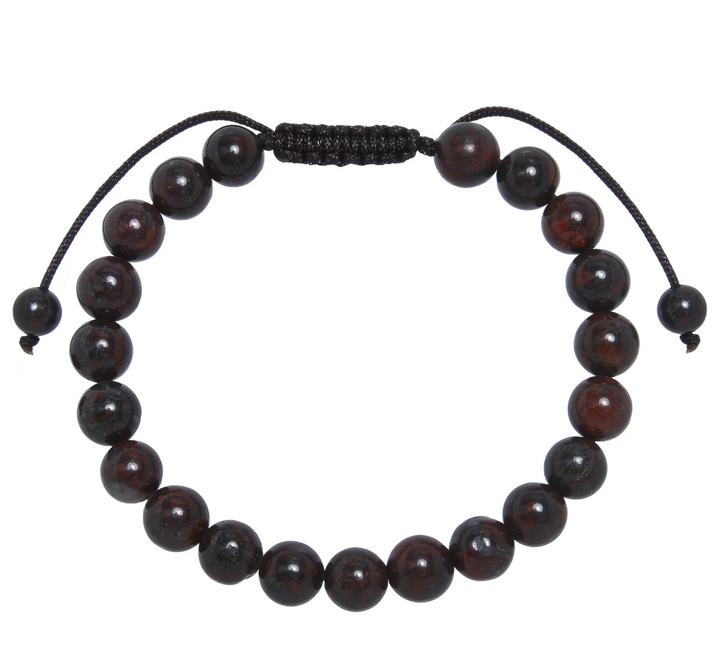
Brecciated jasper is genuine jasper. It broke into angular pieces long ago and was mended by more silica or iron oxide, which gives it the cracked-and-mended look.
See it as
Quartz (microcrystalline) · Jasper
Brecciated Jasper
Jaspe brechado
- Palette
- Red Brown White Multicolor
- Mined in
- United States, Australia, South Africa, India, Madagascar
- Hardness
- Mohs 6.5–7.0 ?
- See-through
- opaque
- Known since
- Prehistoric
- Named for
- its broken, re-cemented fragments (breccia-type jasper)
- Also sold as
- Breccia jasper, Brecciated red jasper
- Intention
- Protection
- Looking for
- Grounding Protection Willpower
- Water
- Fine with water and mild soap
- Dye or finish
- Brecciated jasper is generally sold natural. Dyed lots exist at the low end and resin is occasionally used on crumbly material, so very bright or perfectly even color deserves a second look.
In our pieces · 2See the 2 pieces ↓
MORGAN HILL
Poppy jasper, a jasper with round orbicular patterns, comes from Morgan Hill, California.
16 INCHES
In Roman times a figure of Emperor Nero set in a breastplate was carved from jasper and stood 16 inches high.
OCEAN JASPER
Madagascar's popular ocean jasper is not strictly jasper at all but a highly silicified rhyolite or tuff.
What it is
Angular fragments of red, brown or tan jasper cemented together by secondary silica or iron oxide, giving a cracked-and-mended mosaic look. It is genuine jasper whose broken pieces were later re-cemented.
What gives it its color
Jasper gets its colors from other minerals mixed into the silica: hematite (iron oxide) for red, goethite for yellow and brown, and chlorite for green. In brecciated jasper, broken fragments have been cemented back together, which makes the patchwork pattern.
Where it comes from
One named source of brecciated jasper is Tabu Tabu in South Africa; jasper in general is found in many countries.
In history
Jasper of every kind is among the oldest worked stones: toolmakers at Mehrgarh in South Asia used green jasper for bow drills in the 5th to 4th millennium BC, and Minoan craftsmen carved it into seals around 1800 BC. Roman naturalists sorted jaspers by color and listed seal-stone grades among them.
What's said about it
In crystal lore, jasper is the stone people keep for steadiness. It's said to make you feel grounded and safe, and it is traditionally associated with perseverance. Red jasper in particular is thought of as a root-chakra starter stone.
In older gem lore, jasper was worn as an amulet, and ancient writers describe people in the East wearing it for that purpose. Some old accounts also credit it with bringing rain.
People wear it on the wrist, carry it in a pocket, or hold it in the hand.
How people wear or keep it: On the wrist, in a pocket, held in the hand, or on the root chakra.
In crystal practice
Day to day, the same tradition suggests keeping it close: on the wrist, in a pocket, held in the hand. People reach for it when they want grounding, protection, willpower, and many set an intention when they put it on. Most practitioners cleanse a new stone first (running water only if the stone can take it, otherwise smoke or moonlight) and set it aside now and then to rest.
These are beliefs people have held and still hold about the stone, reported as such. Nothing here is a promise or a medical claim. We sell stones as jewelry, not for these effects.
Associations
Also calledBreccia jasper, Brecciated red jasper
Care
- At Mohs 6.5 to 7 it suits everyday wear, but a hard knock can follow old fracture lines.
- Wipe with a soft damp cloth; mild soapy water is fine.
- Skip ultrasonic cleaners if the piece shows visible cracks.
- Store apart from harder gems such as sapphire to avoid scratches.
How to tell what you have
- Look for angular, broken-edged pieces held in a contrasting cement, and an opaque body. Real jasper is hard (Mohs 6.5 to 7) and does not fizz in dilute acid.
- Dye tends to collect along cracks and gives an even, unnatural color.
What sets the price
Price follows how bold and well-contrasted the broken-fragment pattern and its colors are, plus polish and bead size. Dull, muddy or dyed material is the cheap end.
Rules and sourcing
Dyed lots of brecciated jasper exist, and crumbly material is sometimes resin-filled. The FTC jewelry guides call for a seller to disclose dye or resin.
Related stones
Questions people ask at our table
What is brecciated jasper?
It is jasper (opaque microcrystalline quartz) that fractured and was re-cemented by more silica or iron oxide. Breccia simply means angular broken fragments held in a cement.
Is it natural?
The pattern and color are natural. We have not tested individual strands for dye, so a very uniform vivid red is worth a question to the seller.
Where does it come from?
Sources name the western United States, Western Australia, South Africa, India and Madagascar. Beads on the market come from a mix of such places.
How do I care for it?
It is hard enough for regular wear. Wipe it with a soft cloth and keep it from sharp knocks that could follow the old fracture lines.


Stay in the loop
Sign up to hear about new product drops, upcoming events, and the latest from Peritik. No spam, just the good stuff.